The High Tatras have a way of commanding your attention from the moment you wake. In the heights of Tatranská Lomnica, the morning air carries a sharp alpine freshness, and the peaks thrust upward like the spine of the earth itself. Skiers and hikers study the weather carefully before donning their colorful outfits and gear and heading into the snow. A short walk brings you to the cable car station for the ascent.
As the cabin glides upward, forest gives way to rock and open sky. Below, Tatranská Lomnica shrinks into neat geometry, and ahead, serrated ridgelines dominate the horizon. Even for seasoned travelers, there is something deeply restorative about standing here, suspended between earth and sky, with views stretching across northern Slovakia toward Poland.
Back in town, the Ski Museum offers a different kind of experience – one rooted in history rather than altitude. The museum charts the development of winter sports in the Tatras, from rudimentary wooden skis and leather boots to more modern alpine equipment. It is modest in scale but rich in narrative, revealing how mountain life shaped local identity. Skiing here was never merely recreation; it was transportation, survival, and eventually a source of regional pride. The browns of the wood and the grays of the leather seats and hats offer a striking contrast to the luminosity of today’s skiers.
Lunch shifts the focus from slopes to stove. At Restaurant Stará Mama, the experience goes beyond dining. Guests are invited to enjoy the making of bryndzové halušky – Slovakia’s national dish. Potato dumplings are formed by hand, dropped into boiling water, and tossed with tangy sheep cheese before being topped with grated cheese and onions. For a fully traditional version, the cheese is replaced with small cubes of bacon. It is hearty mountain food, designed for cold climates and long days outdoors. The sheep whose milk produces bryndza graze on mountain pastures; the potatoes thrive in cooler soil. The Tatras are present even on the plate.
The afternoon brings a shift in tone, from alpine exuberance to historical reflection. In Kežmarok, cobbled streets and pastel façades conceal layers of Jewish history. A memorial to the synagogue stands as a reminder of a once-thriving community that contributed to the town’s commercial and intellectual life. Before the Holocaust, Jewish families were deeply woven into the fabric of the region. The town’s Jewish cemetery has been lovingly restored by the municipality as a mark of respect for the thousands of lives lost.

A short drive leads to Poprad, another town with profound Jewish significance. It was from Poprad in 1942 that the first deportation trains carrying young Jewish women left Slovakia for Auschwitz and beyond. Today, a memorial sits on the railway platform at Poprad-Tatry station, and another at the old synagogue, which now functions as a print shop, ensuring that this chapter is neither forgotten nor detached from place.
Yet Poprad also embodies renewal. At AquaCity Poprad, geothermal pools offer warmth and relaxation beneath open skies, steam drifting toward the distant Tatras. The resort was created by British-Slovak entrepreneur Jon Telensky, who transformed deep thermal springs into one of Central Europe’s leading eco-conscious spa complexes. Powered largely by geothermal and solar energy, the site features indoor and outdoor mineral pools, saunas, wellness treatments, and family-friendly water attractions.
For adults, there are multiple bars, including a swim-up bar. If visiting in winter, the nearby Tatras Ice Dome adds another layer to the experience. Ride the funicular to see this intricate ice basilica, carved anew each season. 2026 brings a 30-foot-high replica of the Basilica of Saint John Lateran constructed from 225 tons of ice, honoring Pope Francis and Pope Leo XIV.
The High Tatras provide a dramatic stage. In a single day, it offers both breathtaking elevation and profound depth. Perhaps the perfect way to cap off the stay is at the highly-rated, fairy-tale-esque Grand Kempinski High Tatras, with its stunning, uninterrupted views of the mountains that divide Slovakia from Poland. Its restaurant offers more than 600 quality wines, a large percentage of which were produced locally. The mountain air and bedroom pillow menu ensure a refreshing sleep.
Heading west
Many towns and cities across central Europe began life in the Roman era as military garrisons. Trencín in northwestern Slovakia is no exception, as attested to by the original Roman inscription carved into rock that faces guests at the Hotel Elizabeth with its fine dining experience. Close to the Váh River, Trencín’s Old Town unfolds beneath the dramatic silhouette of its medieval castle. Compact yet characterful, the historic center feels both intimate and quietly grand – a place where pastel façades, Baroque townhouses, and hidden courtyards tell tales of merchants, nobles, and soldiers who once passed through this strategic crossroads. The perfect place to be the European Capital of Culture in 2026.
At its heart lies Mierové Square, a long, elegant stretch lined with cafés and historic buildings whose architectural details reward a slow stroll. Gothic arches blend into Renaissance flourishes; wrought-iron balconies overlook cobbled lanes that wind gently upward toward the castle. Look closely, and you’ll find plaques, stone carvings, and centuries-old doorways that hint at Trencín’s layered past. The castle itself, perched high above, anchors the town visually and historically. From almost any street, a glance upward reconnects you to the fortress that guarded trade routes and shaped the town’s fortunes. Yet it is street level where Trencín truly charms – artisan shops, relaxed terraces, and a pace of life that invites lingering rather than rushing. Trencín’s Old Town is not flashy; it is atmospheric. It rewards curiosity, conversation, and the simple pleasure of wandering without a map.
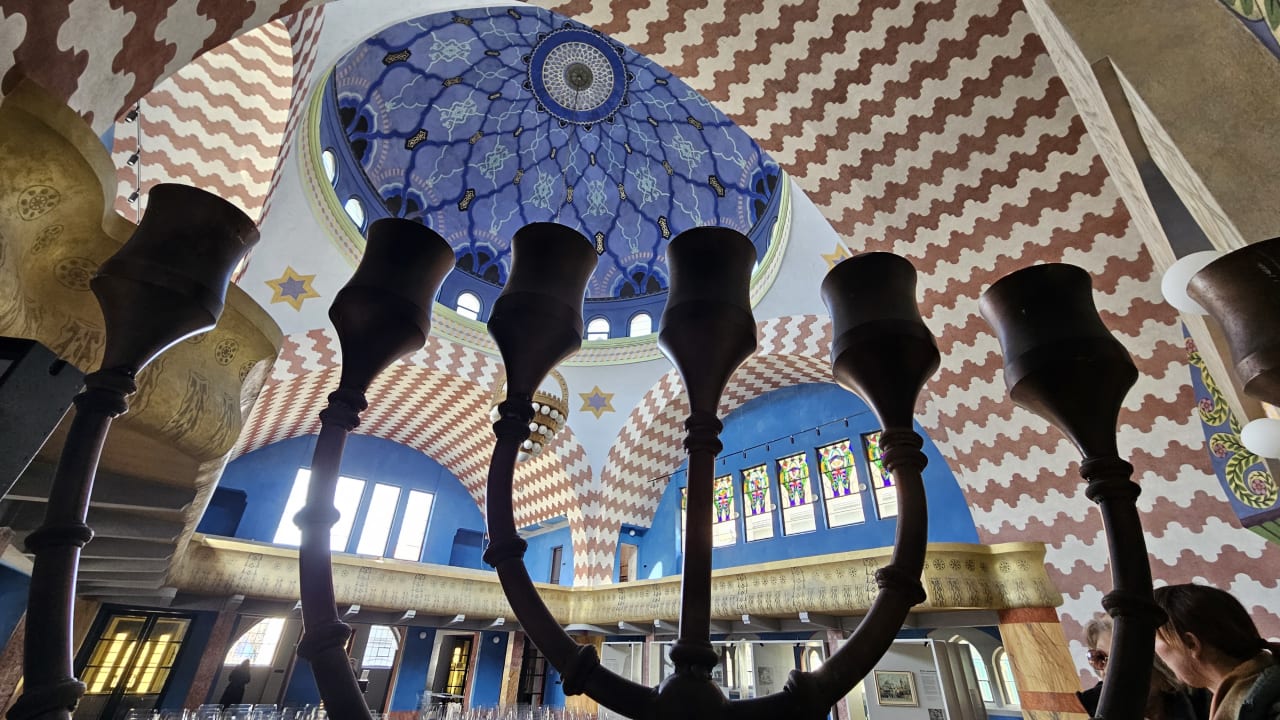
In the shadow of its medieval castle, Trencín holds a quieter, more fragile layer of history: the story of its Jewish community. Jews began settling here in greater numbers in the 19th century, becoming integral to the town’s commercial and social life. Shopkeepers, traders, professionals, and families helped shape modern Trencín, their presence woven into the rhythm of the Old Town streets. That confidence found architectural expression in 1913 with the construction of a grand synagogue, an elegant structure crowned by a dome and designed in a blend of historicist and Moorish Revival styles. It stood as a statement of belonging and permanence.
The Holocaust shattered that world. Beginning in 1942, deportations under the wartime Slovak regime decimated the community. Few returned, and Jewish life in Trencín never regained its former vitality. Yet traces endure. The restored synagogue still stands, now used as a synagogue and for cultural events. Reform services are held on festivals and one Shabbat per month, which may soon become weekly. On the edge of town, the Jewish cemetery, with weathered Hebrew inscriptions and leaning headstones, offers a place of reflection.
The small village of Beckov once sustained a modest but meaningful Jewish presence. Unlike larger regional centers such as Trencín, Beckov’s Jewish community was rural and intimate – families engaged in local trade, agriculture-related commerce, and small business, woven into the rhythms of village life. By the 19th century, Jews formed a recognized part of the population, contributing to the local economy and maintaining communal structures typical of small Slovak market towns. There was never a grand synagogue here; prayer services were likely held in private homes or modest prayer rooms, reflecting the scale of the community.
The Holocaust brought that history to an abrupt end. In 1942, Jews from Beckov were deported under the Slovak wartime regime. The community did not reestablish itself after the war, and today, no active Jewish life remains in the village. What survives is the Jewish cemetery on the outskirts of Beckov – a quiet, overgrown field of weathered headstones inscribed in Hebrew and Hungarian. Graves here date back to the late 17th Century. They stand in the shadow of Beckov Castle.
Rising dramatically from a sheer limestone cliff above the Váh Valley, the castle is one of western Slovakia’s most striking medieval ruins. First mentioned in the 13th century, the fortress guarded important trade routes running along the river and served as a strategic stronghold of the Kingdom of Hungary. In the late Middle Ages, it became a noble residence, expanded with Gothic palaces, defensive towers, and fortified walls that still trace the outline of its former grandeur.
Despite a fire in the 18th century that left the castle in ruins, its silhouette remains powerfully intact. Today, one can witness at first hand its reconstruction by a dedicated bunch of locals. Visitors climb through gateways and courtyards to panoramic views stretching across vineyards, farmland, and distant hills. The castle’s windswept position – perched between sky and valley – gives it an almost theatrical presence. Beckov Castle is less about polished interiors and more about atmosphere: stone, sky, and centuries of frontier history suspended above the landscape.
The awe-inspiring majesty of the High Tatras and, just two hours away, Europe’s culture capital showcase the natural and human wonders of this compact, safe central European state.
Mark and David were guests of Slovakia Travel (Slovakia Travel). They host The Jerusalem Post Podcast Travel Edition.