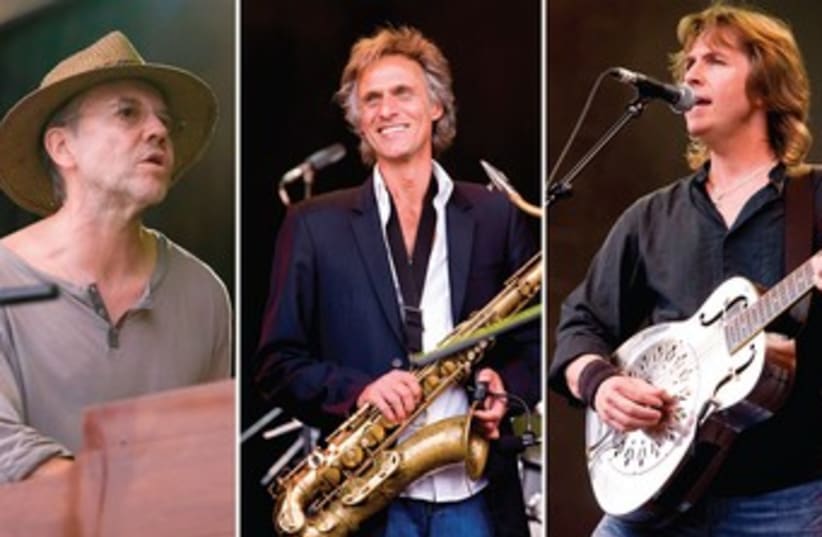
Even though leader Mark Knopfler isn’t involved, members of Dire Straits will perform in Tel Aviv.
By DAVID BRINNDire Straits 370(photo credit: Courtesy PR)
Alan Clark had all the right ingredients for a great Dire Straits reunion – except the main one. The former keyboard player for the 1980s supergroup led by guitar and songwriting virtuoso Mark Knopfler had been asked two years ago to form a group to perform his old band’s music at a charity event at Royal Albert Hall in London.The 59-year-old musician made some inquiries and found great interest from old band mates like bassist John Illsey and saxophonist Chris White, but he knew better than to ask the founder of the band – Knopfler. The gifted guitarist had disbanded Dire Straits in 1991, after having sold more than 120 million albums including the 1985 blockbuster Brothers In Arms, preferring a low-key solo career consisting of rootsy folk and country and movie soundtrack work.Clark made some attempts to locate a replacement for Knopfler, but in the end he, White and other players who had some tangential connection to Dire Straits performed at the benefit without a front man or bassist Illsey, who had fallen ill, playing old classics like “Tunnel of Love” and “Sultans of Swing.” And to Clark’s surprise, he loved it.“For that charity show, I thought ‘we’ll just wing it and somehow we’ll get through,’ but I realized after that the band had so much potential, I thought we couldn’t just let it die, let’s see where we can go with it,” said Clark last week from his home in England.Whether it’s The Doors touring with a Jim Morrison clone, INXS finding a replacement for Michael Hutchence, Queen recording with Bad Company’s Paul Rodgers instead of Freddy Mercury, or The Faces reappearing with Simply Red’s Mick Hucknall trying to outrasp Rod Stewart, it’s become apparent that no band member is indispensable, despite what Bono would have you believe.But Knopfler wasn’t only the voice of Dire Straits, he provided a distinctive sound to its music with his tangy, finger-picking guitar style. Clark knew that for an audience to take a new band playing Dire Straits music seriously, the person filling Knopfler’s role was going to be the lynchpin.Luckily, through the magic of YouTube, there were countless Mark Knopflers available from the scores of Dire Straits tribute bands that have proliferated around the world. However, there was also a downside.“I didn’t find anybody who was even remotely good enough to fill Mark’s shoes,” said Clark, adding that the best of the bunch was a Japanese guitarist who could replicate Knopfler’s guitar licks, but didn’t sing. Clark tired of the search, but his partner Sheila didn’t give up.“About 18 months ago, I heard this voice and guitar coming from the other room, and I went in and asked Sheila, ‘who is that?’” said Clark. “His name was Terence Reis and his voice was amazing, so I got in touch with him and asked him to send me a couple tracks – just him playing acoustic guitar and singing. He sent me the song “Communique” and it was amazing. It was enough for me to say to him, ‘ok, you’re our man.’” Born in Maputo, Mozambique, Reis grew up playing the guitar in the idiosyncratic style of the local finger-picking street musicians, a style that was surprisingly similar to that of Knopfler without being a carbon copy. Combined with a rich voice that hints at Knopfler’s without aping it, Reis proved to be the missing link for new group, christened The Straits.Rounding out the band with Clark, White and Reis are Tom Petty and the Heartbreakers’ drummer Steve Ferrone, bassist Mick Feat who has appeared on Knopfler’s solo albums, keyboardist Jamie Squire and guitarist Adam Phillips, who has played with everyone from Rod Stewart to Richard Ashcroft. For the past year, the band has been performing their two-hour sets chockfull of Dire Straits classics like “Tunnel of Love,” “Money for Nothing,” “Brothers in Arms” and of course “Sultan of Swing” to appreciative fans around the world.“I’m sure most people come along thinking ‘yeah, it will be ok, but it won’t be like it was – how could it without Mark?’” said Clark a day after returning home from a series of shows in Russia with the band.“But they go away saying ‘wow, that was absolutely, astoundingly good.’ Everyone is just so happy to hear this music again.”That includes Clark himself, who never thought he’d be playing Dire Straits music again. Even though Knopfler has concluded that the band had gotten too big for its own good, with 40 trucks worth of equipment and staging employed for every sold-out show, Clark had mixed feelings about walking away from the group.“Mark wanted to his own thing on a smaller scale, but I didn’t find the situation we were in to be too big. I could have dealt with it being even bigger, if that was possible,” said Clark.“But by the end, I admit that I was ready for a break and was quite happy when the band stopped touring. Although we never officially talked about it, I just knew it was the end of the band. Mark was pretty adamant about doing his own thing, which he was already doing before our last record, with movie scores and playing with other people. I didn’t play any Dire Straits music again until I got The Straits together. Sometimes it seems like the craziest dream I ever had.”CLARK’S DIRE Straits dream began in 1980, when days after finishing recording the band’s third album Making Movies, Knopfler called the keyboard player and asked him to join up. He was already an in-demand musician, performing with British acts like Splinter, who released an album on George Harrison’s Dark Horse label, and pastoral folk-rockers Lindisfarne.With Making Movies, Knopfler had moved away from the bluesy, guitar-oriented material of Dire Straits’ first two albums, and inspired in part by Bruce Springsteen’s expansive, cinematic approach to music making, wrote an album heavy on drama, imagery and textures, provided mainly by the Boss’s piano player Roy Bittan.“Mark decided he needed to do that, otherwise he was in danger of just repeating himself,” said Clark. “He realized he had done that with the second album Communique, and even though it was what the businesspeople wanted since the first record was so revolutionary, he knew it was a mistake, and he vowed never to do it again. He wanted to expand the band’s scope beyond guitars and he brought me in to do that.”Clark became Knopfler’s right-hand man over the next decade and Dire Straits’ phenomenal mid-1980s success, acting as the band’s unofficial musical director. The two would arrive at recording sessions before the rest of the band and work up the arrangements of the songs together.“By the time the rest of the band arrived, we’d have a good idea where the song was going. Mark usually presented his songs in a very basic format, and I’d bring in the introductions and instrumental sections,” said Clark.Clark and Knopfler took their partnership outside of Dire Straits in 1983 when they went into the studio with Bob Dylan to record the Knopfler-produced album Infidels.However, their working method veered sideways when faced with the notoriously improvisational Dylan.“Mark and I spent a few days with Dylan going over the songs so we’d have a good idea of what we were going to do in the studio,” said Clark. “Then we had to leave for a three-week tour of Japan with Dire Straits.When we got back and went into the studio to record, Bob had changed just about everything – the melodies, the chords, some of the lyrics – it was kind of like starting over again. In the studio, it was very impromptu. If you happened to go to the bathroom when Dylan came into the studio, then you didn’t appear on that song.”With Dire Straits, the hits kept coming, from “Love Over Gold” to “Brothers in Arms” through their swan song, “On Every Street.” After the band’s demise, Clark continued to tour and record, including being part of Eric Clapton’s band, but eventually he turned to movie and television scoring and occasional session work. Finding himself touring in sold-out arenas with The Straits proved to be an unexpected turn in his career and life that he’s relishing – especially the chance to revisit some locations of Dire Straits’ greatest conquests, like a return to Israel for a show on November 13 at Hangar 11 in Tel Aviv.The last time Clark played Dire Straits songs in Israel was in 1985 at a performance in Jerusalem at Sultan’s Pool. He remembers the visit, which was captured on film and became part of a Dire Straits documentary, like it was yesterday.“I had a really lovely time in Israel. We rode through the Old City on donkeys and playing in Sultan’s Pool was a really memorable experience,” said Clark. “In fact, I played there a second time a few years later when I was in Eric Clapton’s band. That may be some kind of record.”Having improbably resurrected one of the most popular rock bands in history without the benefit of its superstar, Alan Clark’s ability to break records shouldn’t be underestimated.
Related TagsBob Dylan
if(catID != 151){
var cont = `Take Israel home with the new Jerusalem Post Store