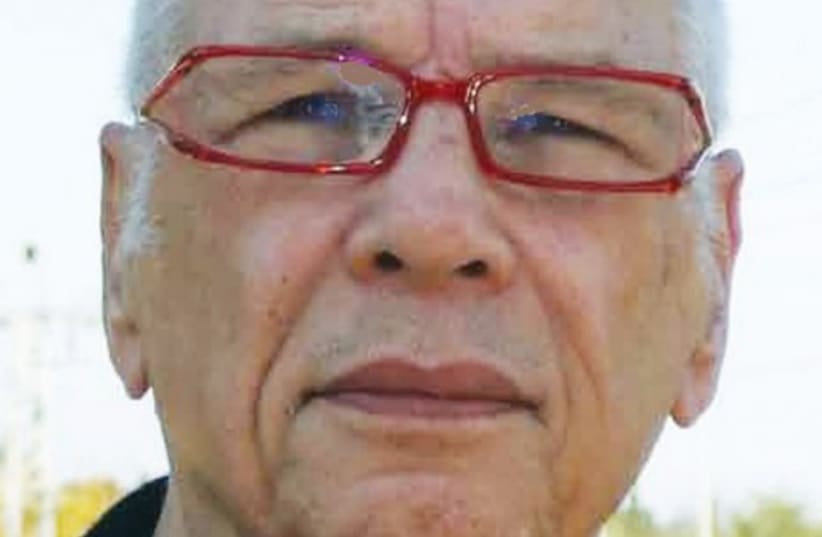
Yaakov Kirschen muses how little has changed just ahead of the 40th anniversary of the debut of Dry Bones.
By ISRAEL KASNETTYaakov Kirschen 521(photo credit: Courtesy)
EVER SINCE the Protestant reformation in Germany, when Martin Luther discovered he could reach out to the illiterate classes through simple woodcutting and metal engravings, political cartoons have become a real means of communicating with the public.Later, Benjamin Franklin’s “Join or Die” cartoon, which depicts a snake whose severed parts represent the Colonies, would become widely acknowledged as the first political cartoon in America.The reason political cartoons are popular is that they are fun to read and often offer a fresh, sometimes humorous, perspective on current events.Many newspapers around the world employ the skills of a political cartoonist and The Jerusalem Post is no different.For years, the Post has run the popular “Dry Bones” series by cartoonist Yaakov Kirschen which next month celebrates its 40th anniversary.Kirschen named his works “Dry Bones” after the 2,600-year-old writings by the biblical Prophet Ezekiel, who refers to having seen thousands of dry bones in a vision, and prophesies the rebirth of the Jewish State.The Dry Bones Project aims, through research and analysis, to create an educational outreach program that will advance popular understanding, and to correct willful rewriting of history.The project intends to do this by means of cartoons, cartoon history books and other works, and through educational lectures.In an interview with Kirschen in Asian Jewish Life magazine, Erica Lyons writes, “‘Dry Bones’ has been a Jewish household favorite since it first appeared in 1973. It has been reprinted, or quoted in a myriad of publications including the New York Times, Time magazine, the Los Angeles Times, CBS, AP and Forbes.Kirschen’s graphic art has, for decades, provided an insightful, pictorial commentary on many of the most significant events of the day.: Collectively, the “Dry Bones” collection reads more like an academic treatise than a comic strip, offering distinct graphic perspectives and snapshots in time.Earlier this year, the Israeli Cartoon Museum awarded its Golden Pencil Award to Kirschen in recognition of his lifetime achievements.The museum’s curator, Liat Margalit said, “The reality of life in Israel led Zionist Kirschen to lovingly comment on the many absurdities he found in the reborn Jewish State. In many ways, ‘Dry Bones’ is Kirschen’s ongoing occupation with the relationship between vision and reality, and his attempts to live with this duality inside him, through the protagonists of his comics strip.”Shuldig (“guilty” in Yiddish) is Kirschen’s alter ego.He is a regular Israeli, an idealistic Zionist, and an incorrigible optimist. Doobie – Shuldig’s dog – is a cynical realist, always balancing out Shuldig’s unbridled and sugary optimism. A few other cartoon regulars populate the political comic strip: King Solomon represents Israel’s government and is the medium through which Kirschen mocks Israeli leadership flaws. Man Drinking Coffee reacts to the latest news while sipping a cup of coffee at a café. The Two Guys’ discussions represent the views of the Israeli public.Through this minimal group of simple characters, Kirschen has managed to put together a profoundly satirical view of life in Israel and beyond, in his internationally syndicated cartoon. He is followed by eager fans who also enjoy his award-winning blog (DryBonesBlog.com), launched in 2005.KIRSCHEN WAS born in Brooklyn in 1938. After graduating from Queens College in 1961, he began working as a freelance gag cartoonist.In 1968, while still living in the US, Kirschen began to experiment with the use of humorous cartoons to deliver political messages. His work at the time was Zionist and anti-Vietnam War.In 1971, he made aliya with his wife and three daughters. He changed his name (originally Jerry) to Yaakov, and two years later began drawing his political and humorous daily comic strip for The Jerusalem Post.For the past 40 years, “Dry Bones” has continued to offer profound satire and witty commentary on everyday Israeli news and international events.In 1993, his graphic novel, Trees, The Green Testament was published. In it, the trees of the world tell the story of the Jewish people, ecology, environmental destruction, reforestation, and Zionism. A front-page story in the Wall Street Journal reported on the surprising popularity of the book and its establishment as an underground cult favorite.In 2009, Kirschen was made a visiting fellow and artist-in-residence at Yale University’s Initiative for the Interdisciplinary Study of anti-Semitism and Racism, where he was asked to study the relationship between anti-Semitism and political cartoons.In 2011, he founded the “Dry Bones Project” (Dry- BonesProject.com) and began to work on a series of graphic novels about Israel’s 3,500 year-old history as the indigenous people of the Land of Israel. The initial works will be published in Chinese for distribution in China.I MEET with Kirschen at his home in Herzliya Pituah where we sat and discussed his early beginnings, his time at the Post and the project he is currently involved with.“Back in the day there were two types of cartoons,” Kirschen says. “There were editorial cartoons and comic strips. An editorial cartoon was always a box and a comic strip was never political, though there were people who pushed the envelope.“I did two things in America. I was a computer expert and I was a cartoonist. The idea of computers being related to entertainment, or cartoons being structured to have an effect... [it] seemed to me that the two [went] together, but to the rest of the world the two were separate.“When I made aliya, I thought I’d come here and I’d be in the computer business. But when I saw the insanity of [Israeli] society, as an American I said, ‘what’s missing is a comic strip for people to laugh [at] and enjoy. Or maybe it needs to be an editorial cartoon.’ “I said, ‘What if I make it a comic strip that is an editorial cartoon? Well, how would I do that? If I took the thing and I cut it in half, then the overall shape would be an editorial cartoon, but it would read like a comic strip!’ “And I came to The Jerusalem Post with it, and there was a guy named Ted Lurie and he was the editor-in-chief.The cartoon worked its way to Lurie, who really didn’t like it and really did not understand it.“And I knew that since the editor who took the cartoon from me said, ‘we don’t have cartoons. This stuff you’re doing is wonderful, but the editor-in-chief sees us as being the New York Times of the Middle East. But this is so good, I’m going to pass it on to him, but hey, kid, forget it – it’s not gonna happen.’ “Within a week, I’m called in by Lurie and he’s going to run the cartoon. So I said, ‘Good!' So we can start next week?’ He said, ‘No, no no. Right now, we’re in the middle of December. You know what? Let’s start January 1. I’ll tell you why, I don’t understand this cartoon at all, but people here tell me they like it.“‘I’m willing to put it in the paper. If, after a couple of weeks, it doesn’t get a following, I’m going to dump it. If however, it gets a following, and you’re here a couple of years, you’ll always be able to tell people, “I started on January 1, 1973.’ “And I thought, ‘What an idiot!’ And for the last 40 years, when people ask, when did it start? I say, ‘January 1, 1973!’ Years later, I was talking to the editor to whom I passed on the cartoon, and I said, ‘Well you see, Ted Lurie really was resilient!’ And he asked, ‘Did no one ever tell you why he really took the cartoon?’ “He had a [visit from a] delegation of prominent newspaper editors from America. They were here as a group and came to the Post, and after showing them around, he took them to lunch. And Lurie asked them, ‘What do you think of my paper?’ And one of them said, ‘How come you don’t have your own cartoonist?’ “He came back from that lunch to find the ‘Dry Bones’ cartoon on his desk – which means that my grandmother could have sold the cartoon at that point! And it has continued for 40 years. And along the way, I’ve commented on all sorts of stuff going on. So that’s the story.“AFTER MANY years,” Kirschen continues, “I was asked by an organization at Yale to be a scholar/artist-inresidence to study anti-Semitic cartoons.They felt the idea of an interdisciplinary study involving a cartoonist may add perspective.“Being a pushy, Jewish, Israeli cartoonist, I said, ‘What do I have to do? Do I need to move here?’ They said, ‘No, but you need to write a paper.’ I figured, ‘What the heck, why not? I could do that.’ ‘Well,’ I said to myself, ‘first I should collect anti-Semitic cartoons.’ “So I began to collect them and I made a discovery. And the last thing I expected was to actually discover something.And what I discovered has to do with memetics. The thing that gets stuck in your head and is passed on to other people is called a meme.“A meme is a viral belief. A cultural virus. Anti-Semitism is a cultural virus. It is a virus that affects society. The idea of a virus is that it reproduces itself in different hosts. Biological viruses infect people, computer viruses infect our digital systems and dangerous cultural viruses infect our societies.“What is it we political cartoonists do? Some of my colleagues will say we try to illuminate the truth, fight injustice and fight for a better society,” he says.An exhibit at Hofstra University Museum in New York launched in October titled “Political Slant: Editorial Cartoons,” displays political cartoons by a number of prominent American cartoonists.In a recent interview with New York Times, cartoonist and Pulitzer Prize-winner Signe Wilkinson of the Philadelphia Daily News said, “Political cartoons do not really change people’s minds, but they’re important to grease the wheels of public discourse, and to give people a different way to imagine an issue.”Kirschen appears to take a similar stance. “What we really do is we put ideas in people’s heads – I just admit to it. In any case, that makes me a master of memetics, since I’m trying to infect people all the time with my ideas!”KIRSCHEN SAYS there is a definitive way to identify anti-Semitic cartoons. “You can’t ask, ‘Is a cartoon anti-Semitic or not?’ and then say, ‘Well, it’s like pornography – you can’t define it, but you know it when you see it.’ Nonsense! I have totally analyzed this whole thing.”Through his research, Kirschen pinpoints three families of viral memes (anti-Semitic image codes found in contemporary political cartoons): dehumanization, stereotyping and moral inversion.“I think the cartoonist is infected,” he explains.“The cartoonist may not know he is infected. The person who did this may be infected with that idea.“And altogether there are about 34 images of anti- Semitism that depict Jews, and those particular images are burnt into your head. Once you see a graphic of a Jew with horns, you never forget it. The Nazis made heavy use of cartoons to spread their message of Jew-hatred.”Dehumanization says, “What are Jews?” According to the cartoons that fit into this category, Jews are demonic, baby-killing, satanic, blood-drinking vermin.“There are 17 categories I discovered in the dehumanizing family,” Kirschen says.“Stereotyping says, ‘What do Jews do? Jews are rich, ugly, money-grubbing and powerful. They secretly control the banks, the media and the world.’” Kirschen explains moral inversion. “The Holocaust happened and a new family grew up – moral inversion. Moral inversion says, ‘Sure the Nazis did terrible things to the Jews, and now the Jews are doing the same damn thing. You look at Gaza, that’s one big concentration camp.“‘Just because they had to deal with Nazis doesn’t give them the right to act like Nazis also... Israel is an apartheid state.’ “All of these are in the family of moral inversion.And though everybody is running around trying to argue that Israel has so many Nobel prize winners, Israel has many medical advances – that doesn’t stop people from claiming Jews are demonic Nazi victimizers. So the argument goes. Unless you see that it’s a virus.“And you can’t argue with a virus. You have to somehow confront the virus.“And when I went around giving speeches, and I would show these presentations, the annoying thing was, at the end people would say, ‘Okay, so what are we supposed to do?’ What are you asking me for? I discovered there’s a virus! And they would say, ‘No! You’re the cartoonist! You figured it out, you’ve got to do something about it!’ “If you’re Louis Pasteur, it’s not enough to discover the virus – you’ve got to come up with the vaccine and do something about it.“So, No. 1, I stopped giving the speeches – I really did. Because every time I would show it [the presentation], people would say, ‘Now what? This is really depressing! And you don’t have an answer? The whole world will be affected and that’s the end of us!’ “So I stopped giving speeches, but I kept thinking about it. And then I realized that the moral inversion strain had now really blossomed and it now could be called the ‘Nakba strain.’ “The ‘Nakba strain’ says, ‘Jews may be smart, they may be victimized, they may have been messed around by the Holocaust, but in 1948 they came here and they seized the land of the indigenous people, the Palestinians, and they set up a Western colonial state on the land of the indigenous Palestinians, and now they won’t even give back part of the land to have some degree of freedom.’ “This is believed wherever the ‘Nakba strain’ has spread. We have moved from Holocaust denial to history denial. It means that 3,500 years of pre-1948 history have been erased. Therefore, the vaccine is to bring back the knowledge of those 3,500 years. So if somebody says ‘Nakba,’ I say, ‘What are you talking about? We were messed over by the Romans before we were messed over by the Arabs. We were messed over by the Macedonian Greeks. You guys are latecomers. We’ve been here a long time!’ “But people don’t have that knowledge. And then I began to analyze this and I discovered that our view of the whole world is North and South America, Europe and the Middle East – maybe some of Africa. But we don’t think of Asia.“So I said, ‘Gee, since I speak in cartoons, and the Chinese and Japanese are really into cartoons, what if I do something about showing the 3,500 years of pre-1948 history?’ So I did something and I did it in Chinese.”HERE, KIRSCHEN pulls out an illustrated book he made for Chinese children. He sees an opportunity to educate China about Israel’s pre-1948, 3,500 year history through a series of free, online, digital Chinese-language graphic books. Each work will tie the history of China to the history of Israel, emphasizing the concept of the Jews and the Chinese as two ancient civilizations that have survived centuries of attack by barbarian forces and foreign empires.According to Kirschen, governments, NGOs and other “rewriters of history” attempt to erase the history of the Jewish people in the Land of Israel. China’s 1.3 billion people have not yet been infected with this denial of Jewish history.Kirschen hopes his initiative, aptly named “Project3500,” will educate and advance civic responsibility by countering the rewriting of history by governments and non-governmental organizations, their funders, and associated frameworks.In the interview with Erica Lyons in the Asian Jewish Life magazine, Kirschen explains, “My work at Yale, investigating anti-Semitism in political cartoons, brought me face to face with the fact that the Chinese were non-Jews who had not been infected with the behavioral virus that we call ‘anti-Semitism.’ Unlike European nations, they haven’t been tainted by anti-Semitism.”He cites the absence of preconceived prejudices in China against the Jewish/Israeli story and openness to further exploration and a general curiosity to understand this ‘Start-up Nation.’ To Kirschen, China’s next generation is ripe for this introduction to the history of Israel and Jewish people and his project affords a layer of protections against one of the great dangers Israel/Jews face, the rampant “willful rewriting of history.” Each “Project3500” trip is a new educational opportunity and a way to reach this new audience.He says, “There is an obvious and natural economic fit between our two nations... but as bearers of ancient wisdoms our two nations, Israel and China, have a responsibility to do more – to bring civilization and stability to a chaotic world.“My message, the message of Project3500, is about the importance of our civilization, and if I do it right, the works should be exciting, fun, and a turn-on for a new generation.”Aside from Project3500, one of Kirschen’s long-standing goals has been to create a Passover Haggada. And now, through his Kickstarter online project, he hopes to raise enough money to realize his dream.The type of success and recognition he has achieved would make any man proud. But he is not ready to stop. He continues to publish a weekly cartoon in The Jerusalem Post in the belief that he can help people see reality from a different perspective.He truly hopes to change perceptions on a grand scale. No bones about it, Kirschen has made his mark.
if(catID != 151){
var cont = `Take Israel home with the new Jerusalem Post Store