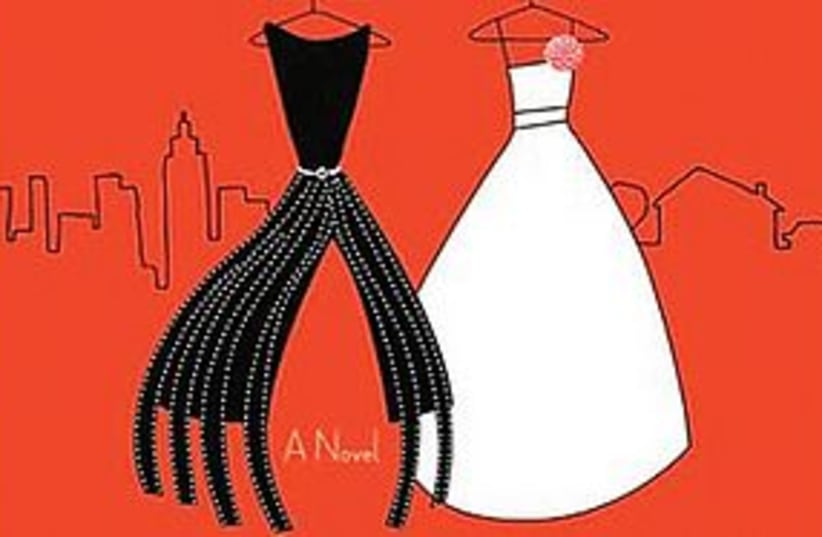
Susan Shapiro held a "book mitzva" to celebrate the publication of her new novel, "Overexposed," after working on it for 13 years.
By ALYSSA PINSKERoverexposed 311(photo credit: courtesy)
‘It took me until I was in my 40s to write a happy, successful 26-year-old protagonist that my 26-year-old editor liked,” says Susan Shapiro, who has published seven books in the past seven years and has been riding a wave of success particularly after her memoir, Lighting Up: How I Stopped Smoking, Drinking, and Everything Else I Loved in Life Except Sex.For more than 30 years the New York City writing professor has helped thousands of students get published, get sane, find love and get it together with her brand of Jewish motherly tough love. But it took her 13 years to publish Overexposed (Thomas Dunne Books, 2010, 320 pages), which is about a poor struggling urban artist and a rich Midwestern wife and mother who end up swapping lives.To celebrate her book’s debut, Shapiro held a “book mitzva” where mentors, family, therapists and students gathered to officially pronounce the project “a book,” blessed by a rabbi. Even Shapiro’s party planner mother flew in from Michigan to surprise her with the bat mitzva she never had and delivered trays of cookies inscribed with her name.The book mitzva was a continuation of a story that was taken from her own life.Her latest fiction is a roman a clef.An excerpt regarding her entry into womanhood: “You and Dad didn’t care about me getting bat mitzvahed.”“How could you get bat mitzvahed when you called Rabbi Weiner a sexist pig and walked out on his class in seventh grade?” she asked... “Of course we cared,” my mother added. “It broke our hearts.”The novel introduces us to Rachel, a self-obsessed, neurotic New Yorker, an aspiring photographer and eternal adolescent and her generous if preoccupied Midwestern Jewish family of doctors.Rachel considers herself an independent girl and wants desperately to be like what she envisions her new friend Elizabeth, who works with her at Vision Magazine, to be. Elizabeth has a famous father, cool connections and an exciting but poor and chaotic life.In the beginning, Rachel is cute and relatable, especially to young, single, urban women who want a career first and foremost. As Rachel looks for love, we cheer her on as she tries to find a suitable candidate, and we witness a series of disasters, including a newly divorced man who winds up marrying his significantly younger Orthodox cousin. And we continue to hope she gets the nice guy.In a quirky twist of fate, Rachel’s hip, single, feminist friend reveals that she really wants a stable home life married to a doctor, and that doctor turns out to be Rachel’s brother. To make usurping Rachel’s place even more complete, she even moves in to her old home.Rachel seems unsympathetic to any woman who would choose the roles of wife and mother when she thinks she could be so much more. At this point, she doesn’t accept the feminist view of the freedom to choose and lacks empathy for any woman who opts for the traditional role. Regarding her new nieces and nephews, the offspring of her new goyish convert sister-in-law, the workaholic control freak that Rachel shows signs of becoming, blurts out to her “condescending psycho sister-in-law who drove [her] insane”: “Since you became a kid factory, you’re in control of everything.”In a Freudian analogy, when her sisterin- law’s due date coincides with her first photography show, Rachel throws a tantrum. “My own family was picking her on the biggest day of my life,” Rachel kvetches to her friends who side with her.However, her brother and mother do show up. “Elizabeth wouldn’t let me miss it,” her brother says, flying in from Chicago to New York on the same day of his firstborn child’s birth, an act few can relate to.Finally, Rachel’s antagonism toward her new addition begins to soften as her career grows. Her relationship with Elizabeth reaches a manageable level. Instead of seeing any playtime with her as cutting into her work schedule, she takes a liking to her four-year-old niece, who reminds her of herself. “My parents said I was precocious and articulate at a young age.”“You’re selfish and work obsessed and haven’t been home to visit in a whole year.” Her mother finally takes a stand, siding with her new daughter-in-law, who rules the home nest. “Feelings misinform,” her shrink tells her. “It was time to... make peace with my family, especially its new yiddishe mama, Elizabeth.”Rachel realizes “they were always there for me, and I had to start coming through for them.”And in the story, she doesn’t get the guy, instead she gets her career and makes peace with her family. Elizabeth gets the guy and the family too, and maybe that’s okay.Shapiro’s funny, Freudian and engaging tale is a good read for everyone who’s thought they had to choose between marriage, career and family. And perhaps it’s just like Rachel said: “Maybe the trick was that women could have it all, just not at the same time.”
if(catID != 151){
var cont = `Take Israel home with the new Jerusalem Post Store