Israel incensed pro-Palestinian film to show at UN
'Miral' to be premiered in main hall of UN General Assembly; film "laden with instances of Israeli cruelty to Palestinians."
By JORDANA HORNUN General Assembly 311(photo credit: ASSOCIATED PRESS)
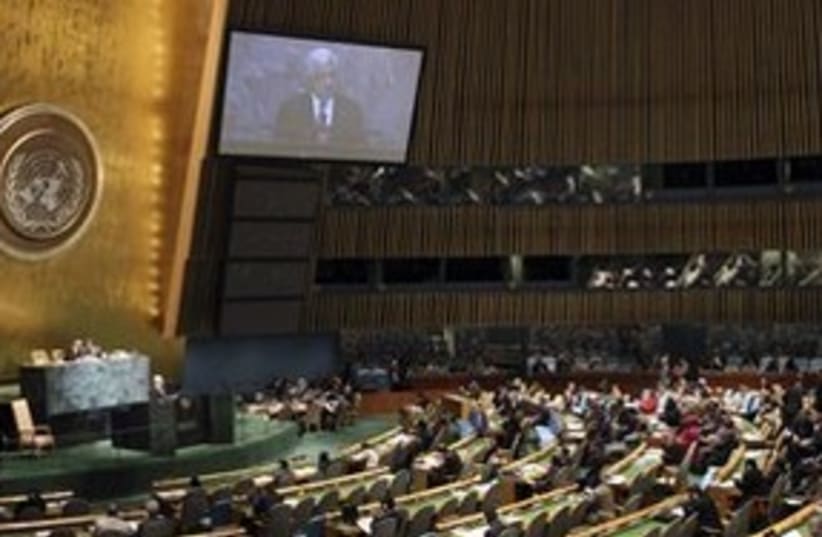
NEW YORK – The feature film Miral, a “relentlessly” pro-Palestinian and anti- Israel story, will be premiered on Monday night in the main hall of the UN General Assembly, in what is believed to be the first feature film premiere to be held there.The film, directed by American Julian Schnabel, is an adaptation of his Haifa-born girlfriend Rula Jebreal’s 2004 novel about a Palestinian orphan growing up amid ethnic hatred and violence, mainly perpetrated by Israeli authorities.RELATED:Germany gives adult rating to anti-Semitic Turkish film“I felt it was my responsibility to [turn] Rula’s book into a film,” Schnabel told reporters in Venice in September, according to the New York Post. “And I thought that I would have something – coming from my background as an American Jewish person whose mother was the president of Hadassah in 1948 – I figured I was a pretty good person to tell the other side.”A member of the Israeli delegation to the UN who had seen the film told The Jerusalem Post on Sunday that the film is “scandalous.”“There’s no historic context, not at all, nothing,” the diplomat said, noting that the film was laden with instances of Israeli cruelty to Palestinians. “You can see us bombing a house in the film, but you don’t see why – maybe this was the house of a suicide bomber that killed 30 Israelis. We don’t know.”Sources said that invitations were sent out on Thursday afternoon for the Monday night screening. Members of the Israeli delegation said the decision to screen a feature film in the General Assembly hall – especially such a dramatically pro-Palestinian and anti-Israeli film – was a “horrible” one.The decision seems to have been made unilaterally by Switzerland’s Joseph Deiss, the General Assembly’s president.Asked whether the showing would be particularly inappropriate following the slayings in Itamar on Friday night, UN spokesperson Jean- Victor Nkolo told the Post Sunday that Deiss condemns “in the strongest possible terms the murder of the Israeli family in the West Bank.”However, Nkolo said, it is the UN’s hope that the film “will show the state of children in conflict.”Nkolo said Deiss had seen the film and thought it would be “conducive to a discussion of children in conflict.”Nkolo said he believes other films have been shown in the General Assembly hall, recalling one on child soldiers in Africa. He did not know if a nondocumentary feature film had ever premiered there.On Friday morning, Israel’s delegation to the UN sent a letter of complaint to Deiss, protesting his decision to host the US premiere of Miral.In the letter, Israel’s Deputy Permanent Representative to the UN Haim Waxman wrote, “We find it very troubling that the UN has chosen to feature this film in the GA Hall. We are not aware of any other films with such contentious political content that have received this kind of endorsement from the president of the GA.”The event, according to the Israeli delegation, “will mark a rare occasion in which the UN’s GA Hall is used for a movie premiere. This is clearly a politicized decision of the UN, one that shows poor judgment and a lack of evenhandedness.”According to members of the Israeli delegation, various offices at the UN denied having any knowledge of the event beforehand, including the office of Secretary-General Ban Ki-moon. His office did not respond to the Post’s request for comment.Waxman said that Deiss, as president of the General Assembly, in some circumstances is independent and therefore has the prerogative to make decisions such as these.“But the hall of the General Assembly is not his own property,” Waxman continued.“This is the main hall of the global community and belongs to the countries of the world. Anything that happens there has to be decided with great care. We find ourselves arguing about commas here and there on every document – so how can this screening happen?” Waxman said members of the Israeli delegation met with Deiss staffers on Friday.“We gave them a very strong piece of our mind on why we think it’s completely out of place, why this is almost bizarre and a very strange decision [that] the only time they’re sending a political movie [is] when it deals with us,” Waxman told the Post.In his letter to Deiss, Waxman stressed that Israel fully supports and respects freedom of speech and artistic freedom.“As you are well aware, Israel enjoys a vibrant civil society and a film industry that produces and screens films that are sometimes highly self-critical and controversial,” Waxman wrote.However, he went on, the UN has a “clear duty to carefully select all programs that are hosted on its premises in order to maintain a spirit of impartiality.”He added, “The screening of Miral constitutes an inappropriate use of the hall of the GA, which already deals with the Israeli-Palestinian conflict excessively and obsessively.”American Jewish Committee executive director David Harris wrote a letter to Deiss on Friday reiterating this point, stating that showing such a film in the UN General Assembly hall “will only serve to reinforce the already widespread view that Israel simply cannot expect fair treatment in the UN.”Harris expressed concern that “the president of the General Assembly would wish to associate himself – and the prestige of his office – with such a blatantly onesided event,” and, like the Israelis, urged Deiss to reconsider his decision.
if(catID != 151){
var cont = `Take Israel home with the new Jerusalem Post Store