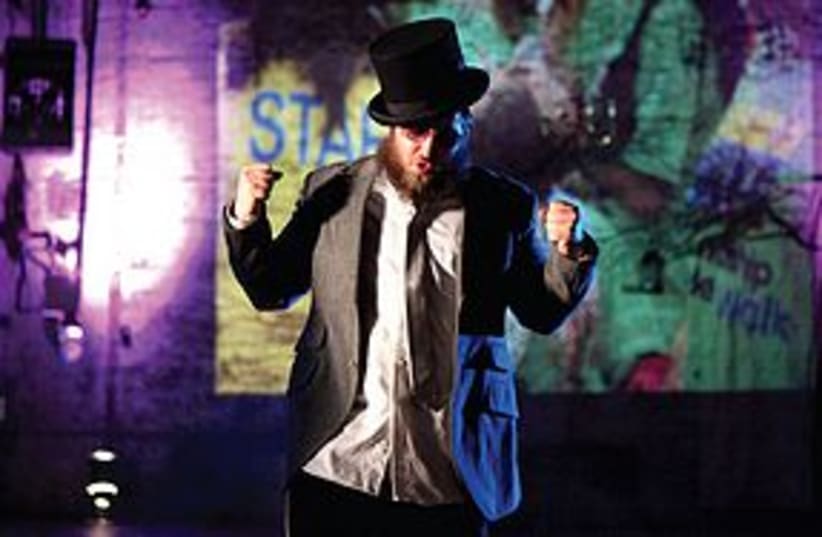
Born into a religious Australian family, Shneur Hasofer has been reborn as Hassidic rapper DeScribe.
By DAVID BRINNDeScribe 311(photo credit: courtesy)
If you had encountered him back in the ’90s near Jerusalem’s Zion Square, chances are you would have crossed the street to avoid him. Shneur Hasofer was one of the lost ‘kids of the wall’ who spent his teen years loading up on drugs and alcohol in downtown Jerusalem.A dozen years and a myriad of spiritual changes later, Hasofer, reborn under the moniker DeScribe, is using his experience to help misguided youth who are in the same boat he was, while forging a name for himself in the New York hip hop world where he combines a pulsating, rhythmic vibe with the strong spiritual ethos of Hassidism. Call him the Lubavitcher Rebbe with natural rhythm and a microphone.“I wasn’t just doing drugs, I was dealing drugs,” DeScribe recalled earlier this month, in a conversation with The Jerusalem Post while on a post-Pessah visit to Israel.“There were no rules, man, I was doing whatever I wanted. I would go visit my parents but there was nothing for me there. I would find comfort in the streets with my friends, who were going through similar issues.”The 28-year-old musician was born into a Chabad Australian family in Melbourne. His mother, Devorah Hasofer, is a known singer in the religious community, who has released many albums and still performs for female audiences. She discovered her son’s musical talent at an early age, giving him drum lessons and bringing him out during her shows as a special guest.However, by his early teens, the child prodigy had begun questioning his commitment to Judaism, and his parents packed him off to study at a Jerusalem area yeshiva.“I started to ask questions and I didn’t get the right answers. That year in yeshiva was the worst of my life. I turned away from Judaism and I quickly became a street kid. There were many nights that I slept at Kikar Zion,” said DeScribe, adding that his family’s aliya to Rehovot in 1998 did little to tame his wildness.Hoping that the army might fill that disciplinary role, DeScribe joined the IDF and served for three years in an infantry unit. But upon his release, he returned to his old ways, opening a business that he would only say dealt in “immoral sales.”“I fell fast on my butt until I realized that this was no way to live, everything collapsed around me,” he said.“I was 21 and hadn’t been religious since I was 15.I decided to move back home and told my parents ‘you have free rein over me.’ Slowly, I started to change the way I thought and behaved and in Judaism I found something that was real that brought happiness to a dark place in my life.”The other thing that brought him out of his hole was a renewed interest in music, especially the beats and rhythms of hip hop. Addicted to the sounds of artists like Biggie Smalls, Cypress Hill and Bone Thugsn- Harmony, DeScribe helped organize an Israeli tour for the Wu-Tang Clan (Remedy & Killah Priest), which whet his whistle to create his own music.“I knew one day I had to do something musically – there was something inside of me. The foundation of hip hop is the beat – it’s a pulse like a heartbeat, and that’s what drew me to it. Even the rhymes are spit out like a drum beat,” DeScribe said, adding that that he was equally mesmerized by hassidic music.“When I was a kid, Hassidic music would move me to the point I would break down. I haven’t found that passion in any other music in the world.”Armed with the self-confidence from his IDF service, his rediscovered commitment to religion and a thirst to create music, DeScribe unexpectedly pulled another left turn when, in 2006, he decided to leave Israel and study in another yeshiva – Tifferet Menachem in Sea Gate, Brooklyn, designed especially for young Jews who had lost their way.“They accepted me for who I was, a little out of the box and different than most cats. I didn’t fit into the regular system, that’s why I was spat out,” he said.“I came in there a bit of a rough dude, I was really ripped from weight lifting and the rabbi slowly broke me down, and taught me a better way to think and act and gave me a new set of eyes to the world.”The rabbi, Avraham Lipsker, also provided DeScribe with the break he needed to launch his musical career, by, in perhaps a world’s first, letting him build his own music studio in the yeshiva.“Someone gave me a laptop, and I downloaded Garage Band and I started messing around and making tracks, marinating my music,” said DeScribe.“Eventually I asked the rabbi to give me leave for two months so I could raise money to buy some actual recording equipment. People supported me all over, my grandparents, my family, strangers. I came back to the yeshiva with a truck load of equipment, and I went back to studying.”“I wanted to build up my credibility with the yeshiva again, and I know the rabbi was looking at that gear and looking at me and wondering when I was going to say something. After two months, I finally talked to him about it and asked him to if I could enclose a room at the yeshiva to house the equipment and make a studio.”“He had the foresight and wisdom to know that I had to express myself and understood that this was the form I needed to use. He even provided me with all the building materials I needed, and in days, we had a crazy studio inside the yeshiva.”Three years later, DeScribe’s music career is in full bloom, releasing an EP called Harmony, collaborations with Matisyahu, Bob Marley’s son Rohan, and his own forthcoming album with a healthy dose of community work in his home of Crown Heights, New York.And that equipment that was in the yeshiva studio is now being used at A.L.I.Y.A. (Alternative Learning Institute for Young Adults) in Crown Heights, where DeScribed has launched the IJam program, designed to give young people at risk experience in the music business.“They were street kids just like I was. We teach them to be proud of themselves and express themselves.It took me years to figure it out, but we just hand them the secrets – the keys to the castle. It’s an awesome opportunity,” he said.DeScribe’s recently released duet with Matisyahu – “Pure Soul” – also has a philanthropic bent, aiding the The Friendship Circle, a non-profit Jewish organization that assists children with disabilities.But DeScribe’s main focus is on building a coalition of racial harmony in Crown Heights in an attempt to lower the tensions between the Jewish, black and Caribbean communities there. Last year, he released a song and video called “Harmony” with Marley, successfully recruiting political and civic neighborhood leaders to participate in both the video and a neighborhood campaign.“We’re trying real hard to bridge the gaps, and it’s very tough because we’re different people with different ideas. There’s tension and a need to burst the bubble, there’s no other option” said DeScribe, recalling the race riots of 20 years ago.“If we’re not actively trying to make the situation better, then we’re all rolling down the hill. We’re trying to be a beacon of light for our communities.”Choosing to spread his message of coexistence and love via the medium of hip hop, so often associated with violence, racism and misogyny, is something that DeScribe saw no need to defend.“There’s a whole consciousness wing of hip hop, with artists trying to make people think, whether it’s political or spiritual thought. There’s no cursing and they’re bringing up essential issues,” he said.“I’m a little out in left field because I’m a Hassidic Jew, but it’s time for people to hear positive things, and it doesn’t matter from whom. Music has serious power and can affect the whole world. If we can utilize this energy to channel positive things, lives can be changed. And if we save one life, all the hard work will have been worth it. Like it says in the Talmud, if you save a soul, you save the world.”
Related TagsrapperMatisyahu
if(catID != 151){
var cont = `Take Israel home with the new Jerusalem Post Store