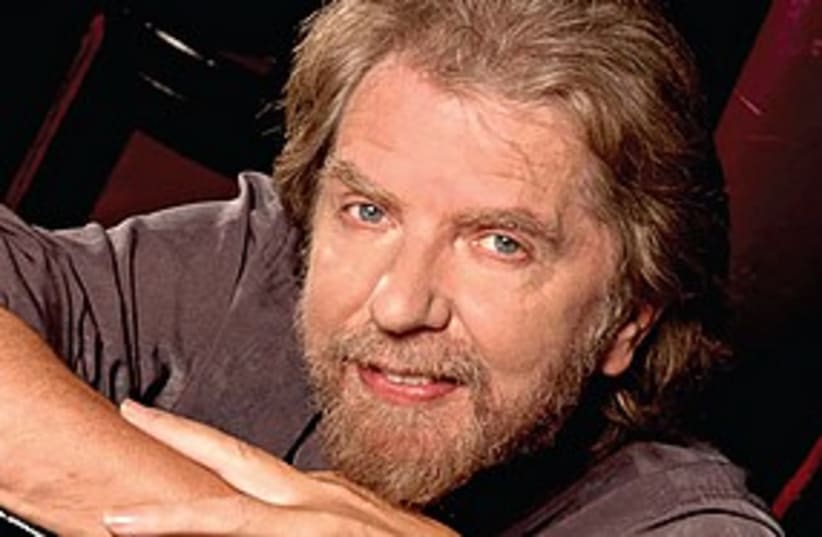
By DAVID BRINNTommy Sands 311(photo credit: Courtesy)
Tommy Sands has a lot of experience with conflicts. Crowned the Irish Pete Seeger for his musical political activism in his native Ireland over the course of five decades, the 64-year-old folk singer became known as the voice of reason during the bloody Protestant-Catholic battles in Northern Ireland. Now he’s hoping he can calm the jangled nerves of our region and use his Irish experience to show that even the most bitter of conflicts can have a sweet ending.Of course, the fact that he wrote “Shores of Gaza,” which was chosen to be the theme song for the Rachel Corrie ship, which sailed from Ireland last month as part of the Gaza flotilla of aid ships, might indicate his sympathies lie with a certain party in the Mideast conflictBut Sands, who arrived in Israel this week for two weeks of performances throughout the country as well as in Bethlehem, Ramallah and Nablus, explained that his song was one of peace, and that the ship which sailed from Ireland with many of his friends on board was, unlike the Mavi Marmara, truly humanitarian in purpose. “The song talks about peace and includes the words ‘salam’ and ‘shalom.’ I wasn’t taking sides. It’s a song for peace, not just for Palestinians, but for Israelis, too,” said Sands on the day of his first show in Bethlehem on Monday.He added that he could understand the actions of both sides’ actions in the flotilla incident but surmised that it was indicative of a much bigger problem.“According to the UN, the people of Gaza are receiving 25 percent of their goods that they need. I see that as one issue. On the other hand, I understand Israel’s need for security. But there has to be another way to achieve it,” he added.Guitarist Sands, who’s performing with his daughter Moya on fiddle/vocals/bodhran/whistle, and Fionan on mandolin/ banjo, had planned on also bringing two Irish politicians on tour with him to talk about how the situation in Ireland was resolved, but that following the flotilla incident, they canceled their participation.“In Ireland we used to say we have a problem for every solution. But now, maybe we have some experience that might contribute to ending the problems in your area,” said Sands. “They were going to discuss the history of the Irish conflict and maybe something could have been gleaned from it.” Sands added that pressure had been exerted on him to cancel his visit as well, but that he was intent on coming to sing for peace. “I was told ‘it’s dangerous for peace activists to go to Israel – activists are getting killed.’ I told them that there are many peace activists in Israel and they’re just fine and they’re the ones with whom we want to show solidarity,” he said.SOLIDARITY AND reconciliation have been the cornerstones of Sands’s philosophy ever since his parents, who both came from families of singers, musicians and storytellers, encouraged a love of Irish culture and tradition in him and his six siblings. Along with some of his brothers and sisters, Sands began performing as The Sands Family in the early 1970s, and they quickly became Irish favorites.Sands emerged as a powerful solo artist and social activist, with his songs evoking an Ireland free of strife.His signature tune “There Were Roses” encapsulated the senseless Northern Ireland conflict in recounting how a Protestant friend of his was murdered, and in the aftermath, a group of Protestants retaliated by killing a Catholic, who turned out to be a good friend of both Sands and the Protestant victim. “From our experience in Ireland, the lesson is that it’s not impossible to find a solution. But you can’t rely on politicians.Each person has to speak and be part of the conversation,” said Sands.He believes that while the problems between Israel and the Palestinians are very different from those that divided the Protestants and Catholics in Northern Ireland, the goal is the same. “The end result has to be reconciliation, and my aim here is to give encouragement to peace groups working in both places,” he said, adding that music has an important role to play in the process. “Music can help – there’s no one big solution to anything, but many small solutions. People from both sides of the divide used to come my house because of my parents – they played music.”Sands said that he felt pride at being compared to his hero, American folk legend Pete Seeger, and that he carries the folk legend’s message of peace with him wherever he goes – even to the Middle East. “I just got a letter from him the day before I left Ireland wishing us well on our trip here. Pete’s a great friend and has inspired us all,” said Sands, adding that he had attended and performed at Seeger’s celebrated birthday party last year at Madison Square Garden headlined by Bruce Springsteen.Whether or not Sands’s shows in the region will do anything to bring about any social change among the Palestinian or Israeli population, the singer said he’s going to enjoy performing anyway, especially with his children on stage with him. When the Yiddish term nachas was explained to him, he said, “Yes, that perfectly describes how I feel.” Sands will be performing Wednesday night at the Yellow Submarine in Jerusalem, and next week will appear in Tel Aviv, Zichron Ya’acov, Meitar and Shorashim. Details are on his Web site – www.tommysands.com
if(catID != 151){
var cont = `Take Israel home with the new Jerusalem Post Store