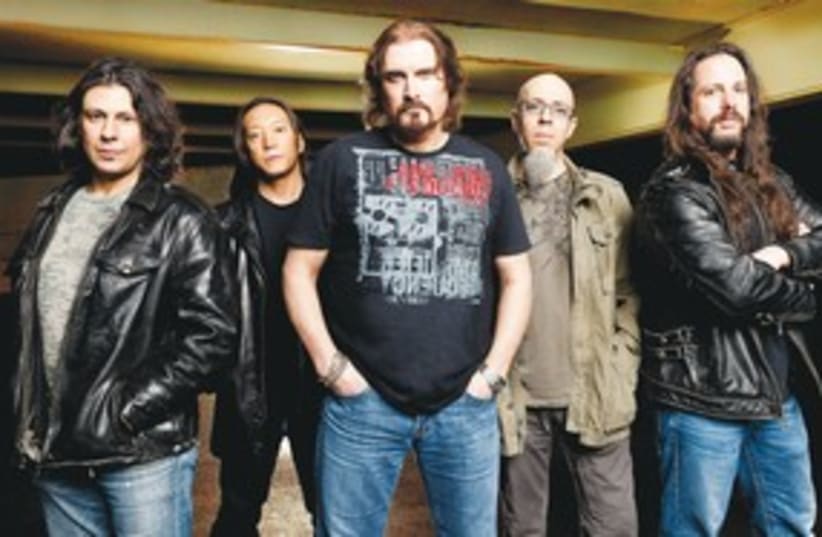
US hard rock staples Dream Theater have undergone an upheaval with departure of original member. But trauma can pave way for creative music.
By DAVID BRINNA dream or a nightmare 311(photo credit: Courtesy)
It’s no coincidence that the upcoming album by American progressive metal giants Dream Theater is called A Dramatic Turn of Events. The veteran head bangers with a huge worldwide following, underwent a seismic shift in their universe this year when co-founder, drummer Mike Portnoy, left the fold, resulting in a public soap opera more reminiscent of screaming tabloid banners than the world of hard rock.Only a couple months after Portnoy unleashed his announcement on his bandmates, prompting them to audition and hire a replacement than the original drummer apparently regretted his decision and asked to be reinstated.“Mike wanted to come back after we had gone through all the emotional turmoil and pain of losing a friend, and the effort we went through to get back on our feet. We were well past our recovery phase and had made a commitment to Mike Mangini,” said Jordan Rudess, Dream Theater’s inventive keyboard player, explaining the wrenching decision to reject Portnoy’s appeal.He was speaking from his home in New York a couple weeks before joining the band on a European tour that will see them arrive in Tel Aviv for a show on July 19 at the Tel Aviv Fairgrounds – two years after performing for a sell out audience of Israeli fans at the same venue.“His leaving was unbelievable, it was so emotional. He’s a close friend of mine and we’ve been through so much together – it basically brought me to tears. But being a positive person and around guys who love what they’re doing, we had to figure out how to move forward.”Rudess and his band mates did that by auditioning drummers, and landing a catch on the first try - Mike Mangini, a former Berklee College of Music teacher and holder of five World’s Fastest Drummer records.“Mike adapted to our world so wonderfully. He’s not only a great drummer, but a great guy. He came into the audition and locked in with us and nailed it.We were amazed,” said Rudess, who joined Dream Theater in 1999 as the ‘new guy,’ 14 years after their inception in 1985.“We were looking for someone who could walk onstage with us and not throw us off in the least, and we found him in Mike. As painful and said as the situation was over not being able to work with Mike Portnoy, life goes on – this kind of thing unfortunately happens in bands and we’re interested in keeping a positive direction and making really good music.” “And now,” he added with a laugh, “I’m no longer the new guy.”FORMED IN 1985 by Portnoy, guitarist John Petrucci, and John Myung – all students at Berklee – Dream Theater has released 10 albums amid the proliferation of countless live bootleg performances which cemented their reputation for being musicians’ musicians, dazzling contemporaries with their proficiency and flash. Not afraid to pay homage to the arena rock bands of the 1970s and ’80s like Rush, Styx and Foreigner, Dream Theater has always been more accessible than your average headbangers, and their fans, including those in Israel, are among the most rabid in the metal world.The 54-year-old Rudess, who grew up in a Reform Jewish family in Long Island, New York, arrived at the band in a circuitous fashion, after being courted over the course of many years. His affinity for the piano was evident already as a second grader, when, without prior training, began to accompany students as they sang.“One day, my teacher called my mother and said, ‘oh, your son is playing so beautifully – it’s so nice that you gave him lessons.’ And my mother said, ‘but we don’t have a piano and he’s never taken lessons,’” recalled Rudess.“So, my mother ran out and bought a piano and I’ve never stopped since.”The young piano player was soon accepted to the Juilliard School of Music Pre-College Division for classical piano training where he immersed himself in the masters for the next decade. But by his late teens, the exposure to rock & roll was acting like a magnet, especially the synthesizer-drenched sounds of the era’ progressive rock bands.“In school, I started getting turned on by friends to different kinds of music – someone brought a Genesis record and was all excited about it which sparked my interest. Then I heard ELP’s Tarkus and realized through Keith Emerson’s work that a keyboard player could be much more than a pianist, and that he could have this tremendous power,” said Rudess, who admitted that he was met with opposition by his parents.“It was difficult for my parents when I moved away from my classical studies, but it was also a big transition for me – I was so immersed in the classical world. But there was a time when my teacher at Juilliard told me she wanted me to memorize a Chopin ballade in one week, and I thought ‘I’m not into this.’” After performing in various hard rock projects during the 1980s, he was named ‘Best New Talent’ in Keyboard Magazine 1994 readers' poll after the release of a solo album. The increased high profile piqued the interest simultaneously of two band – Dream Theater and The Dixie Dregs, the virtuoso jazz-Southern rock hybrid. Both bands extended job offers, resulting in a wealth of riches dilemma for Rudess.“It was a difficult decision, because I was a big fan of Dream Theater. But my wife and I had just had our first child, and I was doing work for Kurzweil the keyboard maker as a product specialist, holding clinics on synthesizers and recording demo songs showing off their products,” said Rudess.“Joining Dream Theater would have meant giving that up and being on the road all the time, whereas the Dregs were more flexible and didn’t tour as much.”During his five years with the Dregs, Rudess encountered Dream Theater numerous times, including opening one of their tours with his ‘power duo’ Dregs offshoot he had formed with their drummer Rod Morgenstein. In 1997, when Dream Theater’s Portnoy and Petrucci formed their own sidegroup, Liquid Tension Experiment, they invited Reduss to join. And a couple years later when they renewed their offer for him to fill the keyboard slot in Dream Theater, he agreed.“I said, you know what – Let’s try – and it’s been 12 years,” said Reduss.That hasn’t meant that Reduss has curtailed his musical wanderlust. He continues to branch out in many avenues – including returning to his classical roots last year by composing his first classical piece “Explorations for Keyboard and Orchestra,” and premiering it in Venezuela with the Chacao Youth Symphony Orchestra.Another, more rock-oriented side project, surprisingly, brought him to Israel. Through his friend Steven Wilson – whose band Porcupine Tree has toured with Dream Theater –a few years ago he met Aviv Gefen, who plays with Wilson in their joint project Blackfield.Reduss soon found himself onstage with Gefen and Wilson, playing keyboards for a series of Blackfield shows in Israel and Europe in 2005.“I had a great time, I stayed with Steven in Tel Aviv. It was more relaxing then when I came back to Israel with Dream Theater in 2009. I didn’t have the time to hang out, because I wasn’t on my own schedule,” said Reduss, who added that he would likely open up some Blackfield shows later this year slated for the West Coast in the US.But Dream Theater remains Reduss’s passion, and their European tour via Tel Aviv is just a teaser for a massive world tour taking place later this year in support of A Dramatic Turn of Events, which is being released in September.“We have poured our hearts and minds into the creation of this album,” Reduss told a metal fan website last week.“All the life changing events that surrounded us before, as well as during the whole process, fueled our desire to dig deep within ourselves and create the best music we possibly could.”
if(catID != 151){
var cont = `Take Israel home with the new Jerusalem Post Store