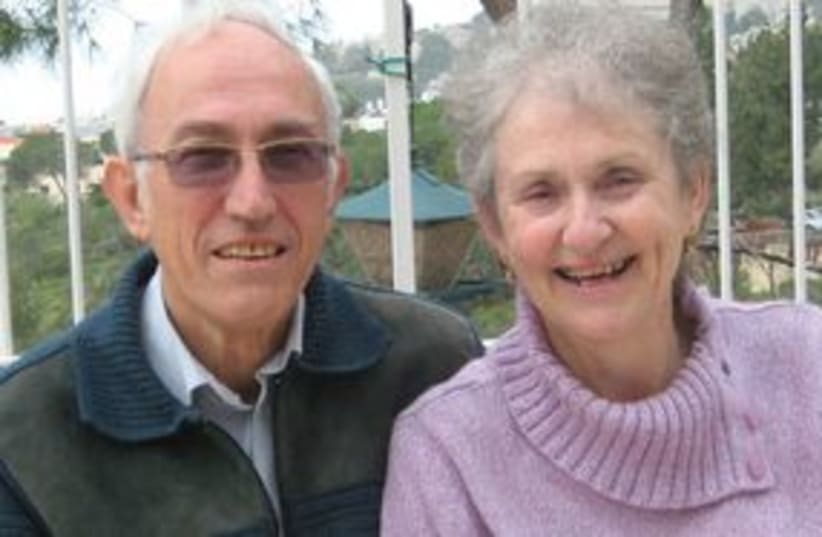
WORK “In the beginning, it was hard to adjust to the six-day week,” says Stuart.In his last period of employment before retirement, he traveled in the field of international marketing.Hadassa taught English privately to adults and children.
FAMILY The Palmers made aliya with their son, Danny, then 14, and younger daughter Gila, 11. Aviva arrived a year later after finishing school and went to Kibbutz Lavi for agricultural training, while Gila settled happily at the Carmel School. Danny had a tougher time, but eventually he settled in well at the secular Bosmath Technical High School.“This did not help with his integration in Bnei Akiva, however,” says Hadassa.The children are all married and the Palmers spend a lot of time with their 15 grandchildren. The family enjoys hiking and exploring the countryside together. Stuart never misses an opportunity to get material for his hasbara activities. On a recent trip to the Negev to see the wild spring flowers, they made a detour to Sderot so that he could add some of the latest developments to his blog.Hadassa had three first cousins here. One of them was, together with her daughter, in the group that was exchanged from Bergen-Belsen for a group of German Templers who were expelled by the British as suspected enemy aliens. Another cousin is still alive at 103.RELIGION Hadassa was brought up in an Orthodox family, but Stuart only found religion at university. At Stuart’s 70th birthday celebration at their synagogue, the entire Shabbat service was run by him, his son, sons-in-law and grandsons.HOBBIES AND VOLUNTEER SERVICE Apart from keeping an open house for potential immigrants and helping them settle, Hadassa works with a Dutch organization, Elah, which befriends and looks after the elderly. “I grew up with elderly relatives and enjoy being with older people,” she says. “But everything stops when there is tennis on TV.” Hadassa is an enthusiastic tennis fan. She also crochets kippot for the family.Hadassa and Stuart coordinate volunteer activities for Chi.L.D, the Haifa center for children with learning disabilities. Situated in a poor-income neighborhood, the center provides a kindergarten and after-school activities for disadvantaged children, trauma therapies for victims of terror and war and a special enrichment program for Ethiopian children. A yearly sponsored walk is organized by the Palmers to provide funds and raise the awareness of the community.A large percentage of Stuart’s time is spent on hasbara. “When I traveled for my work, people always asked about Israel. At that time I didn’t have enough information to be able to answer effectively, so when I retired I got involved.”Through the Israel Citizens Action Network, Stuart spends time giving lectures and organizes letter-writing to the media here and abroad. “We started by involving pensioners who had computer skills, volunteers of Sar-El, the army volunteer program and other volunteer groups, motivating them to continue to help Israel when they get home."In addition, Stuart is active in the Coalition of Hasbara Volunteers, an umbrella group of 106 multireligious and multinational organizations worldwide. This work involves contact with government departments and nongovernment bodies.“For example, when there are accusations that we take water away from the Palestinians, I can present research and information provided by the Water Board that shows exactly the distribution of water in the region. It helps to deal in facts rather than polemics.”“I believe that life is making things happen, not just watching or asking what happened” is Stuart’s philosophy of life.The only criticism the Palmers have of Israel is the deteriorating education system, particularly the lack of Zionist vision.“We know why we came on aliya, but the concept of why we should be here is not taught enough in schools,” says Hadassa.“We know why we’re here, there is no other place,” say the Palmers.