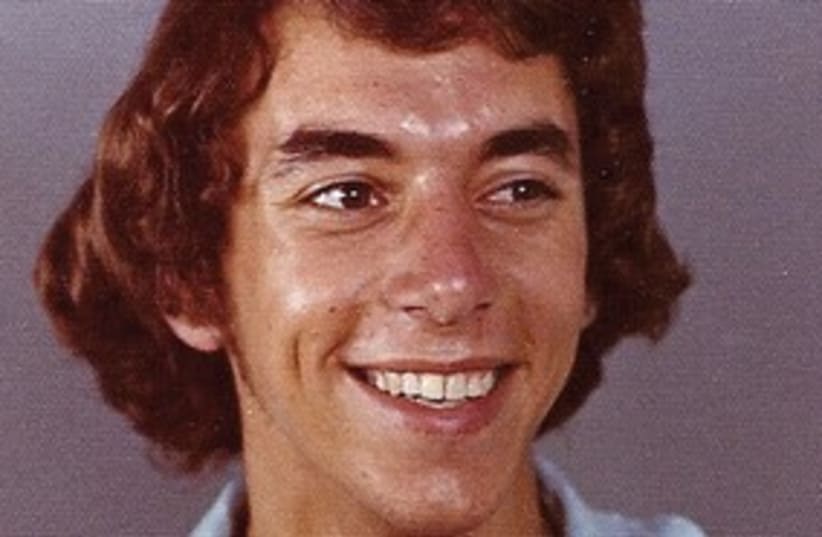
For Yasha Israels, who made aliya from the Netherlands, a 20-year-old with a hairdo which would have qualified him for singing with Abba.
By GLORIA DEUTSCHYasha Handyman 311(photo credit: Courtesy)
In this democratic egalitarian country, you can be sitting at a glittering social occasion dressed in your Savile Row suit one evening and the next morning be in paint-spattered overalls, decorating someone’s living room. That’s how it often is for Yasha Israels, who made aliya from the Netherlands, a 20-year old with a hairdo which would have qualified him for singing with Abba, in 1971.A mechanical engineer, he decided, after 15 years in a white-collar job at Tadiran, that being a handyman would be more fun and possibly more lucrative. In 1986 he gave up his prestigious job and has never looked back. Building, painting, plumbing, electricity – he does them all, a hands-on worker who doesn’t mind getting dirty if the job requires it. Ninety percent of his clientele are English speakers and he gets called for something as small as hanging a picture, or as big as adding an extension. He doesn’t need to advertise – everyone in Ra’anana and surroundings knows Yasha and his business, The Handyman.As the son of Holocaust survivors he has no doubt this is the place he wants to be.BEFORE ALIYA He was born in 1951 in Den Bosch, a town with a small Jewish community. During the war his parents had been hidden, although his grandfather was betrayed to the Germans.“I was more observant than I am now as a boy in Den Bosch,” he says. “In the synagogue they waited for me to become bar mitzva so they could have a minyan for prayer. I was the 11th and once I reached the age of 13, it meant someone could take a Shabbat off occasionally.”Here he doesn’t feel the need to express his Jewishness religiously because everyone is Jewish.ARRIVAL His parents were always keen Zionists and wanted their two children, Yasha and his sister Batsheva, to be here. Even before he made aliya he had the promise of a job in his field of mechanical engineering. He came to Beit Brodetsky, the singles absorption center in Ramat Aviv, in 1971, and although the promised job didn’t materialize, he found another almost immediately in the electronics firm Tadiran, where his fluent English stood him in good stead.“I never really did study Hebrew, but being Dutch it was easy for me to pick up the language,” he says.SETTLING IN He met his wife, Paula from England, in 1973 and they married a year later and moved to Ra’anana where two daughters were born.“There were 20,000 people there then, it was like a village,” he says.Paula worked as a secretary with the Batsheva Dance Company and later got a job in Tadiran. Meanwhile Yasha was working his way up the ladder and became head of his department.“I came to a point where everything was running so smoothly that I personally had nothing to do,” he recalls. “I hated it because I can’t sit and do nothing. I asked for another job but there was nothing available.”Feeling more and more frustrated, when a friend from Sweden announced that he was going to open a business as a builder, Yasha quit Tadiran and the two became partners.They split up early on and in 1986 The Handyman was born.GETTING DOWN TO THE JOB “I was always handy at home,” Yasha recalls. “When friends invited us for dinner, they’d often add, ‘Oh, and bring a screwdriver.’” He learned quickly and was soon an expert in laying tiles and knocking down walls.“In the beginning I only did small jobs,” he says. People would ask him to come and change light bulbs and knock nails in a wall. Then he was asked to paint an apartment with 11 doors that needed painting.“I instinctively knew that just slapping on paint wasn’t the right approach and I firmly believe you should do a job well or not at all,” he says. To this end he went and watched a professional work to see how it was done, and has worked with this particular subcontractor ever since.There were a few disasters in the early days – drilling though a pipe and setting a roof on fire stand out – but fortunately they were far between and a long time ago.CIRCLE “We don’t have Israeli friends, I think out of choice,” he says. “Mainly we are in an Englishspeaking circle, although we both speak Hebrew fine.”For relaxing after a hard day, he likes to play bridge and loves to go out for dinner, exchanging his paint-spattered overalls for a well-cut suit.“I like dressing up,” he says, “as most of the working day I look such a shlumper.”He often visits his mother who lives in Tel Aviv and and is an attentive grandfather.FEELINGS ABOUT ISRAEL “The freedom one has here doesn’t exist anywhere else, the not having to look over your shoulder. I experienced anti-Semitism at school, even after the Holocaust, so I am very content to live here in the Jewish state.”
Related Tagsveterans
if(catID != 151){
var cont = `Take Israel home with the new Jerusalem Post Store