Soldier wounded, 2 Palestinians killed on Gaza border
Soldier's condition stabilizes following surgery; two terrorists attempting to infiltrate Israel from Strip exchange fire with army forces.
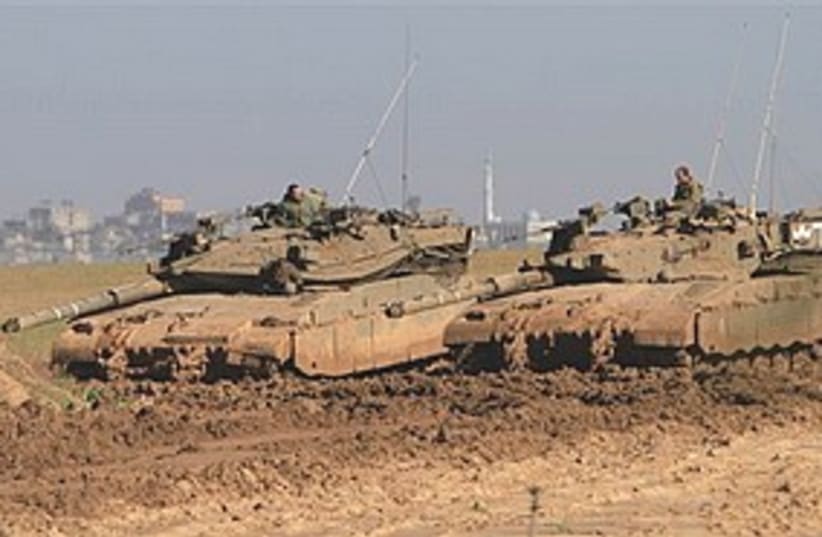
By JPOST.COM STAFF, YAAKOV KATZIDF tanks near Gaza 311(photo credit: Associated Press)A soldier wounded Saturday night on the Gaza border was still in a moderate but stable condition following a successful surgery at Soroka Hospital in Beersheba Sunday morning.Two Palestinian terrorists were killed in an exchange of fire with IDF forces Saturday night along the Gaza border fence.RELATED:New clash with Hamas looms – defense officialsIDF kills 2 Islamic Jihad terrorists on Gaza borderFour to five mortar shells fired from Gaza, one injuredThe incident began when IDF forces discovered two armed Palestinians attempting to infiltrate Israel through the border fence just north of the Kissufim crossing.This past Thursday, three weeks before the two-year anniversary of Operation Cast Lead and amid escalating rocket fire from the Gaza Strip, defense officials warned that Israel is preparing for a possible clash with Hamas in the near future.Defense officials noted that since the beginning of the month, there have been over a dozen mortar and Kassam rocket attacks, more than double in the parallel period last month. In addition, an advanced anti-tank missile was fired several days ago at an IDF armored vehicle along the Gaza border, causing extensive damage.Officials said that Hamas was not directly behind the attacks but that it was turning a blind eye to other terrorist groups, some of which worked on behalf of Hamas.“The IDF must be ready to operate in Gaza in a more extensive way than in the past,” Chief of General Staff Lt.-Gen. Gabi Ashkenazi warned this week.
if(catID != 151){
var cont = `Take Israel home with the new Jerusalem Post Store