Israel is reinstating one of its Dolphin-class submarines; Gantz gives Chief of Staff awards to covert Flotilla 13, Maglan units.
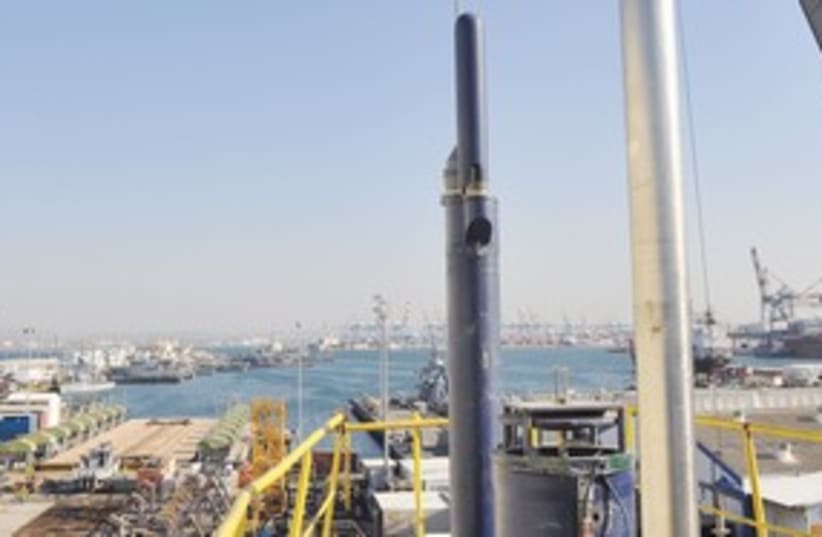
By YAAKOV KATZIsraeli submarine at Haifa shipyard 311(photo credit: IDF Spokesman's Office)
Israel will boost its long-arm strategic capabilities with the reinstatement of one of its Dolphin-class submarines that underwent an unprecedented structural overhaul.The submarine, one of three currently in the navy, arrived in Israel in 1999 and is the first to undergo the mid-life renovation. The Israeli submarines, which were purchased from Germany, have an expected lifespan of 30 years.RELATED:Israel's strategic weapon'Official confirms submarine deal hung on PA taxes'The submarine was taken out of service almost two years ago but the renovation was a carefully guarded secret in the navy so Israel’s enemies would not know that one of its three submarines was out of commission.Now that it is heading back to sea and ahead of the graduation of the navy’s 100th Submariner Course, The Jerusalem Post was invited Sunday to tour the shipyard in Haifa where the submarine is being reassembled.“Every vessel that comes in to the shipyard for maintenance and upgrades comes out with improved capabilities,” Col. Eli Shouach, commander of the navy’s shipyard, told the Post. “There are a select number of countries around the world which can independently renovate a submarine. Some have tried and failed.”Israel’s submarines are the military’s most expensive platform and are often referred to as the country’s second-strike doomsday weapon due to their reported ability to fire cruise missiles tipped with nuclear warheads.The three Dolphin-class submarines in the navy’s fleet are called Dolphin, Leviathan and Tekuma and are believed to be some of the most advanced diesel-electric submarines in the world. They replaced the 23- year-old Gal class submarines and in the coming years will be joined by two additional submarines currently under construction in Germany.Maj. Doron Bareket, the officer in charge of the upgrades, said that the renovations include dismantling all of the submarine’s valves, pipes and sonar systems. The engine is also taken apart, cleaned and reassembled.The submarine’s body is also cleaned and cracks in the hull are welded back together.The entire upgrade is costing the navy close to NIS 100 million, the most expensive upgrade the shipyard has ever carried out.With the expected arrival of two additional submarines in the coming years, the shipyard is also undergoing renovations to accommodate the new vessels and building new hangars, some of which will be protected from potential Hezbollah and Syrian missile attacks.
In related news, Chief of Staff Lt.-Gen. Benny Gantz decided Sunday to award the navy’s Flotilla 13 commando unit, better known as the Shayetet, the annual “Chief of Staff Award” for demonstrating impressive operational capabilities over the past year.The Shayetet’s operations are almost all classified. One known operation from the past year included the seizure of the Victoria cargo ship that was transporting 50 tons of weaponry, including sophisticated Iranian-made anti-ship missiles, from Iran to Hamas.Another group to receive the award was the Maglan unit, which like Shayetet is believed to specialize in covert operations behind enemy lines.
if(catID != 151){
var cont = `Take Israel home with the new Jerusalem Post Store