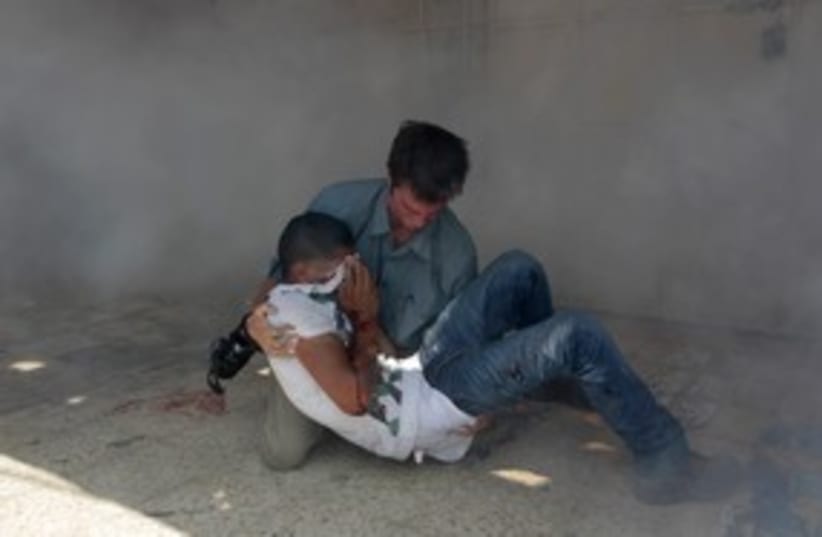
Palestinian injured at Kalandiya, IDF uses 'The Scream'
Demonstrators burn tires, throw stones at security forces; IDF uses new non-lethal sonic crowd dispersal weapon; injured man treated on scene.
By JPOST.COM STAFFA Palestinian wounded at the Kalandiya checkpoint 311 (R)(photo credit: REUTERS/Darren Whiteside)
One Palestinian was lightly injured at a demonstration that turned violent at the Kalandia checkpoint between Jerusalem and Ramallah Wednesday afternoon, the IDF Spokesman's Office said.The IDF, in order to disperse several dozen Palestinians who were burning tires and throwing stones at security forces, used "The Scream," a non-lethal sonic weapon that emits a deafening sound people cannot stand.RELATED:Palestinians take to streets, show statehood bid support Steinitz threatens to stop PA tax transfers over UN bid The injured Palestinian man was treated on the scene.While mass demonstrations have been taking place throughout the West Bank this week, violent incidents like that which took place at Kalandiya were expected to be minimal and isolated.
Unlike a rally in Ramallah Wednesday that drew thousands to support Palestinian statehood in the United Nations, the Kalandiya protest came into direct contact with Israeli forces.In an interview with The Jerusalem Post Tuesday, Home Front Defense Minister Matan Vilna'i said that PA security forces are prepared to contain demonstrations and prevent them from turning violent.Nonetheless, he said, "the defense establishment is well prepared for all possible scenarios."On Tuesday, ahead of the large demonstrations, IDF regional brigade commanders in the West Bank held talks with their Palestinian counterparts to coordinate operations aimed at containing the protests and preventing a violent escalation.The IDF has also tightened its rules of engagement as part of an effort to minimize potential for an escalation due to tactical operations or mistakes. As reported on Tuesday in the Post, the IDF has reduced operations inside Palestinian cities and towns in territory defined as Area A, which is under full Palestinian control.Such operations will be carried out only to prevent imminent terrorist attacks that are in motion, with the understanding that Israeli incursions into Area A embarrass PA security forces and undermine their authority in the eyes of the Palestinian people.Yaakov Katz contributed to this report.Click for full JPost coverage
if(catID != 151){
var cont = `Take Israel home with the new Jerusalem Post Store