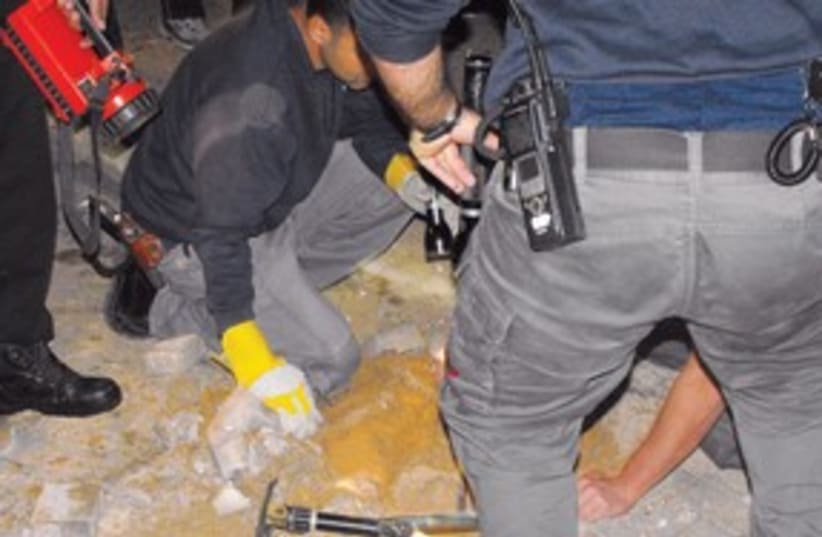
Two rockets explode in residential Beersheba; 1 injured
10 mortars explode in Eshkol, Shaar Hanegev regions; Islamic Jihad claims responsibility; 9 Palestinians killed in IDF attacks on Gaza terrorists; PM "expresses regret" for loss of civilian life.
By JPOST.COM STAFFGrad rocket in Beersheba 311(photo credit: Yasser Okbi/Israel Post)
Two rockets exploded in Beersheba on Wednesday morning, and ten mortar shells fell in Shaar Hanegev and Eshkol Regional Councils.A siren was heard as a rocket fell in an open field in Beersheba at 9:40 Wednesday morning. No injuries were reported.RELATED:Hamas repeats commitment to keep unofficial truceIsrael vows to avenge Gaza mortar barragePalestinian rocket slams into AshkelonAnalysis: Gaza escalation shows IDF deterrence erodingA 122-millimeter Grad rocket landed in a private yard of a residential area in Beersheba earlier Wednesday morning.No deaths were reported in the Beersheba blast, however, one 56-year-old man was injured moderately in his chest by flying debris when he witnessed the grad's explosion from his third story window. He was treated by paramedics who arrived on the scene. Three others were treated for shock.There were no injuries or damage reported in the Eshkol mortar barrage. The shells landed in an open field.The Al-Quds Brigades, a branch of Islamic Jihad, took responsibility for the recent Grad rocket attacks on Beersheba, AFP reported on Wednesday."This is a reaction the the crimes of Zionism against our nation in Gaza," Islamic Jihad announced in a statement.Only hours before, a Grad rocket launched from the northern Gaza Strip exploded south of Ashdod. There were no reports of injuries or damage to property.An air raid siren was heard throughout the city.Islamic Jihad reportedly took responsibility for the Ashdod attack as well.At least nine Palestinians, including four civilians, were killed on Tuesday in separate IDF attacks against targets in the Gaza Strip, marking the bloodiest day in a week of escalating violence in the South.On Tuesday evening, the IDF spotted a terror cell in the midst of preparing to launch a long-range rocket into Israel.The IDF attacked the cell, killing four known terrorists who military sources said were behind the Grad-model Katyusha attack on Beersheba last month.In the afternoon, IDF troops shot mortars into Gaza and accidentally hit civilians in the northern town of Sajaya. The troops fired the mortars after they came under mortar fire from a terror cell that was spotted in a field near the town.Palestinians reported that four people – aged 58, 12, 16 and 17 – were killed in the strike.The IDF said that the Southern Command was investigating the incident, but stressed that Hamas was responsible for choosing to operate from within populated areas.Later Tuesday night, an official IDF spokesperson announcement said that IDF aircraft fired on a terrorist in the northern Gaza Strip. The statement said the terrorist was planning to send rockets in the direction of Ashdod.A short time earlier, four Kassam rockets exploded in open fields in the Sha’ar Hanegev region. No injuries or damages were reported.Prime Minister Binyamin Netanyahu issued a statement Tuesday night “expressing regret” at the loss of innocent life in Gaza, saying it was accidental.According to the statement, Netanyahu stressed that the IDF mortar-firing had been a reaction to Hamas shelling of Israeli civilians.“It is unfortunate that Hamas continues to rain down dozens of rockets on Israeli civilians intentionally, while using [their own] civilians as human shields. Israel has no intention of bringing about a deterioration of the situation, but at the same time, the IDF will continue to act decisively to protect Israeli citizens,” the statement read.Hamas said in a statement that it would respond strongly to Israel’s actions.On Tuesday morning, the IDF thwarted an attack after a tank crew spotted a group of terrorists preparing to fire an anti-tank missile. The tank opened fire and hit the group.According to the Palestinians, 19 people were wounded, including four terrorists, in an air strike the IAF carried out on Monday night.Hamas and several other Palestinian groups threatened on Tuesday to avenge the deaths of the Palestinians killed by IDF gunfire in the Gaza Strip, while the Palestinian Authority in the West Bank strongly condemned Israel.Hamas’s renewed threat came only a day after the movement said it was interested in preserving the unofficial cease-fire with Israel. Yaakov Katz, Khaled Abu Toameh, and Herb Keinon contributed to this report.
if(catID != 151){
var cont = `Take Israel home with the new Jerusalem Post Store