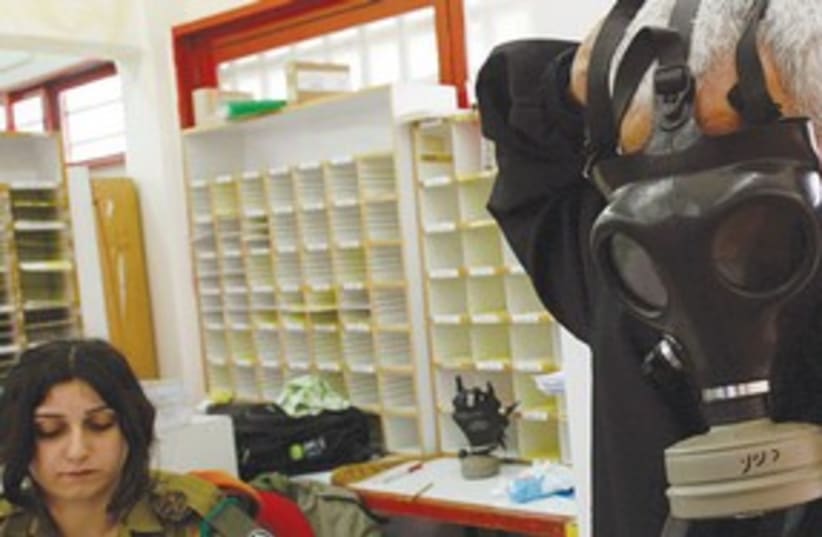
By the end of the month, just over 4 million Israelis will have received their masks, leaving 40 percent without.
By YAAKOV KATZgas mask, IDF soldier_311(photo credit: Gil Cohen Magen/Reuters)
Despite concern that Israel could come under a chemical attack due to the growing instability in Syria, the IDF Home Front Command will suspend distribution of gas masks at the end of the month due to a government refusal to allocate funds necessary to continue their production.By the end of March, a little over 4 million Israelis will have received new gas masks under the IDF’s distribution program, which began in 2006 with the collection of the public’s old gas masks. The remaining 40 percent of Israel’s population will not have masks.Behind the shortage is a disagreement between the Defense Ministry and the Treasury over where the funding for the continued refurbishment and distribution of the masks will come from. The Defense Ministry has asked for a budget supplement, while the Treasury has argued that the money should come from the regular defense budget.“Nothing has changed, even though there will not be any gas masks left by the end of the month,” a senior defense official said on Monday. “Once the production line closes it will also take time to restart it.”News of the lack of gas masks comes as the IDF is increasingly concerned with the possibility that Syria’s extensive arsenal of chemical weapons will fall into rogue terrorist hands. It is also concerned with the possibility that President Bashar Assad will be tempted to attack Israel if he feels that his regime’s demise is imminent.In January, the IDF held a civil-defense exercise to prepare the Home Front Command for a biological and chemical attack against Israel, as well as the first-ever drill simulating a radioactive dirty bomb attack against the country.Distribution of gas masks is overseen by the Home Front Command but is carried out by the Israel Postal Company, which comes to people’s homes and delivers the kits. The IDF has recorded a sharp climb in the number of Israelis contacting the company in recent weeks up to nearly 200,000.One of the catalysts is believed to be the recent media reports on a possible Israeli attacks against Iran, as well as a new campaign by the Home Front Command to get residents of Tel Aviv and Haifa – two cities believed to likely be the most threatened in a future war – to collect their masks.
Related Tagsgas masks
if(catID != 151){
var cont = `Take Israel home with the new Jerusalem Post Store