Israel expresses concern after reports state Assad may be losing control over military assets, including air defense base.
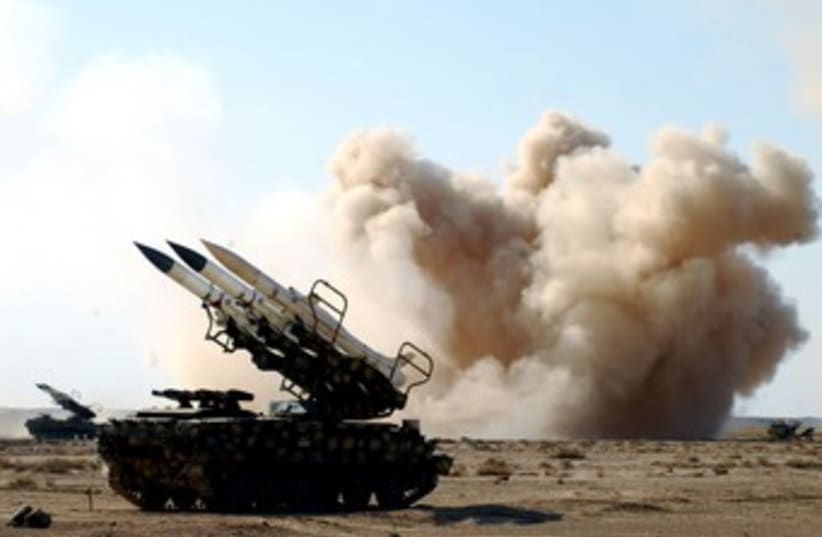
By YAAKOV KATZSyrian anti-aircraft missile launchers 370(photo credit: REUTERS/Sana Sana)
Concern is mounting in Israel over the possibility that Hezbollah will try to move sophisticated weaponry, including Scud missiles, from Syria to Lebanon to protect them in the event of Syrian President Bashar Assad’s downfall.The concern stems from reports that Assad might be losing control over certain military capabilities including an air defense base which was captured by rebels earlier this week.Syria is believed to have allocated a number of Scud D missiles – the most advanced missile in its arsenal – to Hezbollah already in 2010 but they have been stored in bases in Syria.The understanding until now has been that the missiles would only be transferred to Lebanon in the event of a war with Israel but not before as to prevent a potential Israeli military strike.Now though, with Syria in the midst of an uprising, there is concern that Hezbollah might try to move the missiles into Lebanon to prevent them from being captured by rebels or other rogue elements.If this happens and Israel becomes aware of the transfer, the government will have to decide if it should attack and intercept the transfer or ignore it to prevent such a strike from escalating into an all-out war with Hezbollah and Syria.An Israeli strike in Syria could provide Assad with the opportunity to use Israel as a scapegoat and divert attention away from his violent crackdown, to Israeli violence.On the other hand, the delivery of Scud D missiles to Hezbollah would be a significant increase to the organization’s capabilities. Syrian Scud Ds have a range of about 700 km. and can carry non-conventional warheads.In the meantime, the Israel Air Force is in the process of receiving new Arrow missile interceptors that would be better equipped to intercept Scud missiles.The upgraded interceptor is called “Block 4” and contains new software aimed at improving the system’s ability to defend against long-range ballistic missiles such as Iran’s Shahab and Sajil and Syria’s Scud D missiles.The Arrow is Israel’s upper tier missile defense system, complemented by the Iron Dome for short-range rockets and the David’s Sling, which is under development and to be used against medium-range rockets and cruise missiles.In the coming months, the Defense Ministry plans to hold its first interception test of the Arrow 3, a new higher-level system that will provide Israel with a number of chances to intercept incoming enemy missiles.Israel’s concern also focuses on the possibility that Syria’s arsenal of chemical weapons will fall into rogue hands. The concern over the stability of Syria’s chemical arsenal comes at a time when only about 60 percent of Israelis are in possession of gas masks. The IDF is currently lacking NIS 1.2 billion to complete the production and distribution of gas masks to the rest of the public.
if(catID != 151){
var cont = `Take Israel home with the new Jerusalem Post Store