Officials deny reports that Israel under pressure from DC to refrain from taking unilateral steps against Assad's chemical weapons.
By YAAKOV KATZ, HERB KEINONweapons of mass destruction 311 R(photo credit: Reuters)
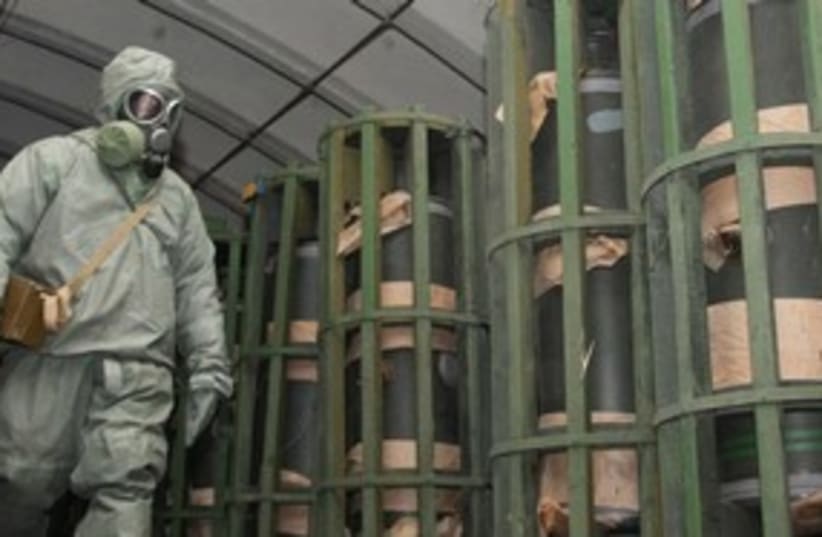
Israeli-US intelligence and defense ties have reached new heights due to the uprising in Syria and fears the country’s chemical weapons will fall into terrorist hands, defense officials said on Sunday.The officials denied reports that Israel was under pressure from Washington to refrain from taking unilateral steps – such as military action – to destroy Damascus’s chemical weapons.“We are working very closely together and there is very close coordination,” one official said, adding that the situation in Syria was at the heart of talks with administration officials, including US Secretary of State Hillary Clinton and National Security Adviser Tom Donilon.Prime Minister Binyamin Netanyahu, in an interview with the Fox News Sunday program, said his concern in regard to Syria was less about who would replace President Bashar Assad, and more about what could happen to the country’s stockpile of chemical weapons in the chaotic “seamline” when there was no government in control.“This is a real problem,” the prime minister said. “Can you imagine Hezbollah – the people who are conducting, with Iran, all these terror attacks around the world – [if] they would have chemical weapons? It’s like al-Qaida having chemical weapons.”Netanyahu said this scenario was unacceptable to Israel, as it was to the US.“I think that this is something we’ll have to act to stop if the need arises,” he said. “And the need might arise if there is a regime collapse but not a regime change, that is you go into some chaos and these sundry sites are left basically unguarded. Hezbollah can come and pick at it, or some other terror organizations or groups can come and pick at it.“It’s a great threat,” the prime minister said of the possibility of chemical weapon “leakage.”Asked whether Jerusalem would act alone or would prefer that the US take the lead, Netanyahu said, “We’ll have to consider our action. But do I seek action? No. Do I preclude it? No.”Defense Minister Ehud Barak had a similar message earlier in the day, saying that Israel “cannot allow” Syria’s chemical weapons to fall into rogue hands.“We are watching for the possibility that Hezbollah will try to move advanced weapon systems,” Barak said during a visit to the IDF’s Tel Hashomer induction center to meet with new recruits to the Golani Brigade. “More than this, we cannot know, including when we will act, how we will act and if we will act.”Barak predicted Assad would fall soon but insisted that it would happen without Israeli involvement.“The Syrian people will topple him and the only ones who are helping him are Iran and Hezbollah – and despite that assistance he will still fall,” Barak said.Barak’s senior subordinate, Maj.-Gen. (res.) Amos Gilad, said on Sunday that Assad’s forces were still in control of the chemical weapons facilities. But on Friday, Barak told Israeli TV stations that he had ordered the IDF to prepare operational contingency plans to prevent the proliferation of chemical weapons in Syria.Syria is said to have one of the largest chemical weapons arsenals in the world, with thousands of bombs that can be dropped from the air alongside dozens of warheads that can be installed on Scud missiles. In addition, in the late ’90s, the US warned that Damascus was developing warheads that could detonate in midair and disperse smaller bomblets packed with various nerve agents.Israel has several options. One possibility could be to attack from the air convoys of chemical weapons or bases where the weapons are stored. The fear though is that such a strike, even if conducted in the twilight of Assad’s regime, would spark an all-out war with Syria, Hezbollah and possibly Iran.
if(catID != 151){
var cont = `Take Israel home with the new Jerusalem Post Store