Abbas to pay grants to prisoners released in Schalit deal
Hamas official says several former prisoners have been summoned for interrogation by PA security forces; Meidan to meet with Shamgar C'tee.
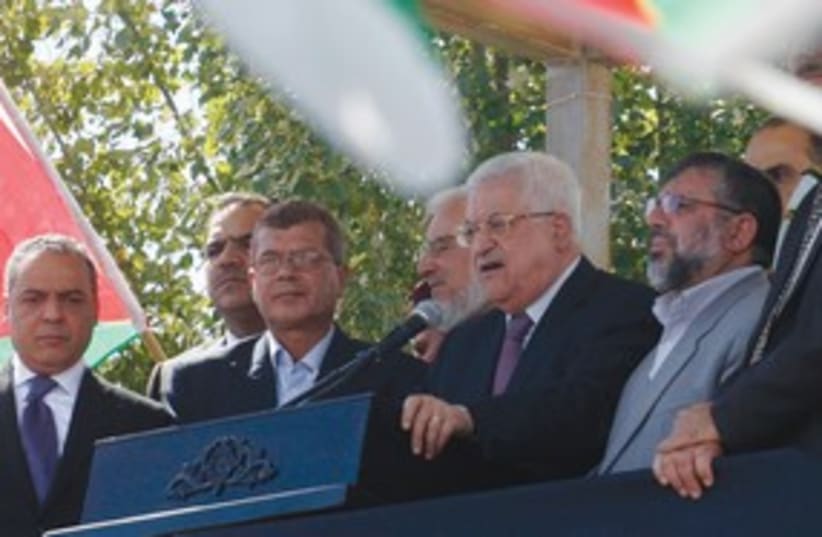
By KHALED ABU TOAMEH, HERB KEINONAbbas addresses released prisoners in Ramallah (photo credit: REUTERS)
Palestinian Authority President Mahmoud Abbas has decided to honor Palestinian prisoners who were released in last week’s Gilad Schalit exchange deal by rewarding them financially, Prisoners Affairs Minister Issa Qaraqi announced over the weekend.Hamas representatives, meanwhile, called for kidnapping more IDF soldiers so they could be traded for the remaining Palestinian prisoners in Israel.RELATED:Abbas, Hamas join forces to welcome prisoners'Abbas says he'll ask Netanyahu for prisoner release'Qaraqi said that all prisoners would benefit from the grants, including those who were deported to the Gaza Strip, a number of Arab countries or Turkey.PA governors and some “national institutions” have begun distributing the money to the released prisoners in accordance with PA regulations and laws, he said.Qaraqi did not say how much each prisoner would get from the PA government.Abbas’s decision follows a similar move by Hamas Prime Minister Ismail Haniyeh, who decided to give each prisoner a $2,000 grant.
Meanwhile, the prisoners who were deported to the Gaza Strip are staying at a five-star hotel at the expense of the Hamas government.Hamas accused the PA security forces in the West Bank of harassing some of the prisoners who were released last week.A Hamas official said that several former prisoners and their families have been summoned for interrogation by the PA security forces in the northern West Bank.Fathi Qarawi, a Hamas official in the West Bank, urged the PA to stop harassing the released prisoners and their families, and to “take advantage of the prisoner swap to achieve Palestinian national unity.”Despite the tensions between Fatah and Hamas, Abbas and Hamas leader Khaled Mashaal are expected to meet in Cairo next month to discuss ways of achieving unity, sources close to the two sides said over the weekend.Ahmed Ja’bari, commander of Hamas’s armed wing, Izzadin Kassam, was quoted on Saturday as saying his group would continue its efforts to kidnap “IDF soldiers and officers,” in a bid to free all the prisoners from Israel.“We have taken upon ourselves the task of cleansing the Israeli prisons [of] all Palestinians, regardless of their political affiliations,” Ja’bari said. “The day the deal was achieved was the happiest in my life, because it brought smiles to the homes of many Palestinian families.”Khalil al-Haya, another senior Hamas official, also threatened that his group would try to kidnap more soldiers to secure the release of Palestinian prisoners.Addressing Israel during a rally in solidarity with the released prisoners in Khan Yunis, in the southern Gaza Strip, Haya said: “Spare yourself the suffering and release all our prisoners, because they will be released in the same way we released some of them now.”Yehya al-Sinwar, a top Hamas representative, told the rally that the Palestinians had no choice but to continue kidnapping soldiers to gain the release of their prisoners from Israel.Prime Minister Binyamin Netanyahu’s spokesman Mark Regev said that the manner in which Hamas has put the released prisoners on a pedestal since their release “has reconfirmed for anyone who needed a reminder that Hamas is an extreme-terrorist movement that sees every Israeli – men, women and children – as legitimate targets.“If anyone in the West had any illusions about them, we hope what Hamas has done over the last few days will serve as a wake-up call and show that they have not become more moderate or responsible.”To those arguing that as a result of Schalit’s release, the naval blockade of the Gaza Strip should be lifted, Regev said Hamas’s rhetoric and actions since the Schalit release have shown that it remains an “extreme regime, which is waging a war on all Israelis.”Meanwhile, David Meidan, who represented the prime minister in the talks that led to the Schalit prisoner swap, is expected to meet this week with the Shamgar Committee, which is drawing up guidelines for conducting negotiations for the release of captive Israelis.The Shamgar Committee, headed by former Supreme Court justice Meir Shamgar, was established by Defense Minister Ehud Barak in July 2008 after the bodies of IDF reservists Ehud Goldwasser and Eldad Regev were returned to Israel in exchange for terrorist Samir Kuntar, four Hezbollah fighters and the bodies of nearly 200 Lebanese and Palestinians.The government held up publicizing the committee’s recommendations until after a deal for Schalit was reached. The committee is now expected to present its recommendations to Prime Minister Binyamin Netanyahu and Barak within two weeks.Barak has said that once Schalit was released, Israel would need to draw up a new policy regarding future swaps, making it clear to both to the enemy and the Israeli public what price Israel would, and would not, be willing to pay in the future.After Netanyahu and Barak review the Shamgar recommendations, they are expected to go to the cabinet for approval, then to the Knesset.Abbas on Saturday met with the leader of Egypt’s Supreme Military Council, praising Cairo’s part in facilitating the deal to release Schalit, Palestinian news agency WAFA reported.Abbas told Field Marshal Mohamed Tantawi that the PA “is relieved that Schalit’s file is finally closed, because it was being used as an excuse by Israel and other parties to hinder the peace process.”According to the report, the two leaders also discussed steps to secure the release of the nine female Palestinian prisoners in Israeli jails who were not freed in the Schalit deal. Jerusalem Post staff contributed to this report.
if(catID != 151){
var cont = `Take Israel home with the new Jerusalem Post Store