Israel, US move to expedite entry for frequent travelers
Visit here by US Secretary of Homeland Security Janet Napolitano focuses on cyber-terrorism.
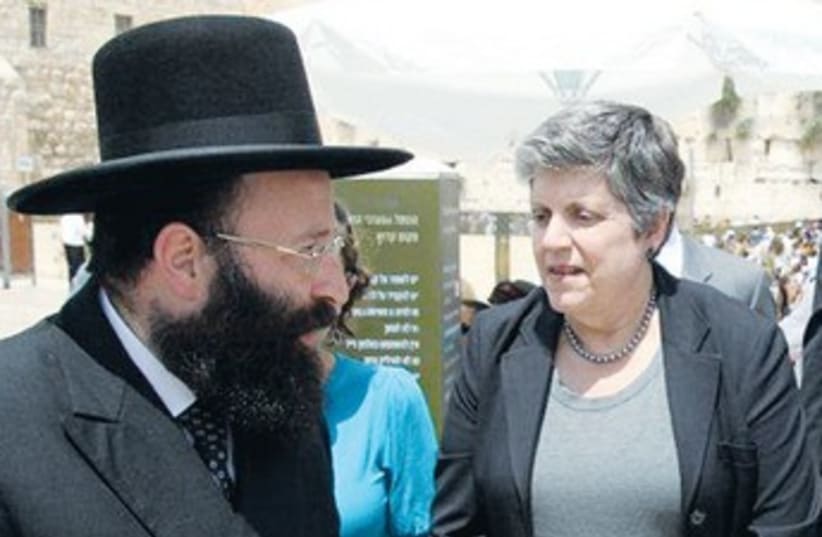
By GREER FAY CASHMAN, HERB KEINONNapolitano speaks Western Wall Rabbi Shmuel Rabinowitz_370(photo credit: Courtesy Western Wall Rabbi)
Foreign Minister Avigdor Liberman and US Secretary for Homeland Security Janet Napolitano signed a letter of intent Sunday regarding Israel’s entry into the US Global Entry program that will speed up the time it takes frequent Israeli visitors to enter the US.The Global Entry program allows expedited clearance for pre-approved, low-risk travelers upon arrival in the United States. Though intended for frequent international travelers, there is no minimum number of trips necessary to qualify for the program. Participants may enter the United States by using automated kiosks located at select airports.Israel will join Britain, Holland, Austria, New Zealand, Japan and Qatar in participating in the program, which is designed for diplomats, businesspeople, and those who have relatives in the US.Those who join will pay a $100 fee and undergo a security check. Once they have registered, they merely have to swipe a finger through a biometric identification machine on arrival in the US, rather than go through border control.In return, Israel will set up a special line for frequent US visitors to Israel, who will go through a similar procedure when landing at Ben-Gurion Airport.At the signing of the agreement, Napolitano said 1.5 million people go back and forth between the two countries each year, and that it was important to reduce the time spent at the border crossings.Following her meeting with Liberman, she met with President Shimon Peres and said fighting cyber-terrorism was the main focus of her visit. Escorting her to the meeting at Jerusalem’s King David Hotel was a large contingent that included US Ambassador Dan Shapiro and Israeli Ambassador to the US Michael Oren.The US relationship with Israel is “strong and robust,” she said, citing offices in her own department that interact with Israeli ministries, making for multiple cooperation opportunities on both sides. American scientists have been talking to their Israeli counterparts about explosives, she added.The challenge of cyber-terrorism is an important area for cooperation, she declared, pointing out that “security, commerce, trade and travel do not have to be opposing forces. If you’re smart about security, it will facilitate commerce and travel.”Peres told the homeland security secretary that her position was one of the most sensitive in the administration. He drew a parallel between economics and security, saying that what was happening globally regarding the economy could also be applied to security.Nowadays, he said, “security depends more on arms than the size of the army. You have a global economy without a global government, and global terror without global security.”Globalism, he continued, makes national governments weaker, with the result that people respect them less.“You have to be alert every morning,” he cautioned Napolitano.Turning to the situation of Iran, the president emphasized the importance of trying to avoid bloodshed, “but not to give up on the essence.” Israel isn’t looking for enemies, he said, “but we can’t close our eyes to danger.”According to Peres, the greatest danger comes from unorganized terror groups around the world, and the only solution to this problem “is a broad-based coalition that will fight terror on all fronts.”
if(catID != 151){
var cont = `Take Israel home with the new Jerusalem Post Store