Israel looks to influence text of PA statehood resolution
Barak on Palestinian turn to UN: "It is very important that all the players come up with a text that will emphasize the quick return to negotiations."
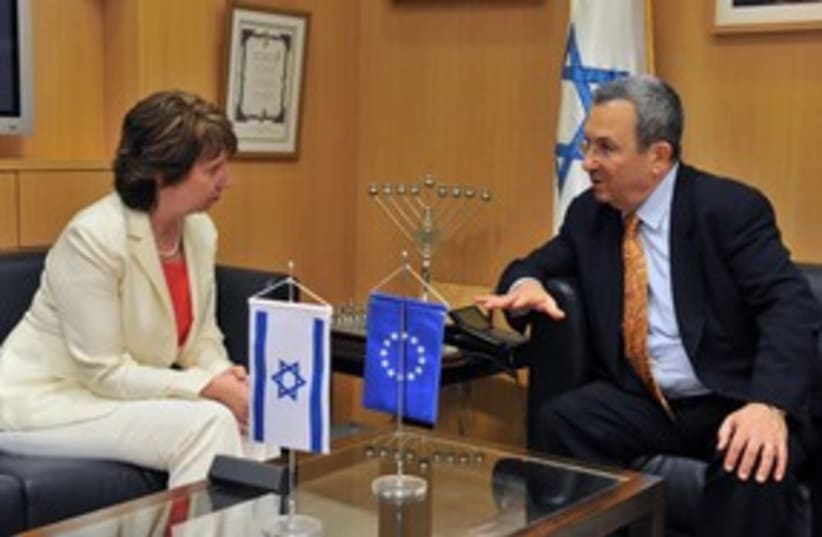
By HERB KEINONCatherine Ashton and Ehud Barak_311(photo credit: Ariel Harmony / Defense Ministry)
In an indication Israel believes the Palestinian Authority will indeed take its quest for statehood recognition to the UN in September, Defense Minister Ehud Barak spoke in a meeting with EU foreign policy chief Catherine Ashton Sunday about the need to influence the wording of the resolution likely to be brought to the world body.Up until now senior Israeli officials have not talked – at least publicly – about trying to affect the wording of the text the Palestinians are expected to bring, concentrating instead on trying to get various countries around the world to convince the PA not to go that route.RELATED:Ashton: E. J'lem construction threatens two-states 'EU may push Israel into peace talks'But on Sunday, after meeting Ashton – in Israel and the PA before convening an informal meeting of the EU’s 27 foreign ministers on September 2 where the issue will be discussed – Barak issued a statement saying that if renewing talks before the UN move was not possible, “it is very important that all the players come up with a text that will emphasize the quick return to negotiations, without an effort to impose pre-conditions on the sides.”Up until now most of the EU’s countries have refrained from committing on how they would vote on the resolution, saying that it depended on the text.Barak told Ashton that from Israel’s point of view, the PA’s turning to the Security Council or the General Assembly were both bad and unproductive choices. “The better path,” he said, “was to go to direct negotiations without preconditions.”Ashton heard a similar message from President Shimon Peres, who said there was a need to work “around the clock and take advantage of every opportunity to return to the negotiation table.”He said the UN bid was a “substantive error, since there is no alternative to direct negotiations between the sides.” She also met with Prime Minister Binyamin Netanyahu, but no statement was issued by either side after that meeting.Prior to meeting Ashton, Netanyahu met with Norway’s Foreign Minister Jonas Gahr Store, in the region before his country chairs a donors’ conference for the PA scheduled in September.According to the Prime Minister’s Office, Netanyahu expressed concern that the PA’s UN move could lead to violence and would hurt the “political process.” The Palestinians have a history of “climbing up trees and then kicking out the ladder,” he said, adding that going through with the move would be as if the PA were abrogating previous agreements.Netanyahu said Israel took risks and evacuated territory on the assumption that the conflict would be settled by negotiations, and that this was an abrogation of those understandings.If the UN indeed adopted a resolution that called for a Palestinian state based on the June 4, 1967, lines, Netanyahu asked, did that mean that the Western Wall was occupied territory? Foreign Minister Avigdor Lieberman was even more direct with Store, saying that if the PA went through with the move he would recommend immediately cutting off all ties with the PA.“It is impossible that in the morning the Palestinian Authority has security cooperation with us, and in the evening brings legal action against us at the International Court of Justice in The Hague,” Lieberman said.The security cabinet met last week to discuss how Israel would respond to the move, but no decisions – if in fact they were reached – were made public.Netanyahu, in his meeting with Store, also discussed the situation in the South, and said that the reason his government was able to show restraint last week in response to the terrorist attack near Eilat and the missile attacks from Gaza, was because “we don’t have to prove that we are tough.”Earlier in the day, at a meeting of Likud ministers, Netanyahu said that he could not say that the tension in the South was over. Rather, he said, the situation remained tense and could flare up again anytime.Regarding the peace treaty with Egypt, Netanyahu said that this has stood the test of time, and he doesn’t believe it should be changed. However, he did talk about the need to “beef up security arrangements on Israel’s side, and speed up construction of the fence along the southern border.”Netanyahu said Egypt has not asked to open up the treaty and allow for more Egyptian security forces inside Sinai, and that if such a request were forthcoming, a decision would be made only after a meeting of the security cabinet.This statement contradicted previous reports.Click for full Jpost coverage
Related TagsCatherine Ashton
if(catID != 151){
var cont = `Take Israel home with the new Jerusalem Post Store