Netanyahu, Peres, Rivlin, other officials read names of their family members, others who perished in the Holocaust.
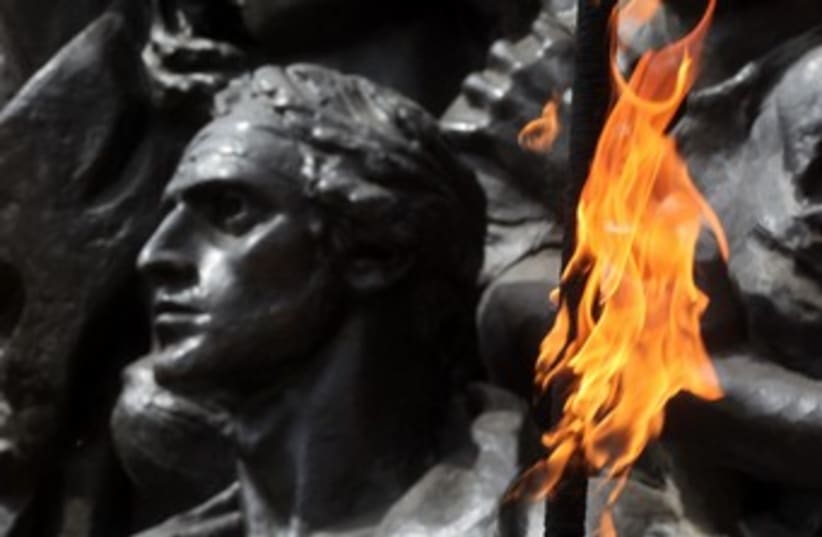
By LAHAV HARKOVHolocuast memorial flame 370(photo credit: Marc Israel Sellem)
Prime Minister Binyamin Netanyahu, President Shimon Peres, Knesset Speaker Reuven Rivlin, ministers, MKs and other government officials read names of those who died in the Holocaust during the Knesset’s memorial ceremony on Thursday.The ceremony is called “Every Man Has a Name,” after a poem by Zelda that was inspired by the Holocaust.Twelfth Knesset speaker Dov Shilanksy (1924-2010), a Holocaust survivor, initiated the ceremony in 1989.Peres told the story of his birthplace, Vishniev, which was then part of Poland but is now Belarus. His mother had five siblings, all of whom moved to Israel except for her brother Michael Meltzer, who stayed behind to take care of his parents. All three were killed, along with the rest of the town’s residents, when the Nazis locked them in a wooden synagogue and burned it down. Anyone who tried to escape the synagogue was shot.“No house, no school, no cemetery remained in Vishniev,” Peres said. “Nothing was left.”Rivlin stated that the namereading ceremony “becomes more important every year as the number of witnesses among us becomes smaller and smaller.”He read the names of the victims from the town of Shklov, Belarus, from which his mother’s family hails. He explained that the Jewish community in Shklov was established in the 16th century, and on the evening following Yom Kippur 1941, residents of the Shklov Ghetto were taken to concentration camps.The Knesset speaker pointed out that there were victims of the Nazis whose names would never be known, such as the infant son of Aharon and Ivgenya Kapsitzky and other young children from Shklov.Netanyahu said that this year’s ceremony was the first that his father-in-law, Shmuel Ben-Artzi, who passed away in November, did not attend.“He would listen closely, because he thought this was a way to give expression to the souls that were lost,” Netanyahu said. “He saw the loss as something both personal and national, in dimensions that cannot be described.”The prime minister read a poem Ben-Artzi wrote in memory of his hometown, Bilgoraj, in which he “expressed his pain over the Holocaust.”Opposition leader Shaul Mofaz read names of Jews killed in the Farhoud, a Naziinspired pogrom in Baghdad in 1941, adding that “the State of Israel must do everything to make sure the events of the Holocaust, the genocide, do not repeat themselves.”Supreme Court Justice Elyakim Rubinstein read names of his family members, as did Intelligence Minister Dan Meridor, Transportation Minister Yisrael Katz, Justice Minister Yaakov Neeman and Deputy Foreign Minister Danny Ayalon. Deputy Education Minister Menahem Eliezer Moses choked back tears as he read the names of 70 members of his father’s family who died in Auschwitz.Education Minister Gideon Sa’ar honored Janusz Korczak, the Polish-Jewish educator who directed an orphanage and stayed with the orphans when they were sent to the Treblinka extermination camp.Communications Minister Moshe Kahlon and Deputy Minister for the Advancement of Youth, Women and Students Gila Gamliel read names of those who perished in concentration camps in Libya, from where their families came.MKs from the Likud, Kadima, Labor, National Union and Shas read names. MKs Tzipi Hotovely (Likud) and Avraham Michaeli (Shas) told of family members from Georgia who had been forced to fight in the Red Army and never returned. MK Amir Peretz (Labor) honored Jews from Morocco who perished in Europe.MK Ronnie Bar-On (Kadima) concluded his name-reading with a quote from Deuteronomy: “Remember what Amalek did to you on your way out of Egypt... that he struck those of you who were hindmost, all the weaklings at the rear, when you were faint and exhausted, and he did not fear God.... God gives you rest from all your enemies around, in the Land that God gives you as an inheritance to possess it... you shall not forget.”At the beginning of the ceremony, the IDF rabbinical chorus sang Zelda’s poem “Every Man Has a Name,” after which survivors, the heads of the Knesset Caucus for Holocaust Survivors Zevulun Orlev (Habayit Hayehudi) and Ze’ev Bielski (Kadima), MK Ruhama Avraham-Balila (Kadima) and her son, an IDF officer, lit six candles.After that, Ashkenazi Chief Rabbi Yona Metzger, Sephardi Chief Rabbi Shlomo Amar and IDF Chief Cantor Shai Abramson read psalms and prayers.
if(catID != 151){
var cont = `Take Israel home with the new Jerusalem Post Store