Quartet again calls for resumption of direct talks
Quartet issues another call for direct Israeli-Palestinian talks “without delay or preconditions.”
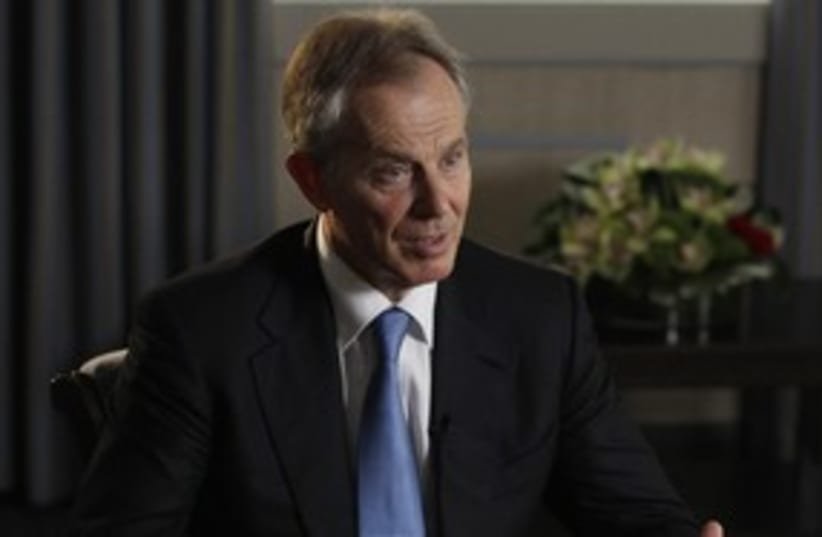
By HERB KEINONQuartet Mideast envoy Tony Blair 311 (R)(photo credit: REUTERS/Luke MacGregor)
The Quartet issued yet another call for direct Israeli-Palestinian talks “without delay or preconditions” following separate meetings its envoys had Wednesday in Jerusalem with Palestinian and Israeli officials.This is the third time the Quartet has held such meetings in Jerusalem, and put out a similar statement, since September 23, when it issued a framework for returning to talks and when Palestinian Authority President Mahmoud Abbas went to the UN to ask for recognition of a Palestinian state.RELATED:Clinton slams Gingrich comments on PalestiniansThat framework called for an initial meeting between the two sides within 30 days, leading to the trading of comprehensive proposals on security and territory within three months, and an overall agreement by the end of 2012.Even that first direct meeting never took place, because of a Palestinian refusal to enter talks until Israel froze all construction beyond the Green Line and agreed to negotiate on the basis of the pre-1967 lines. Instead, Quartet envoys and representative Tony Blair have come for separate talks with the sides about once a month.According to a statement the Quartet – made up of the US, EU, UN and Russia – issued after Wednesday’s meetings, the envoys stressed “the important objective of a direct exchange between the parties without delay or preconditions beginning with a preparatory meeting and leading to the presentation of proposals on territory and security.”
The wording of the statement seemed to support Israel’s interpretation that the comprehensive security and territorial proposals were to come about through direct negotiations between the sides, and not be presented separately to the Quartet by the parties.In a break from the past two meetings the Quartet envoys have held here, this time the envoys did not meet with Palestinian negotiator Saeb Erekat – who was in Brussels – but with a lowerlevel Palestinian official. On the Israeli side, they met, as usual, with Prime Minister Binyamin Netanyahu’s envoy Yitzhak Molcho.Earlier this week, the Palestinians rejected an Israeli call to use Wednesday’s Quartet visit as a time for Molcho and Erekat to begin direct talks.“If the Palestinian side continues to refuse to negotiate to solve problems to move the peace process forward, then this raises serious questions as to their seriousness and to their commitment to a negotiated peace,” said Netanyahu’s spokesman Mark Regev.Meanwhile, Dennis Ross, the recently retired White House Middle East adviser, said at a speech Tuesday at the Washington Institute for Near East Policy that the “psychological gap” separating the two sides remained wide, though on the substantive issues the parties were close.He said that Jerusalem should seek to validate the current PA leadership that believes in nonviolence and negotiations, and that the way to do this was to give signs that the “occupation” was diminishing. To this end, he suggested increasing the Palestinian police presence in Area B, which is under joint Arab-Israeli security control, and giving the Palestinians economic access to Area C, which is under total Israeli control.Ross, who downplayed the possibility of any dramatic breakthrough, did advise Israel against waiting to see how the events in the region played out before moving forward with the Palestinians.If Israel waited, he said, its options would shrink.
Related TagsQuartet
if(catID != 151){
var cont = `Take Israel home with the new Jerusalem Post Store