UN Mideast coordinator supports two-state solution while calling peace process “stuck"; says stalemate plays into Palestinian unilateralism.
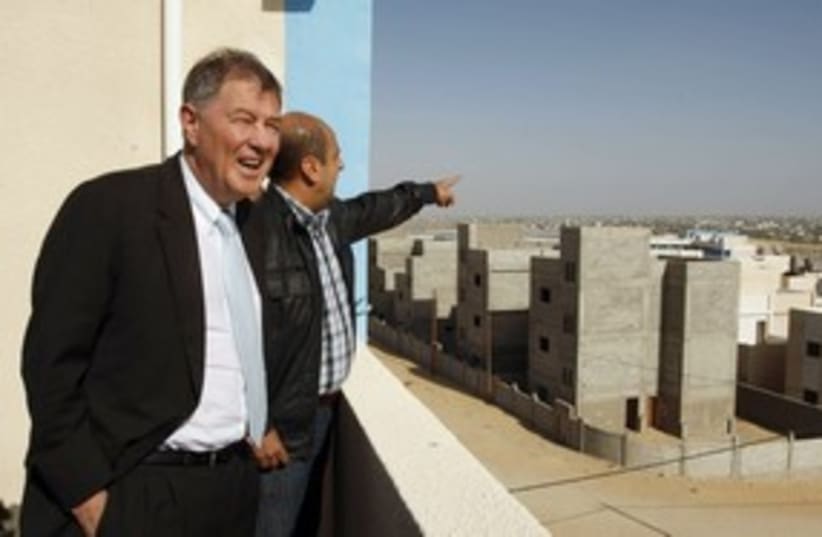
By JORDANA HORNUN spokesman Robert Serry (R) 311(photo credit: Ibraheem Abu Mustafa / Reuters)
NEW YORK – At meeting of the UN Security Council on Thursday, Special Coordinator for the Middle East peace process Robert Serry underscored his support for a negotiated two-state solution, even while calling the peace process “worryingly stuck.”Serry noted that during the recent reporting period, Palestinian factions had concluded a reconciliation agreement under Egyptian auspices, and that on Sunday there were “serious clashes” between Israeli security forces and Palestinians during “the largest popular demonstration of Palestinians in many years.”RELATED:PM slams Obama call for ‘Palestine’ based on ’67 linesA substantial shift toward the Palestinian position Danon: If Palestinians act unilaterally, so will we Both events, he said, “remind us that popular protests and political change continue to sweep the Arab world and shake the unsustainable status quo found in many parts of the Middle East.“The Arab-Israeli conflict will not be immune to these dramatic developments,” Serry said of the Arab Spring. “One way or another, change will come to it too. This change must be shaped to positive ends.”However, Serry noted, while “both sides profess their desire to negotiate a two-state solution deep differences over the stalemate in the peace process remain.”Failure of a negotiated solution, Serry said, would play into Palestinian unilateralism: “There is a genuine lack of trust, and no credible initiative has yet been taken that could overcome the impasse. In the absence of negotiations, and amidst continued Israeli settlement expansion, the Palestinians are preparing to approach the United Nations in September to seek recognition of a Palestinian state.”Serry noted that he was present in Cairo on May 4 for the conclusion of the Fatah-Hamas accord, and that at that ceremony, Palestinian Authority President Mahmoud Abbas reiterated his commitment to the platform of the PLO, which, Serry claimed, “has long accepted Security Council Resolutions 242 and 338, recognized Israel’s right to exist in peace and security, and renounced violence and terrorism – and which remains committed to existing agreements.”However, Serry noted, Hamas statements “such as those calling on the PLO to renounce its recognition of Israel, lauding Osama bin Laden, or stressing that the movement’s sole program is ‘resistance’ are a reminder of why deep international concerns remain, and why we must follow developments vigilantly.”While expressing awareness of Prime Minister Binyamin Netanyahu’s “serious concerns” about the accord, Serry said he would “counsel against reaching a predetermined view about the accord’s merits or prospects.Reunification of Gaza and the West Bank is a vital goal for all interested in peace, and the process should not be undermined in its infancy.”No rockets and three mortar shells were fired from Gaza into Israel during the reporting period, Serry said.Serry called for Israel to freeze settlement activity, and to instate further far-reaching steps to end the closure of Gaza. He noted that UN Secretary-General Ban Ki-moon “is also following with concern media reports of potential new flotillas to Gaza that can provoke unnecessary confrontations. The secretarygeneral calls on all governments concerned to use their influence to discourage such flotillas, which carry the potential for escalation.”In conclusion, Serry stated, “we are three months away from September.”“We hope that real security and economic improvements can be continued in the West Bank, and broadened to begin to include Gaza, and that elections can take place in a year,” he said.“We urge all parties to give this process a chance, while reminding the Palestinians of the importance of agreeing on a government that can live up to the expectations of the people and meet the concerns of the international community, and support negotiations with Israel.”Serry said that a meaningful political initiative “offers the only prospect of reaching September with the various dynamics in play working together toward one objective: a negotiated twostate solution.“In the absence of an initiative, it is too early to assess whether September will bring a new and more effective paradigm for resolving the conflict through negotiations, or renewed confrontation between the parties in the diplomatic arena or on the ground,” he said.“We will continue to seek enhanced and substantive Quartet engagement to shape the process between now and September, and beyond,” Serry said. “We must show purpose, rather than paralysis, as we approach a critical period in the search for peace in the Middle East.”Also on Thursday, Israel’s Deputy Permanent Representative to the UN Haim Waxman sent letters to the Security Council and to Ban regarding the MV Finch vessel’s attempt to challenge Israel’s naval blockade of the Gaza Strip.The letters regarded an incident on Monday in which a Malaysian ship tried to challenge Israel’s blockade of the Gaza Strip. This initiative was sponsored by the Perdana Global Peace Foundation, an organization that participated in the flotilla incident of May 2010.“These kinds of actions are particularly troubling in light of the present turmoil in the Middle East,” Waxman wrote.“Extremists continue to seek out provocations in our region by land and by sea, posing a threat to peace and stability.“The international community should send an unambiguous message to the organizers of these provocations that such initiatives only serve to raise tensions in our region, stressing that the appropriate means for transferring humanitarian goods to the Gaza Strip is through established channels,” Waxman stated in the letter. “In addition, we expect all countries to effectively caution their citizens about the risks associated with participating in such harmful provocations.”
if(catID != 151){
var cont = `Take Israel home with the new Jerusalem Post Store