PA president responds to graffiti, arson attack on Jab'a village mosque; PM: Irresponsible lawbreakers will be brought to justice.
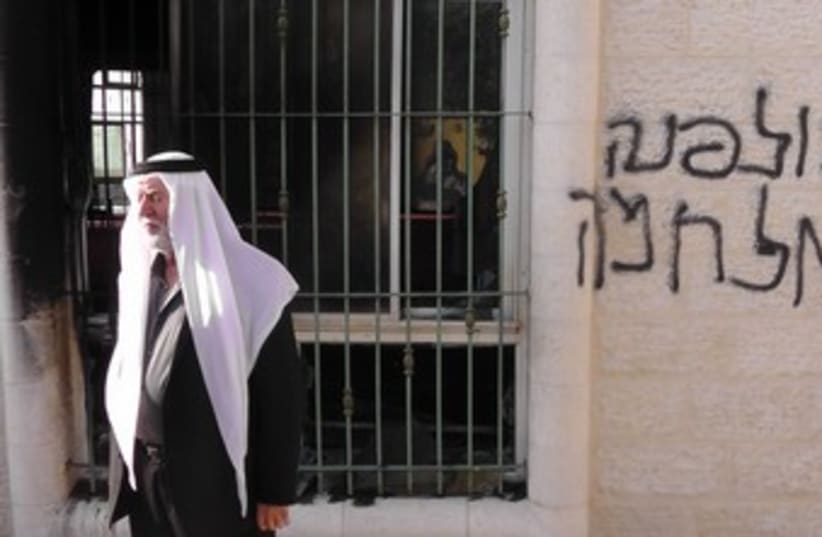
By KHALED ABU TOAMEH, YAAKOV LAPPIN, Y. KATZPrice Tag attack on Jab'a village mosque 370(photo credit: Iad Hadad/BTzelem)
The United States, Israel’s top leaders and the Palestinian Authority harshly condemned a pre-dawn “price-tag” attack Tuesday by Jewish right-wing extremists against a West Bank Palestinian mosque.“Hateful, dangerous and provocative actions such as these are never justified,” State Department spokeswoman Victoria Nuland told reporters in Washington later that afternoon.“This was the work of intolerant, irresponsible lawbreakers,” said Prime Minister Binyamin Netanyahu. “We will act quickly in order to bring them to justice.”He spoke hours after vandals entered the Palestinian village of Jaba, near Ramallah, to set fire to a mosque. They also spray painted the words “Ulpana war” in black Hebrew letters on the mosque’s wall, referring to the West Bank outpost which is slated for demolition on July 1. Police said it was the work of far-right activists.“We suspect this is a price-tag incident,” a police spokesman said, referring to a term coined by far-right elements to describe hate crimes launched in response to state demolitions of outposts.The mosque was lightly damaged in the attack.The mayor of Jaba, Abdel Karim Sharaf, said he had no doubt that extremist settlers were behind the attack.Villagers noticed that the mosque was on fire around 2 a.m., he said. Hundreds of residents rushed to save the mosque and extinguish the fire, he added. He said that IDF soldiers also rushed to the village upon being notified of the assault.The mayor warned that such attacks could trigger violence in the area.Ahmed Nasser, a resident of Jaba, said he woke up to the screams of villagers who saw the mosque on fire.“No one saw the perpetrators,” he said. “But we have no doubt that the attack was carried out by Jewish settlers. Some people found matches with Hebrew writing inside the mosque.”Another resident, Hussein Abdel Latif, said that the graffiti in Hebrew that was sprayed on the walls of the mosque proves that settlers were behind the attack. The settlers, he charged, “feel free to carry out such attacks because they enjoy the support of the Israeli government and army.”Police commissioner Ch.-Insp. Yohanan Danino said recent nationalistic crimes were severe and had to be stopped.“Attacking religious symbols and holy sites is a grave and explosive phenomenon which has consequences for the wider public,” he said. Police have repeatedly expressed their fears that a hate crime could touch off a wave of unrest in the West Bank.Judea and Samaria police attended the scene and gathered forensic evidence.Danino passed down orders to police to do all that was possible to arrest the perpetrators, and to invest high levels of resources “to bring the criminals to justice and place them behind bars.”So far, just two people have been charged for far-right hate crimes. Last year, police set up a national taskforce operating under the Lahav 433 unit to oversee efforts to arrest suspects.The unit’s main goal was to ensure that arrests were made and that charges and prosecutions would follow.Sources in the IDF Central Command voiced concern that additional attacks would take place and that the overall situation would escalate ahead of the planned demolition of the Ulpana outpost.The sources said the IDF was prepared for such an increase and was bolstering its forces in areas it predicted settlers and Palestinians would clash in the coming weeks. One particular hotspot has been near the settlement of Yitzhar, which has seen several clashes between the groups in recent weeks.The police recently confiscated a number of weapons from members of the settlement’s rapid response security teams.In spite of these efforts, PA spokesman Nabil Abu Rudaineh held the Israeli government fully responsible for “such crimes,” arguing that it was not serious in maintaining security. Abu Rudaineh said that this was the sixth attack of its kind against Islamic religious sites in the West Bank since the beginning of the year.Israeli “condemnations were not enough,” the spokesman said. “The Israeli prime minister must stop these assaults on worshipping places and residents and hold the perpetrators accountable.”The PA Minister for Wakf [Islamic trust] Affairs Mahmoud Habbash also blamed the Israeli government for the mosque attack because of its support for the settlers.He said that PA President Mahmoud Abbas has instructed his ministry to immediately renovate the mosque so that it would be ready to receive worshipers this coming Friday.“Israel’s continued assaults against our mosques is an aggression on Islam and all Muslims,” Habbash said during a visit to the mosque.Sheikh Ekerma Sabri, chairman of the Supreme Islamic Council in Jerusalem, denounced the mosque attack as an act of cowardice and terror.He added that the incident was in the context of a “comprehensive war that is being waged against our holy sites and homes and every inch of our land.”Defense Minister Ehud Barak, however, was among a number of top Israeli leaders who spoke out strongly against the attack, calling it a “criminal act” and promising a swift response by the IDF.“This is a grave and criminal act meant to destroy the social fabric in the region and distract the IDF from its missions, which include protecting Israeli citizens in the region,” Barak said. “I have instructed the IDF and security forces to act with all available means in order to capture the perpetrators and to bring them to justice.”Deputy Foreign Minister Danny Ayalon called the graffiti an act of “terror,” adding that such activities harm not only Israel but also the settlement enterprise.“Just yesterday I said at a hasbara [public diplomacy] conference that price-tag attacks are illegal, immoral and gravely undermine the image of Israel and the settlement enterprise under the gaze of the international community,” Ayalon wrote on his Facebook page.“And here, this morning, we hear about another price-tag attack. We must not allow such acts of terrorism to continue.”Judea and Samaria Council head Danny Dayan also condemned the attack, calling it immoral and saying that it damages the settlement enterprise.Right-wing activist Baruch Marzel of Hebron, however, said the attack was the result of deep frustration by teenagers against the government’s racist policy toward settlers. He warned that price-tag incidents would increase in proportion to this level of frustration.Tovah Lazaroff and Hilary Leila Krieger contributed to this report.
if(catID != 151){
var cont = `Take Israel home with the new Jerusalem Post Store