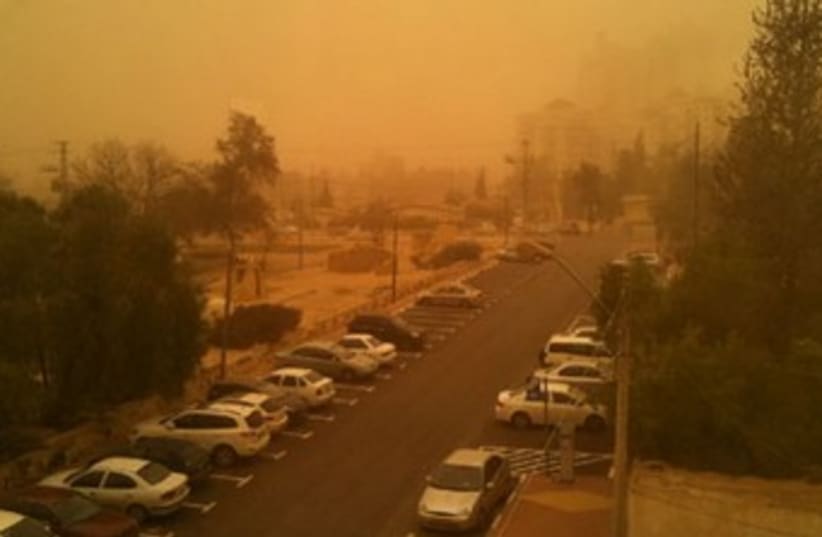
Ben-Gurion University researches conduct a study on the effect of dust storms which come from natural soil sources.
By SHARON UDASINDust in Beersheba 370(photo credit: Alina Vodonos)
A dark yellow-orange haze made the Ben-Gurion University campus barely visible in a February 2012 photograph that dominated a Power Point presentation screen in Jaffa on Monday.The photograph captured one of the dust storms that often overwhelm the Beersheba region and cause widespread air pollution, Dr. Itzhak Katra explained to participants in an Environmental Health Fund conference that morning.Researchers at Ben-Gurion University from a variety of departments are collaboratively conducting a two-phase study on the effects of the dust storms, which come from natural soil sources and are associated with the passage of a cold front system, explained Katra, of the geography and environmental development department.“I call it the orange day,” Alina Vodonos, a PhD student involved in the project, told The Jerusalem Post, referring to that specific February 29 day.The first phase of the study, which is already complete, takes a retrospective look at the outdoor dust exacerbations that occurred in the last decade. A second phase, which is unfolding right now, examines outdoor and indoor dust particulate matter in the homes of chronic obstructive pulmonary disease (COPD) patients, Katra explained.In the retrospective study, the researchers catalogued patients at Soroka University Medical Center during the years 2001 to 2010 with a primary diagnosis of COPD, said Dr. Victor Novack, head of the Soroka Clinical Research Center. Amid the dust storms, the team detected that the presence of the particulate matter tended to be two standard deviations above the standard level, he added.During the entire decade, a total of 7,582 admissions for 147 patients with COPD exacerbation occurred, and the patients had an average age of 68.9. The majority of the patients were male, at 63.6 percent, 22.6% had diabetes and 5.4% had heart failure. The average length of hospitalization lasted around three days, while hospital mortality rate was about 1.8%, according to Novack.At the study’s conclusion, the researchers found that many more patients were admitted during the winter months – when the dust storms occur – than during the summer months. In addition, with increased age came increased admission for COPD patients, Novack said.During the prospective phase, which has just begun in recent months, the researchers have recruited a total of 86 patients – 70 men and 16 women – at an average of 70 years old and with extremely low lung function. The team is examining what exactly occurs among these patients after a dust storm occurs, and has thus far measured particulate matter levels and patient reaction in 19 households, according to Novack.While the researchers have not yet figured out how to advise their patients in handling the dust storms, the Beersheba community provides them “a frontier environmental lab for climate change,” Novack said.These storms constitute about 10% of the year, and particulate matter levels become extremely high on these days, both inside homes and outside.“For now, I don’t have a very good recommendation for my patients,” Novack said. “I can’t say don’t breathe during these days.”
if(catID != 151){
var cont = `Take Israel home with the new Jerusalem Post Store