Elderly triple stars and planets outside our solar system may have chaotic end involving collisions and binary systems.
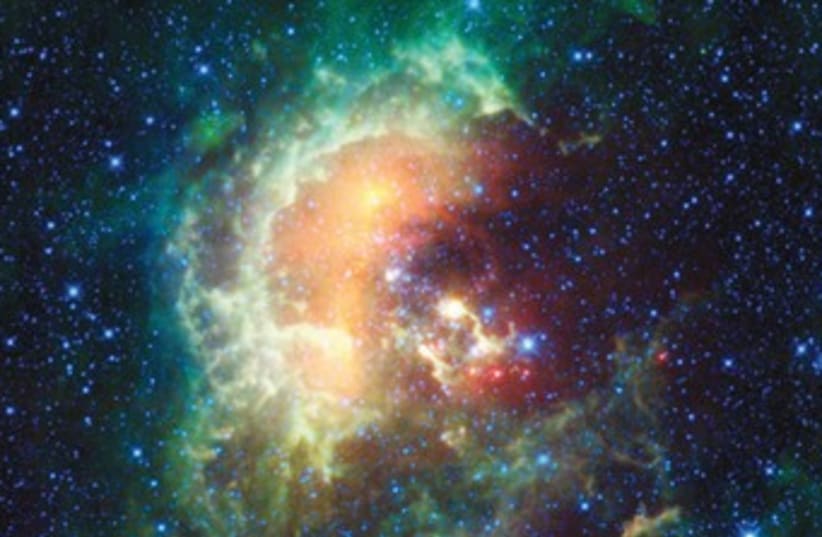
By JUDY SIEGEL-ITZKOVICHStar galaxy nebula colourful 370(photo credit: UCLA/JPL-Caltech/NASA/Reuters)
They leave home, switch partners and take part in violent clashes — but they are stars and planets, not humans. The wild life of elderly triple stars and exoplanets involve physical collisions, star-hopping planets and exotic binary systems.Researchers at the Technion-Israel Institute of Technology in Haifa and the University of Colorado in Boulder used theoretical analysis and simulations to show that the evolution of planets and stars in triple stellar systems can lead to chaotic outcomes.In fact, the famous star that is the brightest in our sky – Sirius – may have had such a wild history. The findings also suggest that stellar collisions may be as much as 30 times more frequent than thought before.Most stars either live alone, with no stellar companion, or share their life with a single companion star. However, about 15 percents of all stars have at least two additional stellar companions, making them part of a triple system. A planet can also be hosted by a binary stellar system, making it a component in a triple system.The evolution of stars as they age involve major changes; a star can expand to become hundred times larger than its original size, and then shed most of its mass through strong winds, to ends its stellar life, leaving a remnant “white dwarf” — or end its life in an explosion, leaving a remnant neutron star or a black hole.The evolution of single stars have been extensively studied over the past century, and the evolution of binary stars, in which one star may exchange material with its companion, have been explored for decades.Prof. Hagai Perets of the Technion and Dr. Kaitlin Kratter of the University of Colorado published their work recently in two studies in The Astrophysical Journal.The evolution of single stars have been studied extensively over the last century, and the evolution of binary stars – in which one star may exchange material with its companion – have been explored for decades. However, by comparison, the evolution of triple stars have by and large been neglected.The Israeli-American team said that triple systems and their evolution deserve much more attention. Single and binary systems are generally stable systems, said Perets. Triple systems, however, are much more fragile, and in some triple systems, even a small change in the system can drive it into an unstable configuration, leading to a wild, chaotic dynamical evolution.The researchers found that the mass lost from one of the triple components as it ages may lead to a significant change in the orbits of the triple components around each other. Many such systems then become unstable, and the three stars may go through a wild dance, in which the stars can switch partners. Eventually, one of the stars is ejected from the system.However, since the mass-losing star is at this stage also typically puffed up to become 100 times larger than its original size, it then becomes a large target, and the chances for another star to collide with it during the chaotic evolution become quite high.Typically, Perets added, stars collide only in a dense environments in stellar clusters, where two unrelated stars hit each other by chance, but the probability for such collisions is small, and outside clusters such collisions practically never happen. “We found that when one considers triple systems, the picture is completely different. Collisions between stars outside these dense cluster environments can be as much as 30 times more frequent, compared with the random collisions in cluster,” he noted.The researchers found that triple evolution might even be relevant for Sirius; which is accompanied by a white dwarf in a binary system, but it has an elliptical orbit. Such a configuration is peculiar for a binary with a white dwarf component (on a relatively close orbit); such binaries are expected to have a much more circular orbit following the transfer of material from a mass-losing star to its companion.The recent study showed that such a peculiar configuration could arise naturally if the Sirius binary had once been a triple system, which evolved, become unstable, and ejected one of the triple components, leaving behind a binary with a peculiar orbit. “Finding out that the triple evolution scenario we studied could provide an explanation for the Sirius puzzle, and that Sirius have had a wild history was a fascinating thought,” said Perets.In the second study, the researchers looked into systems in which the triple component is not a star, but a planet.“When the evolving star has a close planetary companion and a a stellar companion further away, the results can be quite surprising” the Colorado scientist said. “A planet can hop from its original orbit around its host star, to orbit the companion star. Such a star-hopper can jump between its original host and the companion many times, to finally settle down into a new stable orbit around the companion.It could then spend the rest of its life in its new environment, or at least until the companion star also starts losing its mass. Basically, when the neighborhood becomes bad, the planet jumps around to a better location.”However, the story sometimes have a worse ending for the planet, as it may also collide with the companion star or with its original host star during the chaotic evolution, and be destroyed rather than be captured into a new stable orbit.
if(catID != 151){
var cont = `Take Israel home with the new Jerusalem Post Store