Arab World: Turkish difficulty, Kurdish opportunity
The PKK is upping attacks in Turkey's south. Is this evidence of a bargain between the movement, Syria and Iran?
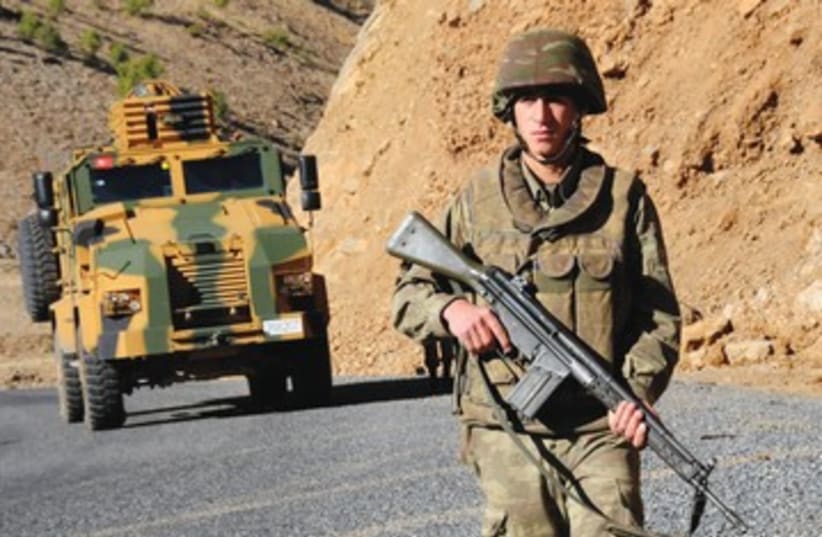
By JONATHAN SPYERTurkish soldier near Iraq border 390(photo credit: REUTERS)
Aserious escalation is currently under way in the ongoing conflict between the Kurdistan Workers Party (PKK) and the Turkish state.The renewed clashes come amid claims by Turkish officials that the PKK is increasing pressure on Ankara as part of a renewed alliance between the Kurdish organization and the Assad regime in Syria.In the latest round of fighting, the PKK last week attacked four Turkish state and security installations in the Sirnak Province of southeastern Turkey. Ten members of the Turkish security forces were killed.The Turks struck back, launching a major ground and air operation against PKK positions beginning at the end of last week.Around 2,000 Turkish troops took part in the operation.While the ground attack was limited to Turkish territory, Turkish aircraft also bombed targets in the Qandil Mountains in northern Iraq. The PKK maintains its main headquarters in this mountainous area adjoining the borders with Turkey and Iran.The Turkish general staff this week released figures claiming that its forces have killed 373 PKK militants over the past five months. The Turkish statement also acknowledged that 88 members of Turkish security forces were killed.The PKK, meanwhile, dismissed these figures. The Firat news agency, which is close to the organization, issued a rival statement saying that 1,035 Turkish soldiers and 101 PKK fighters have been killed over the past five months.The PKK has also issued a number of direct statements in recent weeks alleging that the Turkish authorities are using the bodies of slain PKK fighters for organ harvesting.Whatever the precise truth regarding casualty figures, the last period has been the bloodiest seen in this conflict since PKK founder and leader Abdullah Ocalan was captured in 1999.Amidst the ongoing violence and the flurry of claims and counter claims between the Turks and the PKK, a fascinating question remains: why is the PKK choosing to escalate hostilities at the present time? For the Turkish authorities, the reason is very clear: Ankara claims that the Assad regime has in recent months re-kindled its long defunct alliance with the organization. Ankara also alleges the existence of a renewed agreement between the PKK and Iran, and claims that the Iranians are actively aiding the Kurds in the latest round of attacks.Prior to the outbreak of revolt and civil war in Syria, relations between Ankara and Damascus and Teheran had been steadily improving. But Turkey has taken a harsh stance against the Syrian dictator, domiciling the political and military opposition against him and calling for his ouster.In response, according to Huseyin Celik, deputy leader of the ruling Turkish AKP party, “Assad is pursuing the idea that ‘my enemy’s enemy is my ally… he’s taking the PKK under his wing and using it against Turkey.’” The Turks point to the peaceful ceding by the Assad regime of a number of towns in the Kurdish northeast of Syria as further proof of rapprochement between the PKK and the Syrian regime.Control of the towns has passed to the Democratic Union Party (PYD), which is the pro-PKK franchise among the Syrian Kurds. Turkish officials have alleged that the Syrian authorities left heavy weapons in the area, which are now under the control of the PYD.Kurdish sources close to the PKK dismiss claims of a renewed strategic alliance between the organization and the Assad regime. They point to recent instances of violence between PYD militants and the Syrian armed forces.Three Syrian soldiers were killed this week in the Sheikh Masoud area of Aleppo by PYD militants. This attack was carried out, according to Kurdish media sources, following the killing of 21 Syrian Kurds by Syrian forces in the city.PYD leaders have made clear, however, that they are opposed to any Turkish military intervention into Syria. PKK leader Murat Karayilan stated clearly that any attempt by Turkish forces to enter areas of Kurdish population in northern Syria would be resisted. This is presented by sources close to the PKK as deriving from the determination of the movement to protect Kurds in Syria from Turkish assault, rather than as an element of a grand bargain between the movement and the Assad regime.Similarly, the Kurds note that the Assad regime has been arming Arab tribes opposed to Kurdish autonomy in northeast Syria.Kurdish sources, in relating to the renewed fighting in southeast Turkey, prefer to focus on Turkey’s longstanding failure to address the grievances and demands of the Kurds. They note the failure to rescind discriminatory laws, inadequate political representation and refusal to allow Kurds to educate their children in the Kurdish language as factors ensuring the continuation of conflict.Kurdish denial notwithstanding, it appears that a certain amount of coordination between the PYD and the Assad regime did take place as the regime prepared to pull out of designated areas of northeast Syria. This, however, may well have been due to a narrow and transient confluence of interests rather than a strategic grand bargain.Assad is short of men and is therefore reluctant to expend scarce manpower on securing remote parts of Syria’s north. The PYD, meanwhile, is glad to take control of a de facto autonomous Kurdish area at almost no cost. Of course, Assad and his father followed for 40 years a policy of brutal repression against Syria’s Kurds.This legacy and account has not been forgotten. A resurgent Assad would have no hesitation in reverting back to type.Turkey’s difficulty is the Kurds’ opportunity. Ankara is currently deeply embroiled in the Syrian crisis.Turkey is facing the possibility of a long civil war just across its south-western border. There is a refugee problem. Turkey is committed to the victory of the rebels against Assad, but this victory does not currently appear imminent.Even without a formal alliance between Turkey’s enemies, it is easy to say why the PKK would find the present time an opportune moment for renewing pressure on the Turks. As for the possibility of a “grand bargain” between Iran, Syria and the PKK – it should not be ruled out, but it would be wise to wait for further clear evidence to emerge beyond statements by the Turkish authorities before drawing any definite conclusions in this regard.
if(catID != 151){
var cont = `Take Israel home with the new Jerusalem Post Store