Security and Defense: Something rotten in the IDF?
With a possible radical regime change on Israel’s doorstep, the military echelon should be focused on targeting enemy states - not each other.
By YAAKOV KATZRegime Change 311(photo credit: Associated Press)
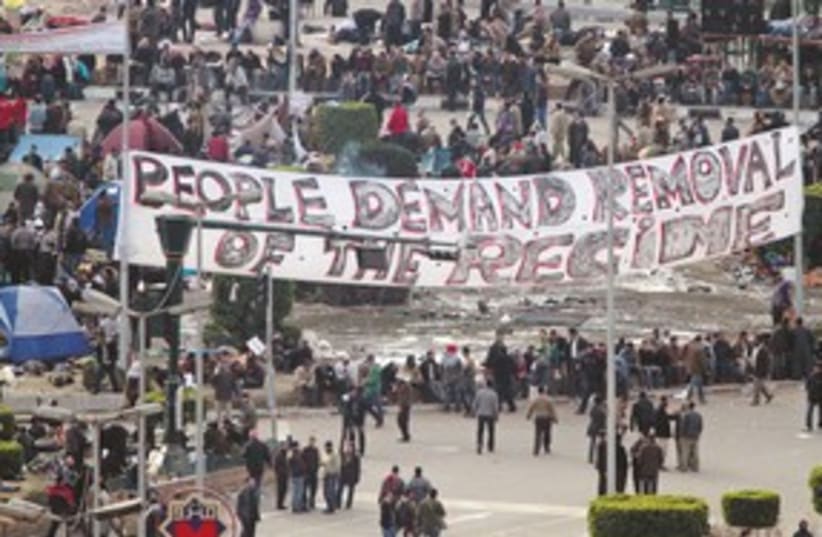
Maj.-Gen. Yoav Galant was not the only person to lose his job on Wednesday. As he was pulling into the driveway of his notorious home (it has also been called a mansion and fortress in recent days) in Moshav Amikam, Egyptian President Hosni Mubarak appeared on television to announce that he would not run for reelection in September.Despite the coincidental timing of Prime Minister Binyamin Netanyahu’s decision to cancel Galant’s appointment as the next chief of General Staff and Mubarak’s announcement, the two are worlds apart.Galant lost his job over the way he planted olive trees in the orchard next to his house and in an alleged false affidavit he submitted to the authorities about it afterward.Mubarak lost his job of 30 years over runaway inflation, high unemployment, ignoring the voice of his people in the last elections and not allowing even a single member of the Muslim Brotherhood into parliament.But the two are also connected.The current upheaval in Egypt, which includes a possible radical regime change, has the potential to significantly alter Israel’s strategic standing in the Middle East. Galant, as a former OC Southern Command, is intimately familiar with the Egyptian military and the IDF’s contingency plans, many of which he wrote or approved.OVER THE years Israel has watched the military growth in Egypt with a great deal of suspicion. While peace between the countries is believed to be a priceless asset, it has kept an eye on Egypt’s military buildup, based mostly on American- made platforms and made possible by about $1.5 billion a year in US foreign aid.The difference between the foreign aid that Israel gets, now almost double Egypt’s, is that the money has been consistently used to fight wars – against Palestinian terrorism in the early 2000s, the Second Lebanon War in 2006 and Operation Cast Lead in the Gaza Strip in 2009 – while Egypt has continued to stockpile weaponry without ever really needing to use any of it.The Egyptian military consists of about 500,000 soldiers in more than a dozen mobilized divisions. It has more than 500 aircraft, including close to 250 F-16s, and 3,000 tanks including more than 900 M1A1 Abrams. It has another 1,000 tanks in dry storage. It has 3,000 or so artillery batteries and the same number of anti-aircraft stations plus a significant number of Scud-B ballistic missiles.The question has always been: Who is threatening Egypt that it needs such a powerful military? A simple glance at the map shows that none of its neighbors, such as Sudan and Libya, come close to its military capabilities, except of course for Israel, which serves as the imaginary enemy in many of its land exercises.In 1996, for example, exercises included a scenario of war against “a little country northeast of Egypt.” It’s safe to assume the commanders were not referring to Jordan. At the same time, the assessment in Israel has always been that Egyptian commanders are in favor of peace, which has provided them with stability and US military platforms.From a straight military perspective, Israel has gained from peace. Firstly, it has been able to focus on what it perceived were its more urgent fronts – Iran, the north with Lebanon and Syria and against the Palestinians. The fact that the Sinai is demilitarized provides a major buffer zone in the event of a new conflict, giving the IDF time to prepare.If a radical regime takes over in Egypt, the IDF will have to be restructured – adding new divisions, new fighter squadrons and new navy vessels – to be able to create a conventional deterrence against the Egyptian military and not to have to rely solely on the deterrence that it gains from its alleged nuclear capability.THERE ARE also more tactical, short-term concerns such as the possibility that a regime change could lead to a massive increase in the amount and quality of weaponry smuggled from the Sinai into the Gaza Strip. It is also possible that terrorists will increase their use of the Sinai as a launch pad for attacks. In recent years, around 20 bomb belts have been captured by troops as terrorists tried to smuggle them in from Egypt.There is also the question of what Israel will do if the new regime instructs the military to begin holding large exercises in the Sinai, a clear violation of the peace treaty but not necessarily enough to go to war over.Strategically speaking, Mubarak’s downfall and the possibility of an Islamic takeover of Egypt need to be viewed in the larger regional context. Similar challenges await Saudi Arabia – another country with an American military – and Jordan, as well as Iraq and Afghanistan following the expected US withdrawals. Lebanon is already in Hizbullah hands. Ultimately, the main victor will be Iran which is replacing the US as the real power broker in the region.It is within this context that Prime Minister Binyamin Netanyahu will have to decide what to do about Iran’s nuclear program. An Islamic-controlled Egypt could provide support – even if just moral support – for Iran. This could eventually translate into military backing in the event that Iran’s nuclear installations are attacked.WITH ALL of this going on it is difficult to understand the considerations behind Defense Minister Ehud Barak’s decision not to extend Lt.-Gen. Gabi Ashkenazi’s term as chief of General Staff for the amount of time it takes to find a suitable successor in place of Yoav Galant. What is even more disturbing is how Barak went on television Wednesday night – on all three news channels – and accused Ashkenazi of normative, ethical and professional flaws. That same day, fighters took off to bomb targets in the Gaza Strip. What were those pilots and soldiers risking their lives supposed to think about when they saw the fighting at the top? It is no longer a secret that something rotten is happening within the defense establishment. In his accusations against Ashkenazi, Barak was likely referring to the upcoming state comptroller’s report on the Harpaz affair, named for Boaz Harpaz, the former intelligence officer who allegedly forged a document meant to torpedo Galant’s appointment. The report could be extremely damaging for Ashkenazi, whose involvement has yet to be completely clarified.For all these reasons, what the IDF needs now is a new chief of General Staff, someone who can grab the reins and guide the IDF back on track.
Related Tagsyoav galant
if(catID != 151){
var cont = `Take Israel home with the new Jerusalem Post Store