1. Netanyahu. Does the prime minister regret the decision he made to stop the vote on advancing elections to September 4 and expand the government with Mofaz? No one close to Netanyahu will answer that question, but they all will say he took a tremendous risk.If Netanyahu fails to broker a compromise between Mofaz and the haredim over equalizing the burden of IDF service, Kadima will leave the government and the coalition will shrink back to 66 MKs from 94. Netanyahu is smart enough not to immediately initiate an election in which he would be painted as the defender of the haredim against the rest of the country.But even if Netanyahu manages to complete his term, which officially ends in October 2013, despite Israelis’ notoriously short memories, they will not forget that when push came to shove he sided with those he referred to as the Likud’s natural partners – the Right and the haredim. That could make centrist Israelis reconsider voting for Likud and allowing Netanyahu to form the next coalition.And even if Netanyahu does reach a deal, the many columns over the past week that painted him as the haredim’s chief advocate have already done irrevocable damage to his reputation.Netanyahu has a weapon that he has exploited to his advantage and that will help him in the negotiations: The cast that has been on his leg since he tore ligaments in a June 11 soccer game. The cast gave him an excuse to cancel appearances at many events.He has not shown up at the Knesset, where reporters can see who enters and leaves his office. All his meetings are at the Prime Minister’s Office, where cars with tinted windows can come and go without tipping anyone off as to what is going on behind the scenes.2. Mofaz. If there ever was a lose-lose situation for a politician, this is it. If Mofaz reaches a deal with Netanyahu, chances are that at least the minimum seven MKs needed to split a faction will leave Kadima and join the new centrist party being formed by former minister Haim Ramon with the help of former Kadima leader Tzipi Livni.If no deal is reached, Kadima will leave the coalition and go back to irrelevancy in the opposition for as long as 15 months, having failed to use its influence in the government to make the changes that Mofaz promised. Anyone who hoped Kadima would change the electoral system, ensure the passage of a less cruel state budget, or advance peace will be disappointed and will look for a new party on Election Day.And the party will probably still split.The best case scenario for Mofaz remains that the current government lasts as long as possible with him in it. That way, at least he could have influence when key decisions are made on big issues like Iran.Meanwhile, Mofaz’s reputation will continue to be sullied. Though it is hard to think it can get any worse than this quote from a source close to Netanyahu printed in Thursday’s Yediot Aharonot: “He is like [former foreign minister] David Levy,” the source said.“Busy acting offended but incapable of quitting.”3. The haredim. There are those who say that the ultra-Orthodox are the big winners in the crisis, because Netanyahu appeared to defend them or because of a patronizing argument that serving in the army will help them in the long run financially and integrate them into Israeli society.But the truth is that the haredim overwhelmingly preferred the status quo. And it will change.The Keshev committee’s recommendations of hefty fines for haredi draft-evaders will not pass in the Knesset, but taking away state benefits from the evaders and their learning institutions will. There will be real enforcement to make sure the yeshiva students who are supposed to be learning Torah are really at their yeshivas. Keshev even recommends fingerprinting them.Whether or not a deal is reached between Likud and Kadima, an alternative to the Tal Law on haredi service must pass in the Knesset by August 1, due to a ruling by the Supreme Court. Whatever ends up passing, even if the haredi parties end up supporting it, will be much worse a scenario for the haredim than they have had for the past decade.WINNERS
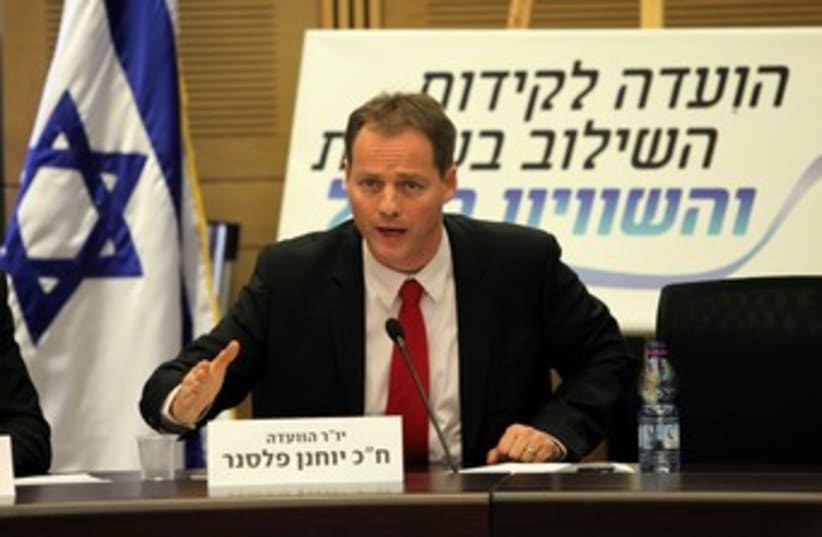
1. Yohanan Plesner. On one hand, he started off as the head of a committee with nine people and he finished the Keshev report on his own after Netanyahu disbanded the committee. When National Union MK Michael Ben-Ari heckled Plesner during his press conference announcing the report, Marina Solodkin was the only MK there with Plesner to heckle back.But on the other hand, Plesner’s persistence will earn him points with his voters.His argument that many soldiers do not finish the masa alonkot – the traditional long march in basic training carrying stretchers – resonates with many Israelis. And you can agree or disagree with the report Plesner put out, but it cannot be denied that it is comprehensive, serious work.Yohanan Plesner is now a household name in Israel for the first time. His face is now recognizable for ordinary Israelis, which other backbench Kadima MKs certainly cannot say about themselves.When Plesner put out a report on the same subject a year ago as an opposition MK on the Knesset Foreign Affairs and Defense Committee, it was barely even covered by the media. Now his recommendations are front-page news.Even if Kadima does not recover from its current slump in the polls, thanks to his hard work, Harvard-educated Plesner has likely earned himself a seat in the next Knesset.2. Avigdor Liberman. It is too easy to forget why Israel was going to go to elections on September 4 before the national-unity government was formed. Yisrael Beytenu had submitted a bill requiring all 18-yearold Israelis to serve in the IDF and had threatened to remove its 15 MKs from the 66-MK coalition if Netanyahu did not support it.All the fervor surrounding drafting yeshiva students that will culminate with a mass Tel Aviv rally Saturday night was started by Liberman – and presumably some good advice he received to focus on the matter by his American strategist, Arthur Finkelstein.Liberman also knew when to leave the Keshev Committee last week, which led to its unraveling. As often happens, other parties followed in Yisrael Beytenu’s footsteps.The reason why Liberman ordered his representative on the committee, MK David Rotem, to leave was that it set targets he saw as too low for drafting Arabs into national service. Requiring Arabs to serve is a hotbutton issue for potential Yisrael Beytenu voters.Even though Liberman is likely to order his MKs to oppose whatever proposal comes to a vote in the Knesset later this month – because in his eyes it will not go far enough – he will be credited with passing it.3. Yair Lapid. The other main beneficiary of the credit for the uproar over drafting yeshiva students did not write a report, propose a bill or organize a rally. He actually didn’t do anything at all.But the chairman of the new Yesh Atid party’s name is Lapid, and he is the son of the late leader of the secularist Shinui party, Yosef (Tommy) Lapid. And that is enough.Voters who put matters of religion and state at the top of their agenda on Election Day will see Lapid as the candidate most connected to such issues, even though he is actually much more moderate than his father.Lapid started giving interviews over the past two weeks, increasing his visibility just at the right time. He was criticized for stepping in many puddles as he started his political career, but now it looks like his star is on the rise.