With its cliques, gossip and cafeterias, the Knesset could easily be compared to high school.
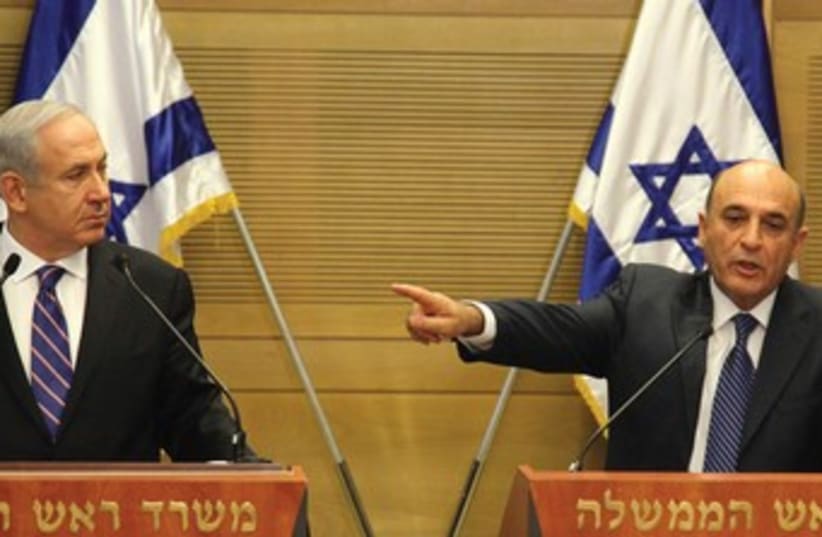
By LAHAV HARKOVNetanyahu and Mofaz 370(photo credit: Marc Israel Sellem)
In the almost four years since freshman MKs entered the 18th Knesset, there have been plenty of highs and lows, triumphs and embarrassing moments. Like any good high school, the Knesset had its cliques – Prime Minister Binyamin Netanyahu and Defense Minister Ehud Barak’s close partnership comes to mind – and gossip in the cafeteria, where political deals are often made.As the graduating Knesset class of 2012 heads to an election, it’s time to look back at the moments that thrilled and embarrassed its 120 members. So, as in any self-respecting high school yearbook, here’s a list of superlatives:Hardest Working: MK Yariv Levin (Likud) Levin is just one of a slate of freshman Likud MKs to the right of Netanyahu in the 18th Knesset.Though he lacked Tzipi Hotovely or Danny Danon’s media savvy and press coverage, Levin worked quietly and without much fanfare as Knesset House Committee chairman on revolutionizing parliamentary procedure.Earlier this year, Levin finished rewriting the confusing, antiquated Knesset regulation book, after three years of work.In addition to doing the thankless work of a parliamentary wonk, Levin has the impressive distinction of passing more bills than any other MK in the 18th Knesset. He passed 40 bills in their final Knesset readings, including one requiring a referendum if a government wants to divide Jerusalem or give away part of the Golan.Attendance AwardsFirst Place: MK Uri Maklev (United Torah Judaism) Last Place: Defense Minister Ehud BarakAt any given moment, one can check the Knesset website to see who is in the building. “Open Knesset,” an unofficial website that gathers information about MKs and their bills, averaged each MK’s weekly attendance and found that Maklev, winner of the Israel Democracy Institute’s Parliamentary Excellence Award, spent more time in the Knesset than anyone else – about 30.7 hours per week. (The Knesset only legislates on Monday through Wednesday.) Who spends the least amount of time per week in the Knesset? Barak, with 4.4 hours, an eighth of which is usually spent giving a statement to the press on Monday afternoons.Biggest Fashion Statement: MK Orit Zuaretz (Kadima) In July 2011 the Knesset was discussing a bill that would allow marriage and divorce outside of the rabbinate.Justice Minister Yaakov Neeman voiced opposition, saying it was “an offense to the unity of the Jewish state,” while MK Nitzan Horowitz (Meretz), who proposed the bill, called for marriage equality. Zuaretz then took the stand in a wedding dress to defend the rights of those who cannot marry according to Jewish law. She was allowed to give a speech in the white gown, but was required to remove her veil.Most Violent: MK Anastasia Michaeli (Yisrael Beytenu) Honorable Mentions: MKs Hanin Zoabi (Balad) and Michael Ben-Ari (National Union) Michaeli gets the title of “most violent” thanks to two incidents in which she physically targeted Arab MKs.First, in June 2010, Michaeli charged at MK Hanin Zoabi (Balad) during a discussion about the latter’s participation in the Gaza flotilla, in an attempt to stop her from speaking. As Zoabi spoke in her defense, Michaeli tried to physically remove her from the stage.The incident nearly devolved into a brawl, and the two female MKs along with MK Jamal Zahalka (Balad) were removed from the plenum. In interviews following Michaeli’s actions, she said she had no regrets and would do it again.Michaeli struck again in January 2012, dumping a cup of water on MK Ghaleb Majadele (Labor). The Yisrael Beytenu MK interrupted Majadele while he was speaking at a Knesset Education Committee meeting and he shouted at her several times to “shut up.” Majadele requested from MK Alex Miller (Yisrael Beytenu), who was presiding over the meeting, to eject Michaeli. Instead, she got up to walk out of the room, and on her way out poured herself a cup of water. Rather than drink it, Michaeli dumped it on Majadele’s head. Soon after, the Knesset Ethics Committee suspended Michaeli for a month.Zoabi gets an honorable mention in this category after assaulting a Knesset usher. The Balad MK interrupted Netanyahu’s speech, in which he criticized her one too many times for participating in the Gaza flotilla and Rivlin asked that she be escorted out.Zoabi claims she accidentally hit the usher while trying to “free herself.”Last but not least is MK Michael Ben- Ari (National Union). His violent moment was directed toward a book, not a person, but was offensive to an entire religion. This summer, Ben-Ari ripped a copy of the New Testament to shreds and threw it in the trash while his trusted assistant, right-wing activist Itamar Ben-Gvir, photographed the act. The books had been sent to all 120 MKs by The Bible Society in Israel, a messianic Judaism institution for research, publication and dissemination of holy books. Later that day, Rivlin told Ben-Ari in the plenum to “stop giving the Knesset a bad name.”Best Vocabulary: MK Ahmed Tibi (UAL-Ta’al) The Knesset Channel has a segment it likes to play in between committee meetings and votes of Tibi correcting other MKs’ Hebrew. The Arab MK speaks Hebrew as well or even better than his Jewish counterparts and is always finding new and creative ways to express himself and make his point, which, more often than not, is controversial.Whether it’s telling racist jokes about Arabs or talking to himself when he was simultaneously serving as deputy Knesset speaker and an MK who wanted to make a speech, when Tibi takes the stand, something interesting will probably happen.One of the most memorable Tibi moments was when he wrote a dirty limerick about Michaeli pouring water on Majadele, which began by rhyming Anastasia with the Hebrew word for plumbing (instalatzia) and ended with a pun using the Hebrew word for cup and the Arabic word for vagina, which sound similar. Tibi was suspended from the Knesset for one week by the Ethics Committee for using “inappropriate language [and] insults with sexual connotations that are humiliating and chauvinist.”Most Creative Insults: MKs Nissim Ze’ev (Shas), David Rotem (Yisrael Beytenu), Miri Regev (Likud) MKs have used plenty of interesting words to describe each other, making it difficult to narrow this category down to only four.Ze’ev is one of the Knesset’s more prolific speakers. He essentially signs up to speak about every single topic and almost always takes the stand with his reading glasses and a piece of paper.The Shas MK deserves a mention in this category for a comment made from his seat and not as part of one of his many speeches. After Zoabi hit a Knesset usher, Ze’ev came out as a Jerusalem Post reader, calling the paper to complain that he was quoted as calling the Balad MK “garbage” – zevel in Hebrew – when, in fact, he called her “Jezebel” – Eezevel. A correction was printed soon after.Next is Rotem, who bickered with Meretz chairwoman Zehava Gal-On during a Knesset Constitution, Law and Justice Committee meeting on a bill to change the way Bar Association representatives to the Judicial Selection Committee are chosen. Gal-On called Rotem “a bully and a rude person.” In response, Rotem, the committee chairman, told her to leave the meeting because she is “not even a beast.” The Yisrael Beytenu MK repeated the insult on the radio the next day and was reprimanded by the Knesset Ethics Committee.Last but not least are two insults from an MK who, despite being a former IDF spokeswoman, has earned a reputation for putting her foot in her mouth.Regev’s barbs were not directed toward her colleagues, but they still got her plenty of media attention. In the summer of 2011, Regev visited the protest tents on Rothschild Boulevard in Tel Aviv and started arguing with demonstrators.They poured a water on her, driving her out of their camp, and she responded by calling them “delusional anarchists.” Almost a year later, Regev found herself in hot water again, this time for saying “the Sudanese are a cancer in the body of our nation” in a Knesset discussion on African migrants.Biggest Surprise: The Election That Didn’t Happen The Bill to Dissolve the 18th Knesset passed in Tuesday’s first hour this week, but this was not the first time it was proposed. On May 8 at about 2 a.m., when the Knesset House Committee was set to approve the bill calling elections in September for its final vote, several MKs seemed to be resorting to delay tactics, giving long-winded speeches for unclear reasons. Soon the reason became clear. While most of Israel went to sleep expecting an election, they woke up shocked to find that Kadima had joined the coalition, which now had 94 MKs. The mega-coalition, which was the largest one in 28 years, lasted only 70 days.Most Disappointing: The “Tal Law” replacement Honorable Mention: The Kadima split This is a case in which MKs from almost every party got worked up – but nothing happened. The Tal Law – which expired in August after being declared illegal by the High Court of Justice in February – provided the legal framework for ultra-Orthodox men to defer their IDF service indefinitely. In the months leading up to August, the Kadima, Yisrael Beytenu, Labor and Independence parties all presented plans to replace the Tal Law, to no avail. After the Likud-Kadima supercoalition was formed, Netanyahu appointed MK Yohanan Plesner (Kadima) to head a committee of experts that would draft a new bill for equality in national service. Haredi parties boycotted the panel, and, rather than rock the boat, Netanyahu dissolved the committee less than a month after it was formed. Since then, the Tal Law expired and nothing has come in its stead, bringing an uninteresting end to a dramatic saga.In second place is Kadima’s internal party drama. The 18th Knesset’s largest faction was constantly in flux, with seven of its MKs leaving because of indecent conduct (Haim Ramon, who chose to resign); perjury (Tzachi Hanegbi, now in Likud); death (Ze’ev Boim, Gideon Ezra); finding a better job (Eli Aflalo); losing in the primary (Tzipi Livni); and becoming a minister (Avi Dichter). After Shaul Mofaz defeated Livni in the party primary and the latter quit politics, pro-Livni MKs whispered to reporters their plans to leave the party and form a new one. For weeks, newspapers and websites were filled with reports that Kadima MKs like Shlomo Molla or Yoel Hasson were working on a split – but it never happened.They now have until early December to make the move in time to run for the 19th Knesset.Most Likely to Cause an International Incident: The Boycott Law Now that Israel is in the middle of an action-packed election season, it’s easy to forget that a little over a year ago newspapers were filled with op-eds eulogizing the demise of Israeli democracy.The panic followed the introduction of a bill, and its subsequent passage into law, that makes publicly calling for a boycott that could harm Israel “economically, culturally or academically” a civil violation, which may carry a fine. Additionally, anyone who calls for a boycott can be rejected from working for the state, and an organization that boycotts the state may not be considered a public institution for purposes of receiving state funding or tax breaks. MKs on the right said the law would curb anti-Israel BDS activity. On the left, MKs called the bill insane, extreme and undemocratic. When the legislation finally passed, Netanyahu called out Kadima for supporting it at first and then changing their minds because of media pressure – coincidentally, in the same speech in which Zoabi interrupted, assaulted an usher and was called “Jezebel” by Ze’ev. Yes, emotions were high in the summer of 2011 – but the flames seem to have died down since then.Congratulations, Knesset class of 2012! Some of the MKs on this list may not be back next year, but four years was plenty of time for action and scandals, and, of course, lots of hard work behind the scenes.
Related Tagshanin zoabiYariv Levin
if(catID != 151){
var cont = `Take Israel home with the new Jerusalem Post Store