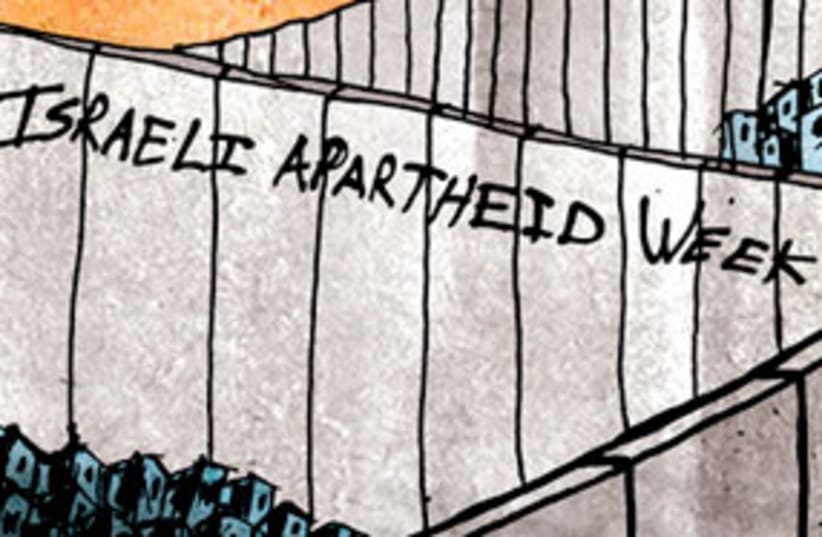
As ‘Israel Apartheid Week’ heats up, the question must be asked, what – if anything – makes the Israeli case similar to South Africa?
By DORE GOLDisrael apartheid week 311(photo credit: Screenshot)
The organizers of “Israel Apartheid Week” (March 1-March 13, 2010) are hoping to replicate what they claim was an unprecedented success for their cause last year when they sponsored events in 40 cities around the world. Yet the arguments against their charge – that Israel is guilty of apartheid – are overwhelming. In fact, given the difficulty in applying the apartheid model to Israel, one wonders what the true hidden agenda is behind this campaign.To begin with, in apartheid South Africa (1948-1994), blacks were not allowed to vote or to be candidates in the general elections, they could not attend white universities or be treated in white hospitals, and they were forcibly removed from white cities. Anyone who is the least bit familiar with Israel knows that Israeli Arabs vote for the Knesset and that there are Israeli Arab Knesset members, who also serve as deputy speakers of Israel’s parliament; an Israeli Arab judge sits on Israel’s Supreme Court; Israeli Arabs study in all Israeli universities and there are mixed Arab-Jewish cities, like Haifa, Jaffa, Ramle and Jerusalem.In 2006, Benjamin Pogrund, a former anti-apartheid activist, who now lives in Israel (he also served as a deputy editor of Johannesberg’s Rand Daily Mail) responded to a report in The Guardian comparing Israel and apartheid South Africa. As a journalist, Pogrund had specialized in apartheid, and was even imprisoned by the South African authorities for his reporting. Looking at the situation in Israel, he noted that when he had been hospitalized in Jerusalem for surgery, he looked around and noticed that the patients, nurses, and doctors were both Arabs and Jews.“What I saw in the Hadassah-Mt. Scopus hospital was inconceivable in the South Africa where I spent most of my life,” he said. The apartheid system was based on legalizing racism. As former Foreign Ministry legal adviser Robbie Sabel has pointed out, in Israel even incitement to racism is a criminal offense.Israel’s accusers also try to focus on the West Bank and the Gaza Strip, but here too their arguments are extremely weak. The majority of Israelis do not want to annex the whole West Bank, but rather feel that they are entitled to “defensible borders” in accordance with UN Security Council Resolution 242. This is not a case of establishing a different legal system for a specific racial or ethnic group within the Israeli state, but rather a territorial dispute between the parties over Israel’s future borders. In fact, it is the Palestinian Authority that has legal jurisdiction over the Palestinians in these disputed territories, not Israel.Even one of the most vicious anti-Israel UN officials, John Dugard, a South African professor of international law, wrote in his annual report to the UN Human Rights Council in 2007 that Israel’s “laws and practices” in the territories “resemble aspects of apartheid,” but he could not bring himself to make a clear legal determination that Israel was an apartheid state.In any case, the organizers of Israel Apartheid Week do not confine their claims to the West Bank, either. In their official film clip that they loaded to YouTube, they make mention of Israeli Arabs, and also demand “the right of return”– the infamous Palestinian claim to allow Palestinian refugees to move into Israel and demographically destroy the Jewish state.THUS, WHAT underlies the Israel Apartheid Week campaign is not international law, but rather a highly politicized interpretation of Israel’s history in which the Jewish people are viewed as a colonialist movement that recently came from Europe to usurp lands from the indigenous Palestinian population, rather than the authentic claimants to sovereignty in their historical homeland.Years ago, former Palestinian Authority chairman Yasser Arafat picked up these themes, when he argued that the Palestinians date back from the ancient Canaanites and Jebusites. According to this narrative, the Jews arrived only in the late 19th century on the wings of European imperialism. This is why Arafat had to deny the existence of the Temple of Solomon in July 2000 at Camp David, for any evidence of Jewish civilization in the Holy Land clashes with the depiction of the Jewish people as Middle Eastern Afrikaners who only recently arrived in the region.Here also the Palestinian case falls apart when it faces the force of history. Using Christian and Jewish sources, Prof. Moshe Gil of Tel Aviv University wrote in his 900 page monumental work, A History of Palestine: 634-1099 (Cambridge University Press, 1992), that as late as the seventh century, Jews still had a massive presence in most parts of what had been their sovereign territory up until the Roman invasion. There are some who suggest that the Jews were still the majority. According to Gil, on the eve of the Muslim conquests, the Jewish presence in the land was nearly 2,000 years old.Moreover, there was a constant effort of Jews to return to their land in the centuries that followed, despite the dangers. By the 1860s the Jews, in fact, reestablished their majority in Jerusalem, well before the arrival of the British Empire. When the League of Nations decided to recognize the Jewish claim to a national home in 1922, it specifically recognized the pre-existing right of the Jewish people to what was to become British Mandatory Palestine.Regardless of what the Palestinian propaganda machine asserts on this issue, many among the Palestinians were actually relative latecomers. Many of the noble Palestinian families in Jerusalem, like the Nashashibis, the Nusseibehs and the Husseinis trace their origins to the Arab conquests in the seventh century under the second caliph, Umar bin al-Khatab or even later to the 12th century and the defeat of the Crusaders by Salah ad-Din.In the Arab world, there is no special status to be derived by saying that your ancestors were Canaanite pagans as opposed to claiming that they came from those Arabian families who accompanied the Prophet Muhammad. In any case, the current Palestinian population also contains many new immigrants; it was US president Franklin Delano Roosevelt who commented in 1939 that more Arabs came into Palestine since the establishment of the British Mandate than Jews.The resolution to the Arab-Israeli conflict will not be reached byjust waging historical debates, but by mutual recognition andaccommodation. Israel Apartheid Week is not about respect for humanrights; it is an incredibly hypocritical initiative that ignores theapartheid practiced by the Palestinians themselves, who make the saleof land to Jews punishable by death. It is also not a movementdedicated to making peace, but rather to denying the historical rightsof the Jewish people. The answer to the challenge is to expose the trueintentions of its backers, who clearly seek to dismantle the State ofIsrael and deny its people their inherent right of self-determination.The writer is the president of the Jerusalem Center for Public Affairs and served as Israel’s ambassador to the United Nations.
if(catID != 151){
var cont = `Take Israel home with the new Jerusalem Post Store