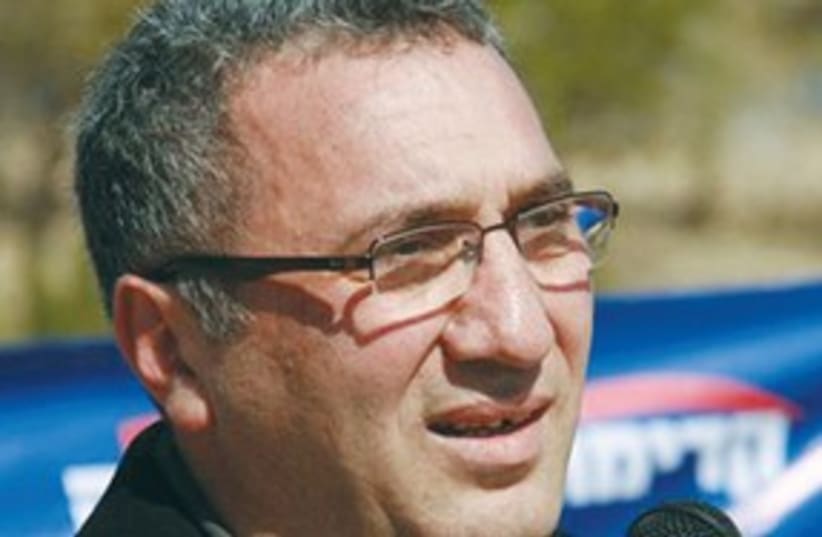
The first Knesset panel aimed solely at fighting the war on the roads is a small but significant step for those who have lost their loved ones.
By RUTH EGLASHTibayev 311(photo credit: Courtesy)
It is Tuesday afternoon in the Knesset, hours after the main parliamentary committees have concluded business and shortly before the plenary debates are due to begin. The halls in the committee wing are comparatively quiet, and the cafeteria workers are cleaning up after the lunchtime rush. Yet tucked away in a room usually reserved for the Economic Affairs Committee, a group of men and women are sitting together for the first time and making history.However, the eclectic mix of government officials, civil servants, social activists, academic experts and concerned citizens is not discussing critical points concerning national security, politics or economics, but rather they are all there to focus on an issue affecting every citizen: road safety.Under the chairmanship of MK Robert Tibayev, the newly formed Subcommittee for the War on Traffic Accidents is holding its inaugural meeting and the fact that all those involved in this ongoing battle have come together for the first time is extremely obvious.It is also clear that the Kadima MK – spurred to push for a panel on the subject after an emotional meeting last summer with US-born Bryan Atinsky, whose wife Efrat, two children, Noam, five, and Ya’ari, nine months, and mother-in-law Esther Gamliel, were killed in a traffic accident a year ago – is still a novice at managing a committee even though he takes his new role extremely seriously.He succeeds in asking tough questions of the government officials present, including why road deaths increased by some 11 percent last year.However, he struggles to control some of the passionate individuals clearly elated that there is now a formal body dedicated solely to tackling what is often referred to as “the number one killer of Israelis.”At one point in the proceedings, Tibayev grabs the gravel and bangs it on the table surface. Calling for order, he apologizes to those still waiting to speak that time is of the essence. Despite that, many important issues are raised in the 90-minute meeting, whose main goal is to somehow decipher why hundreds of people continue to lose their lives or their loved ones on the roads each year.“You ask what causes traffic accidents.”Rahel Rotem, director of the Department for Road Safety in the Education Ministry, said at one point. “I believe it’s a mixture of many things – police enforcement, prosecution, education, culture, physical infrastructure and more – but the main problem is that until now there has been no one, no political party, no politician and no mayor, to take up this battle.”Her comment summed it up and following the hearing, Tibayev told The Jerusalem Post: “This is exactly the problem, there was no one political body dealing with this issue and no one uniting all those who are working hard to prevent it.”Although it is only a subcommittee, Tibayev said it will have the same powers as any other Knesset committee, including the ability to create and pass legislation, hold the government accountable for action or inaction and commission research.Ahead of the inaugural meeting, Tibayev asked the Knesset Research and Information Department to put together a document outlining possible causes of traffic accidents. He also requested an overview of road death statistics and budgetary information on the National Road Safety Authority, a branch of the Transportation Ministry; the Traffic Police, which is responsible for law enforcement on the roads; and the Education Ministry, which provides road safety education.According to the figures collected, some 90-95% of all traffic accidents were caused by careless or negligent individuals; 25-30% by faulty road infrastructure and 5-10% by technical problems with vehicles. Most accidents were caused by more than one of these elements, the research found.Based on data from the Central Bureau of Statistics, the study also highlighted that traffic accidents increased by some 11% in 2010, with a total of 14,603 accidents – 304 fatal and 1,355 causing serious injury. In total, 27,735 people were injured, 1,633 seriously and 349 were killed.In addition, the research also noted sharp budget cuts in recent years to the Education Ministry’s Department for Road Safety and a severe reduction of manpower and resources for the Traffic Police, although the number of cars on the road has increased by 142% since 1990. Information obtained from the National Road Safety Authority also shows that its budget for this year was reduced.“There is no simply answer to what causes these fatalities,” observed Tibayev, who said he intends to call Transportation and Road Safety Minister Yisrael Katz to speak before the committee. “However, I am certain that it is not only people who cause traffic accidents, it is a mix of the culture on the roads, lack of education and inadequate roads that also play a part.“If we continue to cut the budgets for road safety education, we will have a serious problem. The number of young people killed on the roads is higher than any other group.We must invest in education.What do young drivers who have just passed their tests know? They only know how to switch on the ignition. Perhaps road safety education should be a component of the driving exam?” WHILE CHANGING the national driving test could become one of the committee’s goals, for the now Milwaukeebased Bryan Atinsky, who welcomed the new committee, it is more a matter of overhauling the agenda to make road safety a national priority and taking to task those officially responsible for reducing the deaths.“I hope that this committee will ask why the budgets for this issue have been so severely cut,” commented Atinsky, who on March 9 will mark one year since his family was killed in a head-on collision in the Negev. “I hope it can pressure [the government] to return the budgets to what they were or what they should be.”Atinsky, who since the tragedy has been actively involved in fighting for change here even though he has yet to decide if he will return here to live, pointed to increasing law enforcement, cameras and other preventative measures as critical steps in the right direction.“It’s a free-for-all on Israel’s roads, and no one is worried that he will get caught breaking the law,” he said, clearly disappointed that in the year since his family was killed, not much has really changed.“People do not abide by any rules, they pass in no passing zones, change lanes without indicating, run red lights and all the police do is stand by the side of the road and check documents.”“The whole system is upside down and it seems as though people do not realize that this is the number one killer of Israelis, more than war or terrorism,” Atinsky, who was living in Athens, Georgia while his Israeli-born wife Efrat completed her post-doctoral work at the University of Georgia, added.“We are killing each other on the roads and no one seems to be talking about it. When I think about those who might end up going through what I am going through, it just makes me realize that there needs to be more public reaction to this issue.”In response to the formation of the new committee, both the National Road Safety Authority and nonprofit Or Yarok said this was a positive step to raising awareness and creating real change.“We see in a positive way the initiative by MK Robert Tibayev to create a committee that will be dedicated solely to the issue of road safety and the war on traffic accidents,” Ron Moscovich, director of the National Road Safety Authority, told the Post following the first meeting. “This gives recognition to the importance and great urgency that this issue must be dealt with. However, it is also important to highlight that only by fully recognizing all the issues and mobilizing all those involved in this war will we be successful in our mission.”Moscovich pointed out that despite budget cuts, “over the past five years, since we started our work, there has been a significant drop in traffic accidents...We intend to continue this work in the coming year and even though there have been cuts to our budget, there are many issues that can be tackled that do not require funds.”“Whenever the statistics are good, the [authority] says look at the past year, but when the figures are bad, it calls attention to the last five years. We believe we should look at all the figures, and if they are bad, we need to be asking why,” commented Or Yarok director Shmuel Abuav. “That is why it is so important and significant that the new parliamentary committee whose sole job is to look at this specific issue has been created.“The role of the Knesset is to keep tabs on issues and ask hard questions of those who are responsible.We saw that already this week when the new committee asked the Transportation Ministry for a clear list of danger spots in the country and asked why the budgets had been cut for the Traffic Police and the Education Ministry’s department.“[This] is such a serious issue and it is encouraging that Tibayev has been tackling this in such a professional way. The situation on Israel’s roads is very bad and even during the start to this year the figures have shot up sharply.”"I know I am going to have to work very hard on this issue,” observed Tibayev. “Even here today we did not see many Knesset members and there was no media, I am sad to say. But we have to get this issue into the Israeli conscious and I am ready to do this.”
if(catID != 151){
var cont = `Take Israel home with the new Jerusalem Post Store