While there is no indication that the snowstorms that battered the country last weekend are likely to become a regular phenomenon, global warming could well bring more extreme weather conditions and new challenges.
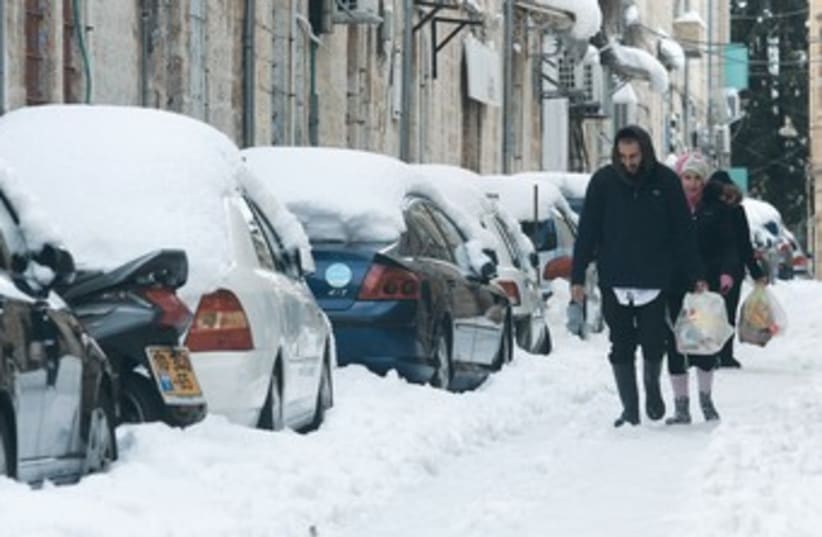
By SHARON UDASINPedestrians in the snow in Jerusalem 370(photo credit: Marc Israel Sellem/The Jerusalem Post)
As the snow and rainfall pounded the country for four days last weekend, chaos ensued – with trees collapsing on power lines, and forces of nature battering infrastructure unprepared for such an event.Yet rather than investing huge amounts of money in equipping towns to more efficiently handle such severe conditions, the key to enduring the next extreme weather event will be better communication between the relevant authorities and the citizens, according to Dr. Limor Aharonson-Daniel, the founding director of Ben-Gurion University’s Center for Preparedness and Response to Disaster and Emergency Situations Research.“I don’t think they were lacking equipment,” Aharonson- Daniel said. “Maybe the timing of moving equipment from one place to another was problematic, as well as the roadblocks of people in the roads.”Eliminating confusion and ensuring that the population understands who is responsible for leading the storm response, as well as better informing the public ahead of time, will be crucial in future situations, Aharonson-Daniel stressed.“The most important thing is that the message to the population should have been given earlier – it should have been much clearer,” she said. “If the population understood earlier how severe the weather is going to be, probably many of the people wouldn’t have gone on Road 1 that day. I think that people did not understand what was going to happen.”At the height of the storm, on Friday, up to 35,000 Israel Electric Corporation households were left without power, or 1.4 percent of the company’s total 2.5 million customers. About 13,000 of these outages plagued Jerusalem and 2,400 Safed, cities whose operations were essentially shut down for the duration of the storm.By Monday morning, a full day after the storm conditions had subsided, 8,000 customers were still without power – a number that fell only to 3,250 households by that night. As of Tuesday morning, a few hundred isolated customers remained without power, mostly in the Jerusalem area, and the company distributed and connected 70 temporary generators throughout the country to places still encountering glitches.All in all, throughout the unseasonably cold storm, Jerusalem received between 40 and 50 centimeters of snow, while Gush Etzion and the Hebron mountains received between 60 and 70 cm., according to the Israel Meteorological Service (IMS). Only three snow events in the past century have rivaled or surpassed the snowstorm in Jerusalem – with 97 cm. falling in February of 1920, 50 cm. in February of 1950 and between 40 and 45 cm. in February of 1992.As far as rains are concerned, the central and southern coastal plains received the most during the storm, accumulating between 200 and 250 millimeters, and even up to 250 to 300 mm. in the Gaza Strip, the IMS reported. The hills of Judea and Samaria received between 170 and 220 mm., while the Tel Aviv and Sharon regions gained between 150 and 180 mm. In the northwest Negev, about 110 to 140 mm. of rain fell, while the Lake Kinneret (the Sea of Galilee) and Hula Valley areas received between 70 and 80 mm. The northern coastal plain and the hills of the Galilee received between 100 and 150 mm.In the Center and South, the amounts of rain that fell in some cases reached two to three times the monthly averages for December.The Kinneret, as well as the nation’s aquifers, reaped the benefits of the mega-storm, with large amounts of rain falling in the North, the Center and the western Negev.From the beginning to the end of the storm, the Kinneret’s water level rose 10 cm., bringing it to 211.30 meters below sea level, the Water Authority said.Although the storm was indeed “a rare event,” Dr. Amos Porat, director of the IMS Climate Department, emphasized that this was not, in fact, “a storm of once in 100-150 years.” Porat referenced the events of 1920, 1950 and 1992, demonstrating that such a storm is instead an event of approximately once every 25 years.“The authorities have to decide accordingly if the country should invest tons of money in infrastructure,” Porat said. “We do not have indications that there is a climate change that will make these events more frequent.”Although it has not been proven that there is climate change afoot increasing the incidence of such events, Porat acknowledged that this “doesn’t necessarily mean that we will have to wait 25 years for such a severe storm.”“It could happen once again in the near future,” he said.As far as the rest of the winter goes, the forecasters at IMS do not predict a dry winter, Porat added.For January, February and March 2014, there is a 30% probability that this period will be rainier than usual, a 37% probability that the period will feature “average” rains and a 33% probability that this will be a dry period, according to IMS data, which uses the European Center for Medium Range Weather Forecasting dynamic forecast model. Because no category reaches above 40%, however, it is not possible to really predict which conditions will prevail, wrote Dr. Henia Berkovich, director of the IMS. Berkovich reiterated that the accuracy of the current seasonal outlook is still relatively low.Prof. Daniel Rosenfeld, a cloud and rain physics specialist at the Hebrew University’s Earth Science Institute, agreed that this specific storm neither provides significant insights into the future nor necessarily signals climate change.“But if you look at the global picture, then you can reach some conclusions,” he said.From a worldwide perspective, scientists are seeing a trend of more extreme weather events, which matches their general understanding of what global warming can do to the climate, Rosenfeld explained.“In this context, the chances for such a storm are consistent with such trends, but at the same time we cannot say that having such a storm is proof of this,” he said.Stressing that “the manifestations of extremes are different in different places,” Rosenfeld said that future extreme weather events in Israel will likely be characterized by more heat waves, a generally dryer climate and less frequent rain events – and often, heavier rains when they do fall.“The bottom line is more droughts and more floods,” he said.In order to ensure optimal preparedness for such events in the future, Aharonson-Daniel said that the government must communicate clearly to citizens as to who exactly is responsible for leading the response. Clear guidelines may exist within the government, but they were not being properly disseminated to the people.One effective communication mode would be making better use of two-way communication channels through social media, in order to both send and receive information from the public. “Whatsapp or Facebook or Twitter can be used to do bi-directional communication with the public, to convey messages of calming people down – ‘We’re on our way to you’ and things like that,” she said.In addition to holding the government responsible for broader issues during such a storm, Aharonson-Daniel said that individual citizens also must think ahead as to what their personal responsibilities should be – how they can prepare ahead for possible incidents like electricity outages.“At the end of the day, each of us is responsible to have in their house what is needed,” she added.Despite these recommendations for coping with future such events, Aharonson-Daniel stressed that all in all, she did not think Israel did a particularly poor job handling the storm. Given the infrequency of such extreme events, the less than perfectly prepared infrastructure was not so irresponsible, she explained.“I think you cannot be prepared for every possible scenario, and in the current age of limited resources it makes sense to choose what challenges you prepare for,” she said. “I don’t think we’re in a worse condition than are other places.”
Related Tagssnow
if(catID != 151){
var cont = `Take Israel home with the new Jerusalem Post Store