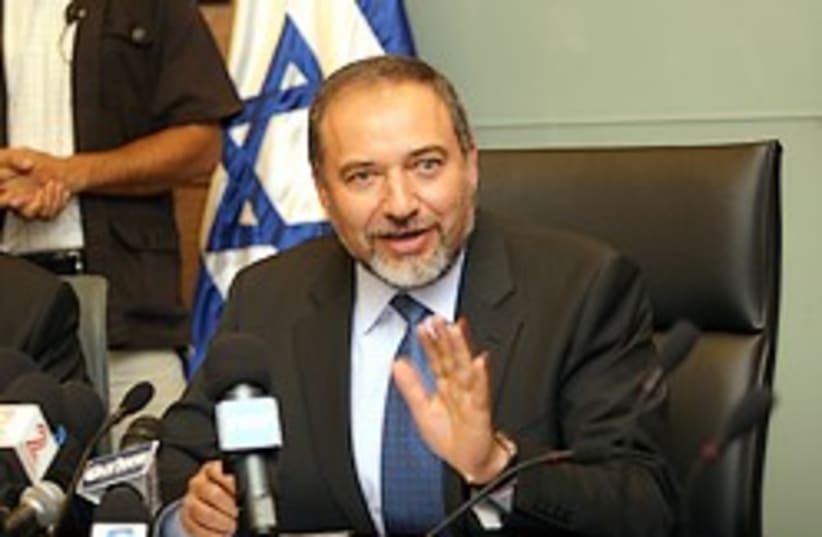
On Monday, the High Court of Justice is scheduled to hear a petition filed by the Movement for Quality Government against the coalition agreement between the Likud and Israel Beiteinu appointing Avigdor Lieberman minister of foreign affairs and deputy prime minister.
The petition itself does not stand a chance. No minister has ever been forced to resign because he was under police investigation, although several - including former prime minister Ehud Olmert, former finance minister Avraham Hirchson, Justice Minister Yaakov Neeman (in a previous government) and former justice minister Haim Ramon - have done so voluntarily.
The rest of the petition is utterly far-fetched. It calls on the court to nullify the provisions of the agreement appointing Lieberman's party colleague, Yitzhak Aharonovitch, minister of public security, another Israel Beiteinu MK as chairman of the Knesset Law Committee and party representatives to the Ministerial Legislation Committee and the Knesset Law Committee.
It is a foregone conclusion that the court will accept the state's preliminary statement regarding Lieberman, in which it said, "The questions raised in this petition have to do with the public and political levels, and not the legal one... Indeed, the appointment of a person to a senior ministerial post while he is under criminal investigation can raise serious public questions... However, at this stage, these questions are not a matter for a legal decision, but for the political and public echelons to deal with."
According to Attorney-General Menahem Mazuz, "At this point, the duty of the law enforcement authorities is to concentrate on conducting a quick and efficient investigation... Given the great public sensitivity regarding this situation, all of those involved in this matter are making a supreme effort to speed up the investigation procedures and reach a decision."
THE HIGH Court has so far only accepted petitions demanding the resignations of ministers after an indictment was filed against them. Nevertheless, if there is no practical importance to the hearing of the petition, it comes at a strategic point in the development of the affair.
The state's response, written by attorney Dana Briskman, was submitted on March 30, a few days after the Movement for Quality Government petition was filed. Since then, Mazuz has gone much further in expressing his opinion, this time personal, on whether Lieberman should be serving in the cabinet at this time.
During an appearance before the annual convention of the Israel Bar in June, Mazuz said that if Israel were a properly-run society, the public and the politicians would not allow Lieberman to serve as foreign minister. "It should not come to this," he said.
But, he continued, it was not the law enforcement authorities, including the Justice Ministry and the courts, that should prevent Lieberman from serving as foreign minister. "The public and political echelons must establish the code of behavior," he said. "The big problem is not that undesirable things happen, but the fact that the public does nothing about them."
THE OTHER, more recent, development in the Lieberman affair occurred last week, when Mazuz met with senior police officials, including Cmdr. Yoav Segilovich, head of police investigations and intelligence; Shlomi Ayalon, head of the Fraud Investigation Unit; and the police team investigating the case.
According to unofficial reports, the police told the attorney-general that it had just about completed its investigation, and would very shortly present him with a summary of the findings, and its recommendation as to whether or not to indict Lieberman.
All signs indicate that it will indeed recommend pressing charges against the foreign minister. If so, it will have been an extraordinarily long haul to get even to this point, which is not the final one in the long saga of the investigation. Mazuz is the one who will have to make the final decision on whether to indict Lieberman and, if so, on what charges.
The allegations that the police are talking about at this point include money-laundering, fraud and breach of faith and tampering with evidence. They have also looked into the possibility of charging Lieberman with accepting bribes.
These charges are not the original ones the state prosecution began investigating almost a decade ago. The history of the Lieberman investigation began with a state comptroller's report on election financing in the 1999 campaign, which brought Labor Party chairman Ehud Barak to power. Although public attention was focused on Barak's campaign and the fake nonprofit organizations which financed it, the report included a small section on funding violations by Israel Beiteinu, the party Lieberman had formed after leaving the Likud.
Then attorney-general Elyakim Rubinstein decided to launch a criminal investigation into the state comptroller's findings regarding Lieberman. Originally, the investigation revolved around two facts. The first was that Lieberman had earned $3 million from an Austrian bank which was on the verge of suffering a devastating financial loss because of a drastic change in the value of the Russian ruble. Lieberman managed to persuade the Russian government to restore the ruble's value, thus saving the bank. It was suspected that Lieberman had used connections with the Russian underworld to effect the change.
The second was that Lieberman allegedly obtained a $1m. loan, guaranteed by an Austrian acquaintance, to run his 1999 campaign.
THE INVESTIGATION limped along for several years. One of the reasons for the slow progress was the fact that the prosecution had to carry out an investigation in Austria, and the authorities there initially refused Israel's request to question Austrian citizens. In 2005, the police handed the file to the attorney-general for his decision.
However, information which was either new or stemmed from the police work conducted until then led to a decision to continue investigating new allegations not directly related to the election-funding suspicions.
On August 11, 2008, Mazuz decided to close the original investigation without pressing charges. The decision came one month after Lieberman filed a petition demanding that the prosecution either press charges against him or drop the investigation altogether.
The new investigation concerned large sums of money that were deposited in straw companies in Cyprus and Israel. In 2007, Haaretz reported that one of the companies, known as M.L.1 International Trading Company, had a single shareholder, who happened to be Lieberman's daughter, Michal Lieberman. In 2004, the company allegedly brought in an income of NIS 7 million.
The second investigation required further questioning abroad, this time in Cyprus where some of the companies were established. Funds deposited in the Cypriot-based companies were transferred to Israel.
According to the reports, police have been unable to discover where the money originally came from. However, they seem to be able to trace the money from Cyprus to Israel and to Lieberman. They also appear to have evidence indicating that Lieberman or his associates changed the names of the Cypriot-based companies in an attempt to throw police off the scent, hence the allegation of tampering with evidence.
These are the actions of which Lieberman is suspected. But there is still a long way to go before we will know whether the law enforcement authorities decide they have enough evidence to prosecute him. Until that time comes - if it comes - there is nothing preventing the Israel Beiteinu chairman from keeping his job and his titles.
| More about: | Ehud Olmert, Ehud Barak, Elyakim Rubinstein, Avigdor Lieberman |