A battle is raging within the IDF over the force’s raison d’être and the role it is supposed to play both in times of war and in times of peace.
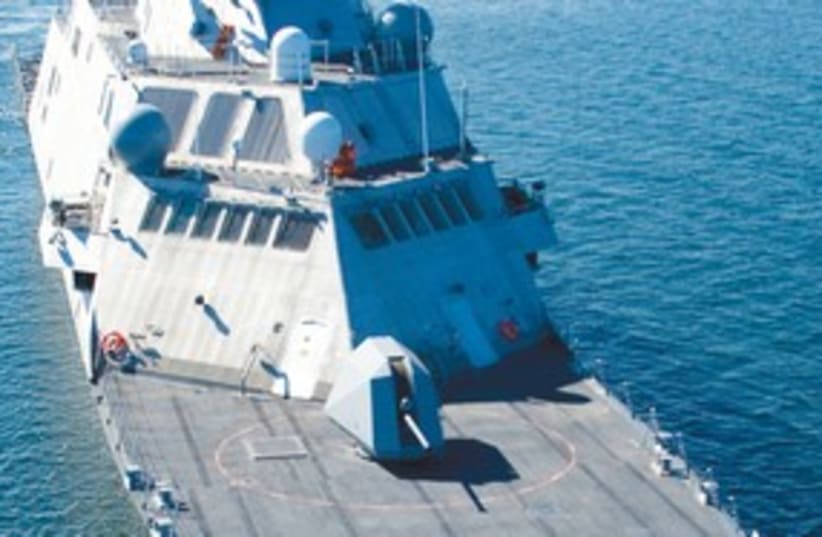
By YAAKOV KATZLockheed Martin’s LCS 311 (R)(photo credit: REUTERS)
By far the smallest branch in the IDF, the Israel Navy has made an impressive leap in its capabilities in recent years, turning into a major player in the country’s military operations.But at the same time, its future hangs in the balance as the IDF General Staff deliberates whether to approve an ambitious plan to purchase two new large vessels that the navy has requested to meet the challenges it faces in the region.The purchase was supposed to happen several years ago; it was approved by the General Staff under the “Tefen” multi-year plan, which will expire by the end of the year.In 2007, close to $500 million was set aside to buy the two new surface combatants, with the navy’s eye originally set on the US Navy’s Littoral Combat Ship (LCS), under development by Lockheed Martin. By 2009, though, Israel decided to pull out of the program due to rising costs and began searching for an alternative.The first idea was to buy the new ships from Germany’s Blohm+Voss, but that plan was also abandoned due to lack of funding. The current idea, which the navy favors, is to purchase designs from Blohm+Voss and to have the vessels built by Israel Shipyards, a privately owned company based in Haifa that already builds the navy’s smaller Shaldag patrol boats.The budget for each ship, including accompanying weapons and command systems, is expected to reach around $300m.But the question now is whether the navy needs the ships to begin with. At the core of the question is an ongoing and heated debate at the military’s top levels over the navy’s raison d’être and the role it is supposed to play in times of war – and also of peace.For decades and under consecutive prime ministers, defense ministers and IDF chiefs of staff, the navy has always been viewed as something of a “stepbrother” to the rest of the military’s branches, and has been particularly under-budgeted in comparison to the air force and the ground forces.This was done despite the fact that Israel’s sea lines of communication are a strategic asset for the small country and span the length of the Mediterranean and around North Africa’s Magreb region.Some 99 percent of all goods arriving in Israel come by sea, as do over 90% of security-related supplies and military hardware. The coast is also lined with strategic installations, such as power plants, ports and oil refineries, as well as a significant percentage of the country’s seven million people.In Israel’s first years as a state, the navy consisted of a mere five vessels, and this neglect contributed to the loss of the Eilat destroyer, which was hit by Egyptian anti-ship missiles off the coast of Port Said in 1967. By the Yom Kippur war of 1973, the navy had transformed itself into a force to be reckoned with after it received a new generation of Sa’ar fast missile boats armed with Gabriel anti-ship missile systems.Using innovative tactics and electronic deception, the navy succeeded in wreaking havoc on opposing Syrian forces in a sea battle off the coast of Latakia, which proved to the world that it was on par with other branches in the IDF.But then the investment in the navy stalled. Peace with Egypt and Jordan raised the assessment that threats to Israel were mostly by land from Syria, Hezbollah in Lebanon – which has accumulated tens of thousands of rockets – and Hamas in the Gaza Strip. The threat from the sea was perceived as minimal.The navy also had difficulty integrating itself into larger IDF operations like the Second Lebanon War in 2006. While the army was fighting Hezbollah on land, the navy attempted to fight from the sea and imposed a sea blockade on Lebanon.Unfortunately, though, it disregarded the other side’s capabilities, and on July 14, 2006 – two days into the war – Hezbollah and Iranian operatives fired a radar-guided, Chinese-made C-802 anti-ship missile at the Sa’ar 5-class Hanit missile ship. Four soldiers were killed in the attack, and while little damage was caused to the vessel, the strike resonated throughout the IDF.The thinking then was that the navy was doing more bad than good.Later, it was discovered that the soldiers aboard the Hanit had not activated its Barak missile defense systems due to a gap in intelligence regarding Hezbollah’s missile capabilities.The major change came two-anda- half years later during Operation Cast Lead in the Gaza Strip, launched in late 2008.During the operation, the navy positioned itself as an integral partner in the land battle laying siege to Gaza to prevent weapons smuggling, and at the same time exercising sea-ground support while demonstrating a close level of interoperability with IDF infantry units ashore.In addition, teams of commandos from the Navy’s Flotilla 13 – better known as the Shayetet – were employed in a wide-range of missions, sometimes on classified operations, but other times as part of larger-scale IDF ground maneuvers.Another example was the navy’s decision after the Gaza operation to bolster its amphibious landingcraft capabilities to land ground forces in places like Lebanon and Gaza by sea in a future conflict.It is also undergoing an unprecedented procurement phase, with new submarines, fast patrol boats, unmanned sea vessels and the integration of unmanned aerial vehicles (UAVs) into its operations.By 2013, for example, it is slated to receive two new Dolphin-class attack submarines, which are being built in Germany to join the three it currently has in its fleet. In April, the Defense Ministry concluded negotiations for the purchase of a sixth submarine as well.Reportedly equipped with the ability to launch cruise missiles tipped with nuclear warheads, Israel’s submarine fleet is purported by foreign analysts to be its second-strike capability and viewed as a strategic asset in the face of Iran’s race for nuclear power.Another change following the Second Lebanon War was the understanding in the IDF that the navy was integral to combating Iranian weapons smuggling to Hezbollah and Hamas.One of the known smuggling routes is in Eastern Africa, where boats unload weaponry onto trucks that then drive up through Sudan to the Gaza-Egyptian border, where it is smuggled into Gaza via a network of tunnels.As a result, the navy is operating more frequently in the Red Sea and has sent a number of vessels, including a submarine and Sa’ar 5 class corvettes, through the Suez Canal over the past couple of years.In addition, rumored operations far from Israel that succeeded in thwarting smuggling plans to Gaza and Lebanon have been attributed in the press to commandos from the Shayetet.BUT THE question now comes down to the new surface vessels and whether they are really needed, or whether the Navy could instead continue to rely on its current fleet of three Sa’ar-5 class corvettes and a number of Sa’ar 4.5 corvettes for long-range operations.V.-Adm. Eliezer Marom, the current commander of the navy, has pushed hard for the new ships. He believes they are key to the navy’s efforts to keep Israel’s shipping lines open and to effectively conduct operations far from the country.Marom’s argument is backed by a number of officers in the IDF who are concerned with the growing instability in Egypt and believe Israel needs to reinforce its navy to counter the massive Egyptian Navy one day if needed.On the other hand, former navy commanders like Yedidya Ya’ari – the current head of Rafael Advanced Defense Systems – is opposed to purchasing the new ships at the cost of hundreds of millions of dollars and instead believes the money should be invested in the weapons systems the ship will carry.“The type of ship is less important,” one senior officer who agrees with Ya’ari explained recently.“The question is what weapons will be installed on the ships, and this can be done with a simple freighter or auxiliary ship.”Both schools of thought agree, though, that the navy needs to increase its firepower, particularly when it comes to sea missiles.One such system is the LORA missile developed by Israel Aerospace Industries, which has a reported range of several hundred kilometers and superior accuracy.The US Navy, for example, uses sea-to-surface missiles such as the Tomahawk missile and similar weapons in growing numbers.The main argument in favor of investing in naval firepower capabilities is that in a future war, the air force and ground force bases would come under heavy missile fire from Hezbollah and possibly Syria. In addition, the IAF would need to focus – at least at the beginning of a war – on suppressing enemy missile fire.By contrast, Israel’s current enemies cannot easily track navy ships and have invested most of their resources in missiles and rockets.The ships can also operate out of range of Hezbollah’s missiles, which is not the case with IAF and IDF bases.“The IDF must build its naval force to take advantage of this situation,” V.-Adm. (res.) Gideon Raz, a former deputy head of the navy, wrote in a recent article published in Military and Strategic Affairs.“The naval force would enhance the inventory of weapons that would be possible to operate at any given time against targets in enemy territory.”While two years have passed since the Gaza operation and five since the Lebanon War, the navy has yet to be able to sail calm seas, especially in the face of potential war on multiple fronts.Whether he gets new ships or not, Marom and his staff vow to continue to remain relevant. The navy, these officers say, will stick to its current procurement plans, will increase training and will fight to participate in every future IDF operation as it works to retain its status as a key player in Middle East warfare.
if(catID != 151){
var cont = `Take Israel home with the new Jerusalem Post Store