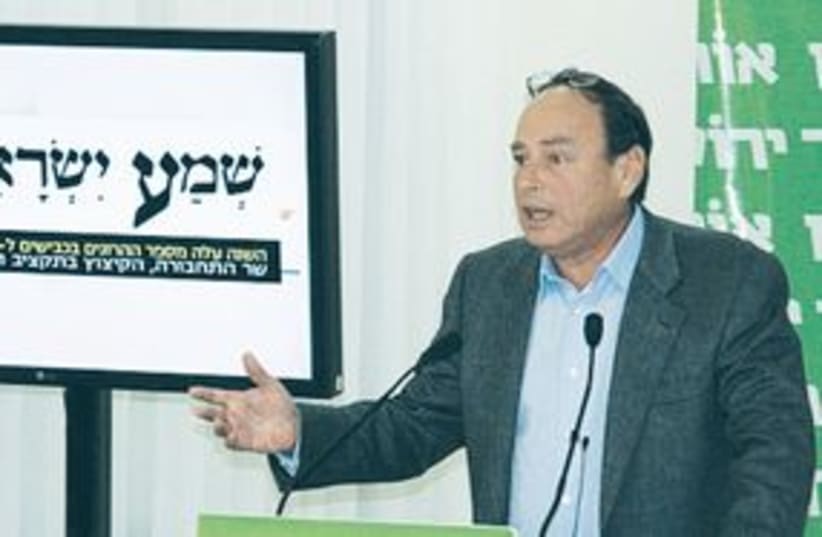
2010 marked a surge in road fatalities; Avi Naor, founder and chairman of Or Yarok,
points finger of blame at Transportation Minister Israel Katz.
By RON FRIEDMANOr Yarok 311(photo credit: Courtesy)
Fifteen years after the death of his son in a traffic accident, Avi Naor still dedicates a large part of his time to battle for safer roads. The founder and chairman of Or Yarok, a nonprofit organization devoted to reducing traffic accidents on a nationwide level, Naor sees the end-ofyear traffic death tolls as a national tragedy and a personal affront. In a rare interview with The Jerusalem Post, he lamented the increase in deaths that ended a five-year downward trend and pointed a finger directly at the man he holds responsible, Transportation and Road Safety Minister Yisrael Katz.“When you look at this year’s results – and the results are very harsh, 380 plus deaths, around 32 more than last year – and when you know that there are targets that were approved by the government, aiming for a 6 percent decrease every year, and instead of a decrease, there was an increase, you see a shift that goes beyond mere statistics,” said Naor.“Things become even worse when we compare ourselves to other countries which share our targets and see that their numbers continue to drop and realize that we are the odd ones out.“When you look at what we’re doing and the way we’re doing it, it should come as no surprise. The rise is not because of bad luck or because one big accident altered the statistics. The rise is a result of many accidents. And when you look into the details, you find that you can link them to a series of faults.”He said those faults include decreasing budgets for the Traffic Police and the National Road Safety Authority, lack of leadership in the authority, which functioned for 18 months without a director- general, reduced investment in road safety infrastructure, reductions to airborne evacuation and less road safety education.“There is a fundamental principle in governance – there are ministers and the ministers are responsible for setting policies and seeing them through. The defense minister is responsible for security; the education minister is responsible for education and the road safety minister is responsible for traffic accidents,” said Naor.ANYONE DRIVING around the country in recent weeks couldn’t have missed the massive campaign that Or Yarok has mobilized against Katz. With constant ads on the radio and giant billboards bearing his name and photo, all accusing him of failure and worse, with cynically transferring the blame on to the public.“When it comes to traffic accidents, the government, the transportation ministers and the police have succeeded in creating a vicious cycle, where they tell the drivers that they are at fault, that we are all bad and reckless drivers. We feel guilty and don’t dare to complain to the government and demand more safety,” said Naor. “We demand that the transportation and road safety minister commit to remedial policies, and embrace goals which have been adopted by the government, and do everything in his power to make sure they are met. In Israel, the minister in question, to avoid responsibility uses cynical evasion measures, claiming that since every casualty is a world unto itself, it is immoral to treat them as statistics and set fatality targets.”After saying similar things in a press conference earlier in the week, Naor’s organization suffered a full-on attack by Katz’s media relations department; his spokesman sent out a press release accusing Naor and his people of operating out of a desire to topple Katz and that they were using people’s deaths to score political points.Naor rejected the claims stating that he had no political aspirations and that a board of directors, led by him, governed his staff. “I founded the organization 13 years ago and have invested hundreds of millions in it. If I had wanted to go into politics, I could have done it with far less money,” said Naor, a cofounder of hi-tech giant Amdocs, who is rumored to have made millions from its sale and other successful business ventures.Naor’s fundamental demand is that Katz realign his priorities. “It used to be that there was a transportation minister, and he was responsible for the country’s transportation requirements – trains, planes and automobiles. Since 2006, we have a minister of transportation and road safety, and he’s also responsible for reducing accidents. The problems arise when the two goals contradict each other, when the interest of traffic flow comes at the expense of safety, or the concern for more roads overshadows better enforcement.”OVER THE years, Or Yarok has moved from being an organization primarily concerned with educating young drivers to being active on a range of fronts.With 5,000 volunteers, an established research arm, annual conferences and ongoing public campaigns, it has become a constant voice in the country’s continuous battle with road deaths.“When the National Road Safety Authority was established, I thought that it would take up much of the things that we do and that we would be able to scale back operations. Now that the authority is becoming constantly weaker, I think that we’re going to be here forever, pushing and providing support and when necessary calling out the culprits,” said Naor. “Only when we reach a critical mass of people will we be able to bring about the change that will revolutionize the driving culture.”Naor said that there was no single silver bullet solution to solve the country’s accident problems and that what was needed was a well thought out combination of enforcement, deterrence, education, technology, safety standards, public transportation and advanced infrastructure. “Each element can contribute to the desperately needed change, the additional ingredients are foresight and responsibility.”
if(catID != 151){
var cont = `Take Israel home with the new Jerusalem Post Store