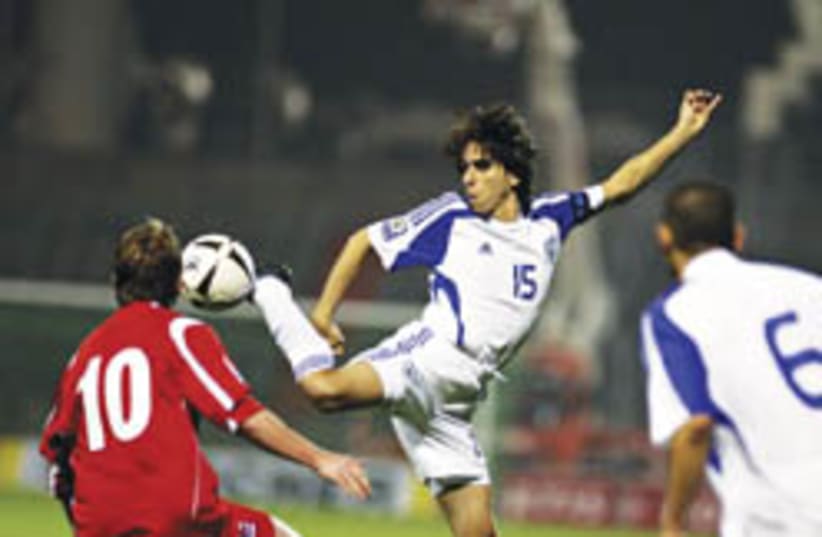
Why soccer star Yossi Benayoun's medical condition was cause for as much concern as the absence of a health minister in the new government.
By RUTHIE BLUM LEIBOWITZyossi benayoun 248.88 (photo credit: AP)
If the media reflect public sentiment, rather than merely shape it, it was telling in recent days that, alongside the constant focus on Prime Minister (no longer "designate") Binyamin Netanyahu's coalition-building, there was on-going coverage of an issue clearly no less crucial to the country's stability and future than the incoming cabinet.
Indeed, the question of whether Liverpool midfielder and Israeli national team captain Yossi Benayoun was going to be able to play in last Saturday's home World Cup qualifier against Greece, in spite of an injured hamstring, was part of every major news broadcast for days. Lest one imagine that it was only reported on, let me set the record straight. Like the other topics of the day, Benayoun's participation, or lack thereof, also generated heated editorial debate, with no aspect of the affair left unanalyzed. Sportscasters and health experts alike put in more than their respective two cents, as did other kinds of opinionated observers, arguing over the significance of the national team's being treated - or treating itself - as though it were comprised of a single player, without whom defeat would be guaranteed.
Well, Benayoun ended up at Ramat Gan stadium last Saturday night. He played for 77 minutes, before being carried off the pitch on a stretcher, due to a pulled muscle. The result: a 1-1 tie, making victory in Crete on Wednesday night, or at least a draw, a near must.
Luckily for Netanyahu and his new ministers, their swearing-in ceremony took place the night before the fateful match to determine Israel's odds of having a shot at the Mondial in 2010. Equally fortunate for them - and for channels 1, 2 and 10, who broadcast the the official changing of the guard at Beit Hanassi live - it preceded the Grecian event by a good 10 hours.
Why lucky? Because let's face it: In a race between Bibi and Benayoun, it's a no-brainer which of the two "key players" would beat the other in ratings. It is thus more than a touch ironic that the talk-show sphere's perpetual preoccupation with, and anger over, the latter's failure to appoint a full-fledged health minister was interrupted to make way for a hot news flash: that Benayoun would be banished to the bench in Crete - or at least not among the starting lineup - since he was nursing both a cold and his leg, which hadn't managed to heal properly. I wouldn't put it past the pundits to blame Bibi for Benayoun's medical condition. They are certainly calling into question his choice of Yuval Steinitz for finance minister.
Still, this almost pales in comparison to their concern over the fate of the nation, placed by Coach Dror Kashtan in the hands - or rather feet - of runner-up star players Itai Shechter and Yoav Ziv.
THAT THE blah-blah surrounding Benayoun - who, ailments aside, ultimately took to the field, but to no avail, since the team lost anyway - has not been relegated to the sports pages alone is only partially due to a countrywide passion for soccer.
The deeper explanation for its elevation to "higher places" is that Benayoun is among few Israelis who have not only made it to the big leagues abroad, but are recognized internationally. In this respect, he is no different from a homegrown Nobel Prize laureate in terms of how much media attention he receives. We Israelis like to know what our national heroes are up to, even if we are not followers of - or even particularly familiar with - the activities that catapulted them to fame and fortune. And we members of the local media take that interest seriously. This means that, no matter what else is going on here, including the entry into office of the most top-heavy government in the state's history, room will always be made for the likes of Benayoun.
Newly sworn-in Culture and Sport Minister Limor Livnat - purportedly disappointed with her pick of the portfolio draw - would do well to take that into account. If she manages to stay off the back benches and plays her own game right, she could score of few goals with the press.
ruthie@jpost.com
if(catID != 151){
var cont = `Take Israel home with the new Jerusalem Post Store