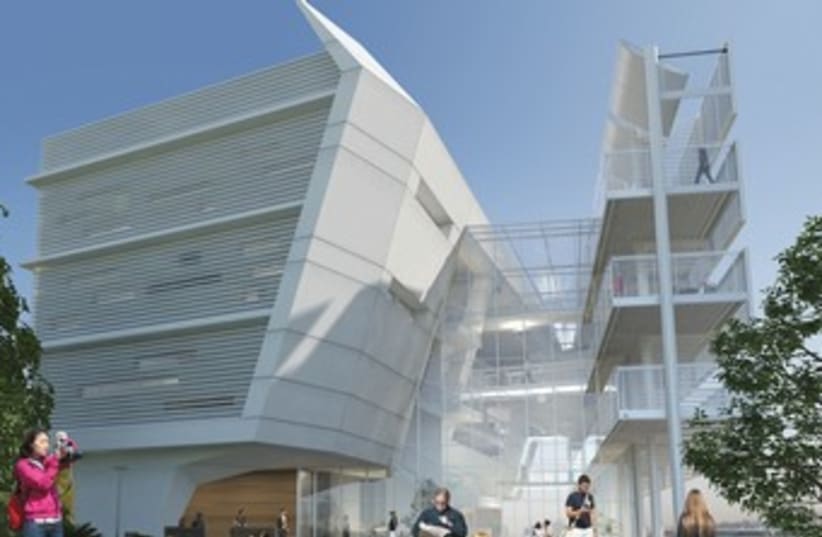
TAU Porter School for environmental studies getting green campus, hopes it will lead in sustainable construction.
By SHARON UDASINPorter School(photo credit: Courtesy)
Overlooking the Ayalon Highway and the expansive Gush Dan region rolling into the distant Jerusalem hills, a brand new green oasis will soon bedeck the highest peak of Tel Aviv University’s campus.Sixteen glass laboratory cubes, most with transparent windows, ceilings and floors, will stand stacked on the roadside portion of the building, which will house researchers at the brand new home of the Porter School of Environmental Studies.Currently sandwiched in a small portion of the university’s Gilman Humanities Building, the school will be receiving its own home for the first time since its turn-of-the-century establishment – in the auspices of the EcoBuilding, slated to open in fall 2013.The new building, along with the school itself, aims to espouse a vision of environmental education for future generations, with hopes to one day even achieve an independent environmental faculty at the university – something that does not exist in Israel.The design team, whose members won a Porter School competition to construct the building in 2008, include Dr. Joseph Cory, the founder of GEOTECTURA, Dr. Jacob Grobman of Axelrod Grobman Architects and Nili and Nir Chen of NCArchitects.“It’s a project that began with a vision,” Cory said, during a site tour with The Jerusalem Post earlier this week. “This is why we felt honored to be part of this exciting competition together with 50 more offices that competed. We were lucky to complete.”The building will adhere to LEED Platinum standards – the first to do so in Israel – and embody what Cory calls “the future of architecture.”The site, originally a large parking lot, will now only include seven car parking spaces – five for electric vehicles and two for handicapped drivers – but will contain a bicycle parking room as well as bathrooms and showers.Meanwhile, the building is located on a peak just steps – about 700 meters – above the University Train Station, causing the “connection between public transportation and the university [to become] stronger,” Cory said.“There’s no encouragement for private cars,” added Dr. Arie Nesher, professional director of the school and architect by trade.The university is currently constructing a huge underground parking lot for the campus needs because it “has no other land for expansion,” he said.The building will be the university’s first certified green structure, a decision that Cory said he hoped would spur further green plans.“It’s like a vertical, living museum,” Cory said, pointing to the building plans.Protruding from the center of the seethrough laboratory research cubes will be a spaceship-like meeting room. Companies will be able to rent out the glass cubicles to conduct research and receive assistance from students; and government officials, executives and other leaders will be able to conduct gatherings inside the meeting capsule, explained Edny Raz, director of the Porter Foundation.“It will be a meeting point between government, NGOs and research,” Raz said.Behind the glass cubicle eastern façade is the rest of the building, housing classrooms and other facilities, and atop the building’s roof, there will be a green garden with special vegetation requiring minimal vegetation, Cory explained.The southern façade of the building is going to be shaded by solar vacuum tubes, whose receptors heat water up to 100- degrees Celsius, providing the hot water necessary to power all the air conditioners of the building, according to Cory.“The energy of the building is from nature, from the sun,” he said.The building will also be making use of a special type of “passive ventilation,” angling the windows in such a way that allows optimal natural wind circulation, and minimizing air conditioning needs.Employing Computational Fluid Dynamics, the architects have devised a system that will help get wind inside the building while funneling warm air out through special evacuation pipes, Cory explained.“This way we hope to save lots of money on the operation of the building,” he said.A wind turbine, which will provide only 1 percent of the building’s power, will be housed at the site predominantly for exhibition and educational purposes.“This building is all about teaching and showing the tools of sustainable design,” Cory said. “We are putting in many things in order for people to be able to explore this technology, these methods.”Another sustainable technology that the building will be employing is a gray water system, where water from sink use and toilet flushing will be transferred for biological plant treatment to the ponds below, and then also used to water vegetation.“We will encourage the students to use the bathroom so that we have enough water,” Nesher said, laughing.Ideally, the school would love to be able to use the water to flush toilets inside the building, but this technique is not yet permitted by the Health Ministry.A garbage-recycling system within the building will also be partially visible to visitors and students, providing decoration through a glass wall, Raz said.In the building lobby, TV screens will display in real time exactly how much the building is saving at the moment and how much energy is being used, according to Cory. On the outdoor portion of the capsule the architects will install energy-efficient LED lights that show the current pollution level in the Gush Dan region, according to the laser measurements of a rooftop meter, he added.Outside the building, a promenade will connect the train station to the area, and then wrap around the structure and into Ramat Aviv, Raz said. Four balconies along the boardwalk facing Gush Dan will act as observation points, where school officials hope to hold environmental exhibitions.Eventually, the designers would like to build a bridge connecting University Gate 14 to the new building, stretching over the road and the existing roundabout, to be named Shirley and Leslie Porter Square, Raz said.Even the building process must be sustainable, and rather than transporting away excavated soil and then bringing back more in the future for building, a large mound of dirt stands at the entrance of the construction site for reuse, Cory explained. Meanwhile, barriers erected around the site keep construction pollution away from passersby, and all trucks exiting the area must be hosed of all cement particles.“We take into consideration the recycled components,” Cory added, noting that the building tiles come from 60% reused materials.“The waste of another building site is actually making our building come together.We don’t treat this as waste. This is a treasure for us.”Once the building is complete and operational, the designers aim to move to “Phase II,” which will include a center for renewable energy and environmental technologies, bringing in financing from multinational corporations, Nesher explained.The center will have a “flexible lab design” with around 13 or 14 labs that are for use only when a researcher actively is working on a project, he said.The concept of the new building itself embodies the vision of the school, Nesher emphasized.The Porter School originally came to life due to from Dame Shirley Porter, former lord mayor of Westminster and leader of the Westminster City Council, whose Porter Foundation provided the initial funds for the school and is now financing the new building.“She cleaned Westminster,” Raz said.Upon arrival in Israel, Porter immediately began providing support to environmental groups, such as Adam Teva V’Din (Israel Union for Environmental Defense), and with her late husband Sir Leslie Porter, she also funded many other buildings at Tel Aviv University, in Beersheba and an urgent care center at Ichilov Hospital, according to Raz.While the environmental movement in the US began in the 1970s, during the height of the Vietnam War and the “hippie generation,” it only reached Israel in the early 1990s, Nesher said.“The reason for the school to be established was the beginning of the environmental movement in Israel,” he explained.Initial funds for the Israel environmental movement was a bottom-up process and started through NGOs, with the funds of a few major donors – the Porter Foundation, the Goldman foundation, the Karev Foundation, the Rothschild Foundation, the Cummings Foundation and others, according to Nesher.“There was a major need for professionalism in the environmental movement,” he said, noting that this idea inspired Porter to provide the funding for a school focusing on environmental studies.In the early 1990s, he and Porter began to work together on the idea for Tel Aviv University, where her foundation had already established several buildings, including the first life sciences facility.“If you want to create and bring knowledge the only way to do it in a long-term and sustainable way is to create a school, in academia,” Nesher said.Because the environment is by nature inter-disciplinary, however, the school could not be housed within one faculty, which meant breaking away from the traditional academic structure, Nesher explained.Like the Earth Institute at Columbia, the Yale School of Forestry and Environment and the School of Natural Resources and Environment at the University of Michigan, the school would “emerge with different people from different disciplines,” he said.Upon opening the school, Nesher said he and his colleagues had to convince – and provide budgets – to the Law School for hiring an environmental law expert and to the Economics School for hiring an environmental economics expert, as these did not exist before. Likewise, the first environmental medicine and green architectures courses occurred through the initiatives of the school.Now, approximately 100 academics work with the school, 70 of whom are from within Tel Aviv University and 30 of whom are from universities around Israel and the world. About 250 students are currently enrolled in the school’s PhD, masters with thesis, masters without thesis and international, English-language master programs, the last of which is concluding its first year.All masters thesis students must have thesis advisers from two faculties, to address multiple angles of whatever environmental issues they are tacking.“This is the only table at the university where there are representatives from all nine faculties,” Nesher said.Recently, the Porter School received longawaited approval from the university to recruit researchers in joint appointment with other faculties on campus, so that the school will have faculty members as well as bring in leading researchers in new environmental fields.Thus far, the school has received the green light to do this with four different people, aiming at nine – one with each faculty, Nesher said.“Eventually the university system will have to adapt to the changes in the world,” he added.Now that Nesher and his colleagues have succeeded in convincing the university to adapt itself to the inter-disciplinary program structure – a clear break from tradition – he hopes to eventually be able to fulfill another, much larger goal for the program.“We want to see the school having its own faculty members,” Nesher said.Ultimately, Nesher said he aims for this school – and hopefully its eventual independent faculty – to be a “hub for the region,” encouraging international cooperation with other institutions.“The change of the environmental awareness in Israel is coming bottom-up, it’s coming from the youngsters, through education,” Nesher said. “The criticism is that my generation basically messed up the environmental direction.”“Israel is no longer just about the issue of building concrete and roads,” he added. “It’s thinking about sustainably and future of the people – where they are going to the ocean, what air they will breathe, where their kids will play.”
if(catID != 151){
var cont = `Take Israel home with the new Jerusalem Post Store