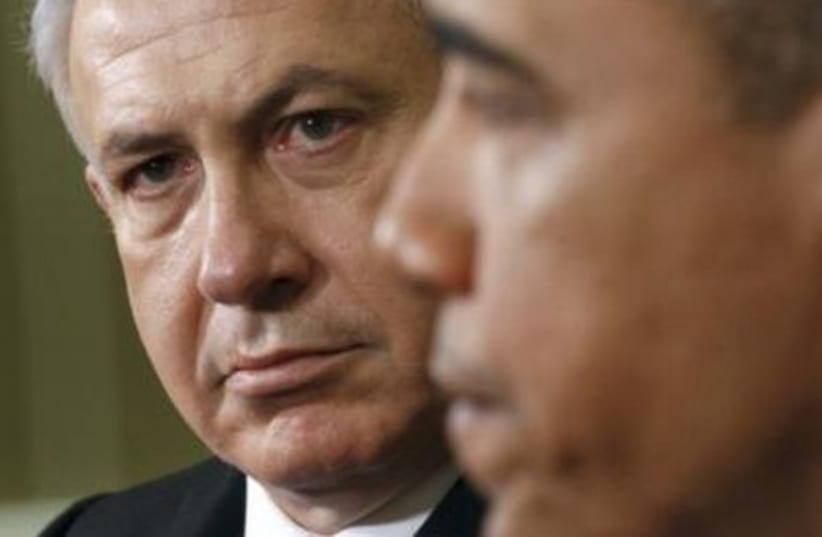
Belying conventional wisdom that Israeli public will side with US president against PM who jeopardizes US-Israel ties, Netanyahu jumped in polls.
By GIL STERN STERN HOFFMANObama, Netanyahu meeting in Washington GALLERY 465 (R) 3(photo credit: REUTERS/Jim Young)
Shortly after Barack Obama was sworn in as president of the United States in January 2009, Kadima, which was in the middle of a campaign, tried to harm the Likud’s candidate, Binyamin Netanyahu, by saying he wouldn’t be able to get along with Obama.Former Likud MK Natan Sharansky responded that Netanyahu and Obama would indeed get along, so long as neither one surprised the other. That statement proved prophetic: Obama surprised Netanyahu in their first White House meeting by insisting on a settlement freeze, and again two weeks ago by announcing a plan to advance Middle East peace the night before Netanyahu arrived in Washington.The Likud strategists’ response to Kadima’s attack on Netanyahu was equally interesting. They asked on what page the story would appear, and when informed it was set for page three, asked why not the front page.Likud strategists later revealed that their polling data had indicated that Kadima’s warning that Netanyahu would not get along with Obama had actually boosted Netanyahu’s campaign. They found that Israelis were concerned about Obama and were looking for a prime minister who would know how to say no to him.What the strategists revealed went against conventional wisdom in Israel that our politicians cannot get away with clashing with Uncle Sam and that the Israeli public would side with the American president against a prime minister who dared put the USIsrael relationship in jeopardy.Their data was proven correct again last week, when Netanyahu and his Likud Party jumped in the polls following the differences of opinion that surfaced in his and Obama’s speeches in Washington.Netanyahu received the boost despite negative reporting about his clash with the president in Israeli newspapers, television and radio.Yediot Aharonot in particular, which some have suggested the Obama administration has used to talk to the people of Israel over Netanyahu’s head, clearly took the president’s side and portrayed Netanyahu as caring more about backbench hawks in his party than about the leader of the United States.Ministers and MKs from across the political spectrum speculated in the Knesset corridors this week about how Netanyahu had succeeded in finding the right words to appeal to both Israelis and Americans and how Obama, who is no less great an orator, had found a way to upset Israelis, Arabs and Americans alike.The most common answer given was the “rally around the flag effect,” in which nations unite when they are confronted by adversaries. This occurred when Americans gave George W. Bush long-forgotten record approval ratings at the start of the Iraq war, and with Ehud Olmert at the start of the Second Lebanon War.Even the most anti-Obama Israelis don’t compare him to Hassan Nasrallah or Saddam Hussein. But he succeeded in uniting Israelis against him just as well, in part because his speech could not have been delivered at a worse time.Israelis saw Palestinians trying to invade from Syria and Lebanon and go to their great-grandparents’ former homes in Jaffa, and Palestinian Authority President Mahmoud Abbas sounding much like his new Hamas partners when he wrote about his longing to return to Safed in The New York Times the following day. The message to Israelis from the so-called Nakba Day was that the conflict was not about the fate of the West Bank, but about Israel existing at all.One right-wing minister said that when Obama announced in his State Department speech two days later that his plan was to deal with the border issue first and leave the refugee issue for a further stage, it hit home for many Israelis that the president was asking Israel to give up its assets in return for a promise of Palestinian concessions that would inevitably remain dangerously unfulfilled.According to the minister, the theory that the Israeli public would side with the president of the United States against an Israeli politician in a clash between the two remained untested, because the aftermath of the Nakba events was not a normal time.The second reason given for Netanyahu’s success was that he had succeeded in uniting a consensus of Israelis around him before he left for the US. He did this via his speech to the Knesset, in which he outlined consensus issues like keeping settlement blocs and ruling out a Palestinian right of return.Finding the Israeli consensus and speaking on its behalf has been a central part of Netanyahu’s strategy since he formed his government and purposely overpaid then-Labor chairman Ehud Barak to be a part of it. This strategy allows Netanyahu to confront Obama as the leader not just of the Israeli Right, but of all Israelis and their most basic interests.Likud ministers said that Obama, in contrast, had been proven by the applause Netanyahu received in Congress not to be speaking for Americans in general, or even the consensus of politicians in his own Democratic party. They gave standing ovations for statements Netanyahu made that directly contradicted what Obama had said.That applause was the lasting impression Israelis received from Netanyahu’s visit. Perhaps if the feud with Obama at the White House had happened after the speech to Congress, the lasting impression would have been different.One leftist MK put a more negative spin on the applause. He suggested that Israelis did not understand the American mentality.Israelis, he said, are not used to politeness and often mistake it as sincere, so they did not realize that ovations for the prime minister and recognition for his wife did not mean the Congressmen were ready to join Likud.But even the most critical MKs gave Netanyahu credit for finding the right words to make the senators and Congressmen stand up for him nearly 30 times. One pro- Obama MK said he wished the president had advisers who understood Israelis as well as Netanyahu senior adviser Ron Dermer, who wrote the Congress speech, understood the US.The MK lamented that had Obama had better advisers, perhaps he would have succeeded in dividing Israelis by reaching out to the Left and Center at Netanyahu’s expense. But the MK said that by choosing to confront the prime minister on issues like building in Jerusalem’s Jewish neighborhoods and not ruling out the return of Palestinian refugees, he had lost the Center and disappointed the Left.Dejected doves in the Knesset said they had been looking to Obama for leadership in the absence of leadership for their camp in Israel. They said they looked with envy at the Republicans in the United States, who had regained control of Congress, while the opposition Left in Israel remains in shambles.But the MKs on the Left said they were still hopeful that Obama could regain Israelis’ trust and that he would announce at the last minute that he intended to come to President Shimon Peres’s conference in Jerusalem in three weeks.They expressed confidence that if he did this, he could succeed in finally upgrading the support he received from Israelis in The Jerusalem Post’s polls, which have found that a huge majority of Israelis consistently believe his administration is more pro-Palestinian than pro-Israel.Noting the lack of an especially attractive Republican candidate for president, one leftist MK said that Netanyahu might have the upper hand now, but Obama had six more years to learn from his mistakes.
if(catID != 151){
var cont = `Take Israel home with the new Jerusalem Post Store