It is hard to overstate the contributions to jurisprudence of Menachem Elon, who died last week.
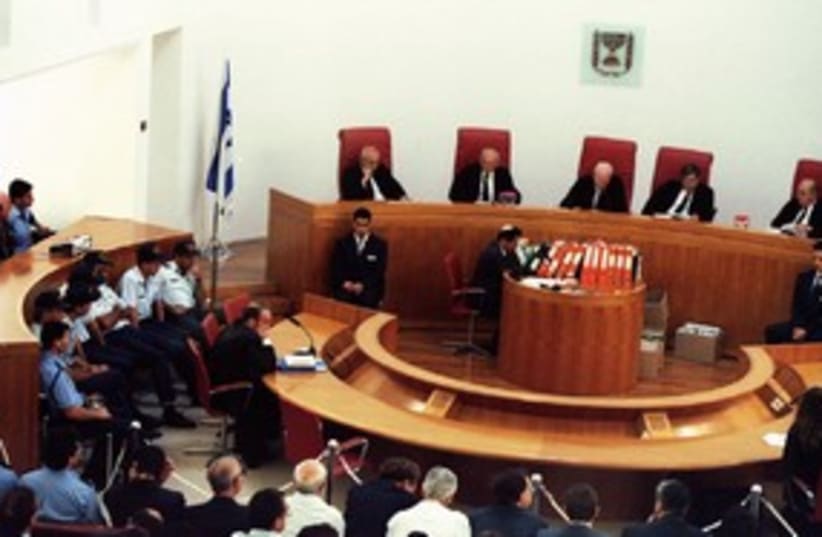
By YONAH JEREMY BOBIsraeli Supreme Court 311(photo credit: REUTERS/FILE)
It is hard to overstate the contributions to jurisprudence in the State of Israel and to Jews worldwide of former deputy Supreme Court president Rabbi Menachem Elon, who died last week.Elon was the founder of the modern Mishpat Ivri movement to study Jewish law from a combined legalreligious rather than a wholly religious perspective. The movement is strong in various Israeli law schools and in a number of American law schools.Possibly even more noteworthy, he pressed, largely successfully, for integration of certain fundamental Jewish law principles into the jurisprudence of the Supreme Court.Elon was a fan of the Basic Laws enacted in the 1990s – in particular of their giving “effect to the values of the State of Israel as a state both Jewish and democratic,” as he stated in the English translation of his major fourvolume work, Jewish Law.Elon noted that the Basic Laws “mandate recourse by the Israeli courts to two sources.”One source was looking to “the scope and meaning of the enumerated rights in the democracies where freedom is prized.” But another source was implementing “the values of Israel as Jewish state” by understanding the “Jewish heritage, which has dealt with these rights extensively in the Bible, the Talmud, the post-Talmudic legal literature, and the works of countless generations of Jewish thinkers.’” Another law that Elon highlighted and analyzed is the 1980 Foundations of Law Act, which he said severed the legal system of Israel from the English legal system and sought to “found the system of Israel instead upon the principles of ‘freedom, justice, equity and peace of the Jewish heritage.’” Elon’s jurisprudence and study of Jewish law included exploring the differences between historic Jewish law and modern Israeli legislation; specific influences of Jewish law on modern Israeli law, including regarding personal status law; and trying to resolve “complex questions... as to the relationship between the rabbinical courts and the general legal system of the State.”His jurisprudential impact went far beyond Mishpat Ivri. As deputy president of the Supreme Court, he made many influential rulings and his respect for traditional Jewish law did not prevent him from reaching progressive decisions on major issues.One of the most notable examples was his writing the opinion and voting in favor of the petition of Leah Shakdiel to join the religious council of Yeroham in 1988.The minister of religious affairs had obstructed Shakdiel’s nomination to the religious council on the grounds that she was a woman. The key state arguments to the High Court were that religious councils deal with significant religious matters in which women do not participate according to Jewish tradition and that the inclusion of a woman in such a context would paralyze the activity of the council, jeopardizing important religious services to the community.The three-judge panel ruled that the exclusion of women from state administrative bodies was discriminatory, contradicted the fundamental principle of equality in the Declaration of Independence and was explicitly forbidden according to the Women’s Equal Rights Law of 1951.Though a proponent of Mishpat Ivri, Elon’s ruling in the Shakdiel case established that religious law could not be applied beyond the domain of family law if it conflicts with human rights.Lea Shakdiel became the first woman to serve on a religious council in Israel. Legal scholars credit the High Court’s ruling as having impacted religious groups and religious standards. They say that the ruling accelerated processes of integration of other women in religious administrative bodies and reduced the gap between strict conservative religious doctrines and modern human rights standards.But another dimension that Elon added as a scholar of Jewish law was stating with authority that the issue in question was not even a prohibition of Jewish law, but more of a general public policy preference. His unique ability among the justices to make this line of argument both contributed to modern interpretation of Jewish law and, for some, softened the loss on the issue. Elon indicated that in actual cases of conflict between Jewish and modern Israeli law, while eventually modern Israeli law would prevail if there was no alternative, a balancing of the legal systems’ values should first be attempted.Another major ruling that showcased the incredible integrity and commitment to the rule of law of Elon in the face of reaching a decision, which likely plagued him and the other justices on the panel, was the 1993 Demjanjuk decision.Having hidden his identity from justice for decades after the Holocaust, John Demjanjuk was finally located, extradited from the US to Israel and convicted in the Jerusalem District Court of committing crimes against humanity, crimes against the Jewish people and other crimes with a finding that he was the notorious SS soldier known for his cruelty as “Ivan the Terrible” of Treblinka.More specifically, Demjanjuk was alleged to have served as an SS “wachman,” to have perpetrated unspeakable acts of cruelty on victims in the Treblinka concentration camp and to have operated with his own hands the engines that pumped the poisonous exhaust fumes into the gas chambers. The allegations were that he had personally caused the death of hundreds of thousands of people killed in this manner. He was sentenced to death and appealed to the Supreme Court over both the conviction and the sentence.Although most of the numerous legal issues presented in the case were dealt with in a way that the Supreme Court could have upheld the conviction, the court shocked the nation and the world, acquitting Demjanjuk due to additional evidence having been introduced late in the case.The new evidence supported Demjanjuk’s claim that he had never even served at Treblinka and therefore could not be Ivan the Terrible, for whose deeds he had been convicted and sentenced to death.The court noted that it was true that the new evidence consisted only of depositions taken in the USSR, without the testimony of those who had taken them. However, the court said that the volume of these depositions created a reasonable doubt that could not be ignored. Ultimately, the court reached the conclusion that the new evidence created a reasonable possibility that Demjanjuk was not Ivan the Terrible and was not guilty of the actions for which he had been indicted.On the other hand, the evidence also showed that the appellant had served as an SS wachman in the Trawniki Unit, and the deposition of a wachman named Danilchenko described in detail the appellant’s service in Sobibor.Under section 216 of the 1982 Criminal Procedure Law, the court said it could even convict Demjanjuk of an offense not alleged in the indictment if proven by the evidence and provided he was given a reasonable opportunity to defend himself. The facts proved Demjanjuk’s participation in the extermination process, the court noted, and could perhaps sustain his conviction for other offenses under the Nazi Punishment Law.But the Court eventually decided not to apply section 216. Granting Demjanjuk a “reasonable opportunity” to defend himself now meant an additional extension of the hearings beyond an acceptable limit, his legal proceedings having been extended over many years. The right of defense in a criminal trial was of the greatest importance, and the court would not sacrifice it.It must have been a heart-breaking decision to acquit, because of mistaken identity, the length of the proceedings, a man who evidence suggested was actually a Nazi guilty of crimes against the Jewish people. Though Demjanjuk was finally convicted in May 2011 in a new trial in Germany, he died in 2012 before appeals were exhausted and never received any punishment for his crimes.But Elon stood for integrity and the rule of law first and foremost, and in that decision helped frame the Supreme Court internationally as a court that would rule objectively no matter the cost and the pain – something that had been questioned after the Eichmann trial. His legacy on these issues of jurisprudence are likely to extend far beyond his lifetime into the distant future.
if(catID != 151){
var cont = `Take Israel home with the new Jerusalem Post Store