Security and Defense: Why is the Dagan era ending?
And what does this signal for the covert battle he waged to thwart Iran’s nuclear drive?
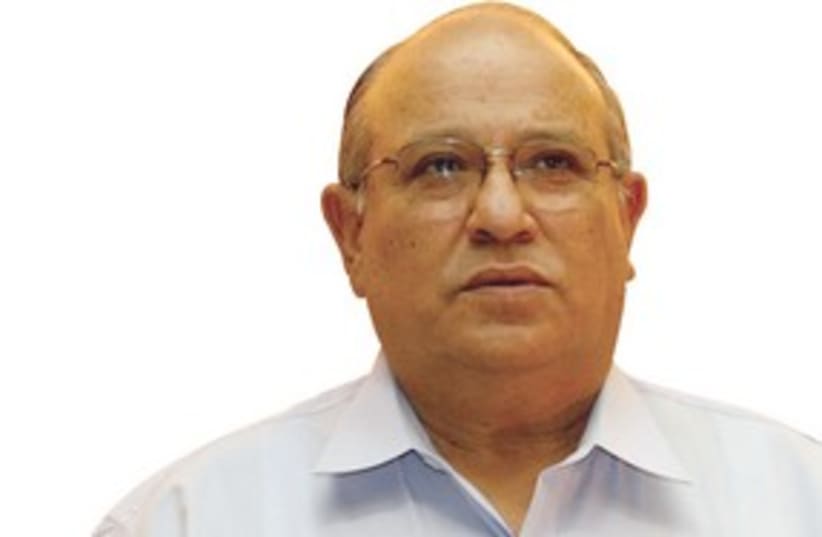
By YAAKOV KATZDagan 311(photo credit: Ariel Jerozolimski)
When Meir Dagan was appointed head of the Mossad in 2002, one of the first things he did was hang an old blackand- white picture, fraying at the corners, on a wall in his office at the spy agency’s headquarters near Tel Aviv.The black-and-white picture is of an old bearded Jew, wearing a tallit and kneeling down in front of two Nazi soldiers, one with a stick in his hand, the other carrying a rifle slung over his shoulder.“Look at this picture,” Dagan, 65, reportedly often urges visitors to his highly secure office. “This man, kneeling down before the Nazis, was my grandfather just before he was murdered. I look at this picture every day and promise that the Holocaust will never happen again.”The injunction “never again” has characterized Dagan’s eight-year tenure as head of the Mossad. It underpins the two main objectives on which he has focused the organization: preventing Iran from obtaining nuclear weapons and waging a covert shadow war against Israel’s axis of evil – Iran, Syria, Hizbullah and Hamas.Dagan’s work has reportedly paid off. In recent years, Iranian scientists began to disappear.Equipment sent to Iran for its nuclear program arrived broken, likely sabotaged.Warehouses in Europe where equipment for Iran’s nuclear program was stored before being shipped went up in flames. In 2005, Iran was plagued by a number of mysterious plane crashes, killing dozens of Revolutionary Guard Corps officers, including several senior officers. All this was attributed, in the foreign press, to the Mossad.His successes have brought frustration for others.Over the years, three of his deputies have resigned – angered by the government’s decision to repeatedly extend Dagan’s term in office, stymying their career prospects.But those successes have certainly brought more funding for the Mossad. According to one former senior intelligence operative, by 2007, five years into his reign, the Mossad’s annual budget had jumped significantly.“Whether you like him or not, Dagan is one of the greatest Mossad directors ever,” a former top Mossad official said this week. “His achievements are innumerable.”But now the Dagan era is drawing to a close. It was announced this week that he would stepping down at the end of the year. And the race to succeed him has already begun.MEIR DAGAN was installed into the top intelligence post by prime minister Ariel Sharon, who had worked with him in the 1970s running a unit of elite commandos called Sayeret Rimon whose soldiers disguised themselves as Palestinians and raided the Gaza Strip in search of PLO fighters.After his appointment in 2002, he immediately set out to revolutionize an organization that had been rocked by the botched assassination of Hamas’s Damascus-based chief Khaled Mashaal in Amman in 1997, under the tenure of Mossad chief and former Labor MK Danny Yatom. Two Mossad agents were caught in the botched operation. In exchange for their release, and to salvage ties with a furious Jordan, Israel was forced to provide the antidote to save Mashaal’s life and to release hundreds of Palestinian prisoners, notably including Hamas founder Sheikh Ahmed Yassin.After Yatom came Efraim Halevy, the Mossad veteran who had salvaged the Israeli-Jordanian relationship after the Mashaal fiasco. Some credit Halevy with rehabilitating and restoring proper practices to the battered organization; but one critical former Mossad operative sniped that Halevy preferred talks with Arab diplomats at cocktail parties in Europe over dangerous and risky operations in the Middle East. “Under Halevy, the motto was ‘don’t get in trouble,’” said this source.If so, that attitude completely changed under Dagan, who brought a new sense of daring.He was given one key task by Sharon – to do everything possible to thwart Iran’s pursuit of a nuclear weapon. To do that, Sharon reportedly told Dagan that he needed to recreate the Mossad as a spy service “with a knife between its teeth.”Indeed, Dagan’s Mossad is credited with orchestrating a string of assassinations around the world: In February 2008, a car bomb killed Imad Mughniyeh, Hizbullah’s military commander in Damascus. Later that year, Gen. Muhammad Suleiman, Syrian President Bashar Assad’s liaison to Hamas and Hizbullah and the head of the country’s covert nuclear program, was shot dead by a sniper at his vacation home in the port city of Tartus. In January, the Mossad reportedly struck again, killing Mahmoud al-Mabhouh, the Hamas arch terrorist, in Dubai.According to foreign reports, the Mossad was also behind the discovery of Iran’s uranium enrichment center in Natanz, as well as the discovery of Syria’s nuclear reactor, which was destroyed by the IAF in 2007.Under Dagan’s tenure, relations with the CIA also peaked due to the Mossad’s success in once again providing critical intelligence and proving itself to be a major player. “There is unprecedented cooperation between the agencies today,” one top Israeli security official said recently.The decision to consistently extend Dagan’s term was a vote of confidence in the Mossad and an appreciation of his achievements. Furthermore, one top defense official added, by extending his term, Israel was sending a message to the world regarding the severity with which it views the Iranian nuclear threat. The annual extension meant that Israel was keeping Dagan in place in case tough sanctions were not imposed and Israel might feel it had no choice but to attack Iranian nuclear installations.If that is true, then the latest round of sanctions – albeit not as tough as Israel hoped – could be what paved the way to the announcement of Dagan’s retirement.While Dagan’s opinions on a military strike against Iran are not publicly known, some sources claim that he believes there is still time to stop it from obtaining the bomb by non-military means.Last year, he stirred controversy when, in an appearance at the Knesset, he was quoted as saying that Iran would not obtain the bomb until 2014, pushing back earlier assessments by a number of years.At the time, officials explained that Dagan was referring to the stage when Iran will have the ability to fire a missile tipped with a nuclear warhead into Israel. Iran could very well develop a testable nuclear device before then, they said.THIS WEEK’S news of his imminent departure hasn’t only set off a race to succeed him. It also raises serious questions regarding the long-term strategic thinking of Prime Minister Binyamin Netanyahu and Defense Minister Ehud Barak, since it means that, starting in October, all of the country’s security chiefs will step down within six months. These include Chief of General Staff Lt.-Gen. Gabi Ashkenazi, Military Intelligence chief Maj.-Gen. Amos Yadlin, Shin Bet (Israel Security Agency) chief Yuval Diskin and Dagan.One possible candidate to replace Dagan is T., who served in the past as his deputy, stepped down and recently returned to the agency. Other candidates are believed to be the head of Tzomet, the Mossad branch that directs its worldwide network of agents, and the head of the Tevel branch, which is responsible for ties with foreign intelligence agencies.Diskin and Yadlin are candidates, too.Predictions within the defense establishment are that Netanyahu will choose a successor to Dagan after Barak chooses a successor to Ashkenazi, who is to finish up his four-year term in February. This is because one of the generals vying for the top IDF post, if unsuccessful, could be given the Mossad directorship as a consolation prize.WHAT IS unknown is how big a role the recent fiasco surrounding the Mabhouh assassination in Dubai, attributed to the Mossad, played in the decision not to extend Dagan’s term. A number of friendly states were angered by the use of their passports in the operation. As a result, diplomats were expelled from Britain, Ireland and Australia and currently an alleged Mossad agent is under arrest in Poland awaiting extradition to Germany, where he will stand trial for illegally obtaining a German passport reportedly used in the operation, according to the foreign press.Either way, it is interesting to compare the international fallout following the assassination to the recent discovery of an alleged Russian spy ring in the US. According to recent reports, the FBI has claimed that at least one of the alleged spies was in possession of a forged British passport.Tom Gross, a former Israel correspondent for The Sunday Telegraph and an expert on British politics and media, is waiting to see whether there will be a discrepancy between the way the Foreign Office in London responded to the reported use of British passports in the Dubai operation and the way it responds in the Russian case.“I wonder what outrage the British government will express concerning the latest reports of forged British passports – this time apparently by the Russian government,” Gross said. “Will furious denunciations be made, and senior Russian diplomats in the UK be deported, or is such action only reserved for Israelis?”
if(catID != 151){
var cont = `Take Israel home with the new Jerusalem Post Store