NSC report should be mandatory reading for anyone concerned with the way gov't confronts future challenges, like nuke issue.
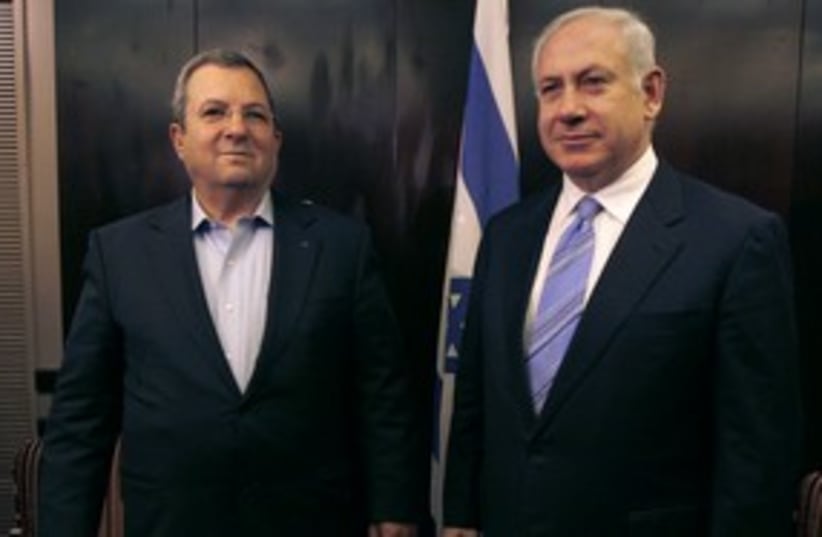
By YAAKOV KATZPrime Minister Netanyahu with Defense Minister Barak 311 (R)(photo credit: Ammar Awad / Reuters)
Sometime in the coming months, the government might find itself before one of the most daunting decisions the country has faced in its 64 years of existence – to attack Iran’s nuclear facilities or to hold its fire and forfeit control of Israel’s destiny into the hands of the United States.This question can hardly be compared to the question of how to prepare for and handle the Turkish flotilla that tried to break the Israel-imposed blockade over the Gaza Strip in 2010 – in its gravity, significance or sense of consequences on an existential level.On the other hand, the decision-making process which led up to the flotilla, the way the raid was carried out and the way the government and military handled the subsequent media fallout, should serve as a red warning light for the Israeli people as its government considers how to meet such daunting challenges.It is important to note that many of the problems raised in State Comptroller Micha Lindenstrauss’s two reports released on Wednesday – on the 2010 Turkish flotilla and on the National Security Council – have been corrected or at least ameliorated. For example, the comptroller clearly states that since his investigation began, the NSC has been playing a more active role in the governmental process.Nevertheless, the report on the NSC should be mandatory reading for anyone concerned with the way the government is confronting challenges such as that posed by Iran.Take this one line as an example: “The decision-making process at the highest levels of the government on some of the most critical issues for Israel – many of which are hidden from the public’s eye – are not handled in the best way possible,” Lindenstrauss wrote.This one line is a direct contradiction of everything Prime Minister Binyamin Netanyahu and Defense Minister Ehud Barak have tried to portray when it comes to the deliberations regarding Iran and a possible military strike.Barak, for example, has more than once claimed that the discussions on Iran have never been as comprehensive as they are today. “I have sat in meetings as head of Military Intelligence, as chief of staff, as defense minister and as prime minister, and I can say that never before have discussions on one single issue been so thorough and comprehensive,” Barak said just a few months ago in a meeting with several reporters.Yaakov Amidror, the current head of the NSC, deflected some of the concern that might emerge from the report regarding the Islamic Republic.“Today we are dealing with bigger things in the international arena,” Amidror said. “The decision-making process is much, much better.”Well, Lindenstrauss doesn’t necessarily agree. While the focus of his report is on the NSC and its lack of influence within the governmental process – particularly the prime minister’s failure to give it authority to serve as a body that can provide an alternative perspective to those of the IDF and the Mossad – his concern should be all of Israel’s concern.The public may never know what Lindenstrauss was referring to or, it might only come out with the state commission of inquiry that would be set up following an Israeli strike against Iran and the war that ensues (if there is one).While the Iran debate has long featured in newspapers around the world – particularly due to the outspoken opposition to a strike from former security chiefs Meir Dagan, Gabi Ashkenazi and Yuval Diskin – the debate is not as transparent as some would make it out to be. Israelis, for example, do not really know what timeline Netanyahu and Barak are working with and how the determination will be made if and when the day comes.As Lindenstrauss shows, while some officials warned of violence on the Mavi Marmara, they were not taken too seriously.The security cabinet was not convened, and instead, Netanyahu met personally with Barak and the IDF chief of staff (Ashkenazi).Iran though is not Turkey.While the flotilla helped seal the coffin containing the remains of Israeli-Turkish ties, a mistake when it comes to Iran will have far greater consequences for Israel, the region and possibly the entire world.
if(catID != 151){
var cont = `Take Israel home with the new Jerusalem Post Store