The first newspapers in the country were published in Jerusalem, pioneered in 1863 by Halevanon.
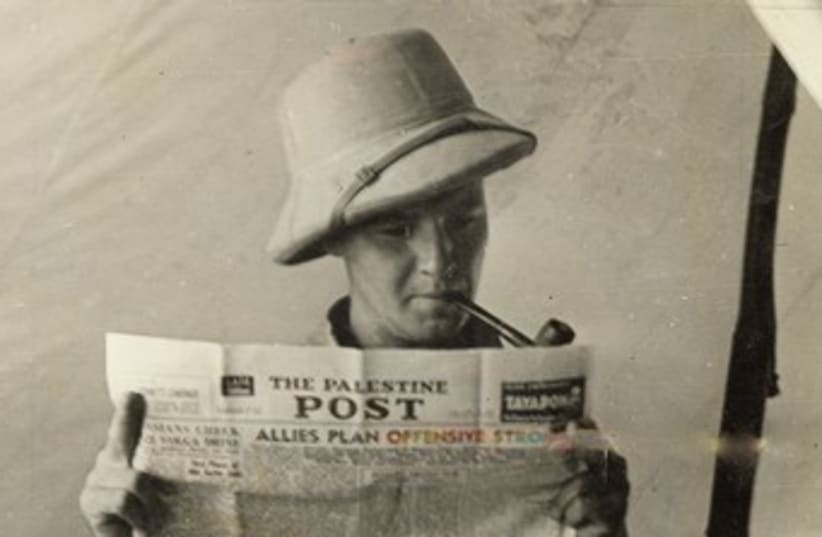
By GREER FAY CASHMANTHE PALESTINE POST oldschool newspaper reading 370(photo credit: JERUSALEM POST archives)
If Tel Aviv is the media capital of Israel, Jerusalem is the media cradle.The first newspapers in the country were published in Jerusalem, pioneered in 1863 by Halevanon, which was published by the famous Yoel Moshe Solomon, among the founders of Jerusalem’s first Jewish neighborhood built outside the walls of the old city.Halevanon was followed a half a year later by Hahavatzelet published by Rabbi Israel Beck, who had been a printer in Safed and had moved to Jerusalem to counter the work of missionaries. The papers were both weeklies, with the former directed towards the interests of the non-hassidic community, and the latter serving as the voice of the hassidim. Rivalry was fierce and both publishers kept informing the Turks on each other, until finally both were shut down by the Ottoman authorities.The first daily paper to surface in Jerusalem was Hazvi, initially a weekly publication which first appeared on October 24, 1884. Over time it developed into a daily with a circulation that reached its apex in 1909 with 1,200 copies, nearly half of which were distributed in Jerusalem.Hazvi was edited by Eliezer Ben-Yehuda, who is credited with reviving Hebrew as a spoken language. It was the first of several newspapers that he edited. When his son, Itamar Ben-Avi, joined the paper, he revolutionized it by introducing a different style of writing, more sensationalist headlines and news – as distinct from literature – with the aim of appealing to a wider range of readers.Altogether, Hazvi was a much more secular publication than its predecessors, in addition to which it was a perfect vehicle for the introduction, by Ben-Yehuda of new words into the contemporary Hebrew lexicon.The paper went through several name changes. From 1902 to 1908 it appeared as HaHashkafa, after which it reverted to Hazvi and then in 1910 became HaOr.During World War I it was outlawed by the Ottoman authorities who were exceedingly angered by editorials calling for a Jewish homeland.The oldest surviving daily newspaper in Israel today is Haaretz which, though now published in Tel Aviv, was founded in Jerusalem in 1919 as Hadashot Haaretz.The second oldest daily is The Jerusalem Post, founded on December 1, 1932, as The Palestine Post by Gershon Agron, who later became mayor of Jerusalem.Even then, it was fashionable for journalists to dabble in politics, and it should not be forgotten that Theodor Herzl, founder of the Zionist Movement, was a journalist, and it was when he covered the outrageously anti-Semitic Dreyfus trial that he came to the conclusion that the true destiny of the Jewish people lay in the return to their ancient homeland.It was this realization that swept Herzl along the path of political Zionism.The Palestine Post became The Jerusalem Post in 1950, after the establishment of the state, and what is remarkable is that it has not only outlived subsequent Hebrew publications that have faded into the dust of history, but has expanded at a time when print media is on the decline. The only other daily that preceded The Jerusalem Post was the now defunct Histadrut organ Davar which operated from 1925 to 1996.It is interesting to note that although the print media is saturated with female writers and section editors, The Jerusalem Post and Davar were the only daily papers whose owners and publishers saw nothing amiss with having a woman as chief editor.Lea Ben-Dor was the first – and so far the only – female editor-in-chief of The Jerusalem Post and Hannah Zemer was the only female editor-in-chief of Davar.Although Ben-Dor had been a journalist for many years, her reign as editor-in-chief was very brief – just over one year.Nonetheless, when she died at 68, she left a strong impression on those who had known her and worked with her.In his obituary for Ben-Dor in mid- March, 1981, David Landau – then the political reporter and news editor for The Jerusalem Post, while simultaneously serving as Bureau Chief for the Jewish Telegraphic Agency, and who later became the editor in chief of Haaretz – wrote: “Lea Ben-Dor, a former editor of The Jerusalem Post whose relatively hawkish views and acerbic commentary on events in the Knesset were widely respected, though not always shared by her colleagues, died here last week at the age of 68. She was buried Friday. Her funeral was attended by Mayor Teddy Kollek, government officials, Supreme Court justices and leading members of Israel’s journalistic community.“In eulogizing Mrs. Ben-Dor, Kollek paid tribute to her talents as a journalist, political commentator and a patriot, recalling her various services to the state. She was associated with Israel’s secret service during the early years of statehood and at one point took a three-year leave of absence from the Post to work in the Prime Minister’s Office.“Mrs. Ben-Dor was the daughter of George Halpern, a prominent Zionist from Germany who was one of the founders of Bank Leumi and the Migdal Minyan Insurance Co. She often recounted to friends her memories of visits to her father’s home by Chaim Weizmann – the first president of Israel – and other Zionist leaders.“She was educated at Roedean, a prestigious girls school in England, and at Cambridge and London universities. She joined The Palestine Post – as the newspaper was known before 1948 – in the middle 1930s and took leave during World War II to serve with the British Army in Egypt.“During the 1950s and 1960s her influence was strongly felt at the Post. She and then-editor Ted Lurie were strongly pro-Ben-Gurion and saw to it that the views of Israel’s first premier shaped the “line” of the paper. Her often sharply-worded column on doings in parliament became an institution on Israel’s political scene.“Mrs. Ben Dor remained a hawk and a staunch admirer of former defense minister Moshe Dayan after the Yom Kippur War when many of her Post colleagues held different outlooks. The clash of views became serious when Mrs. Ben-Dor assumed editorship of the Post after Lurie died in 1974.“But chronic asthma and impatience with administrative duties, rather than political differences, cut short her tenure on the newspaper. She retired after less than two years, but remained a member of the Post’s Board of Directors.”Curiously, Hannah Zemer, the long-time editor of Davar, and the first woman to be editor of a newspaper in Israel, also died in March – but 22 years later, in 2003, at age 78 – having survived by seven years the newspaper she used to run.Zemer was editor of Davar from 1970- 1990, having previously filled other positions at the paper.A Holocaust survivor, Zemer was born in 1925 in Bratislava, Slovakia, to an Orthodox family in which Jewish values existed in harmony with Western culture, though the school at which she studied was a Beit Yaacov seminary.When she first came to Israel in 1950, Zemer worked briefly as a teacher in the ultra-Orthodox education system. She later joined the IDF and, following her discharge, began working as a journalist on a publication called Omer, which was an easy to read version of Davar published for new immigrants who found difficulty reading Hebrew without under-vowels.Zemer’s talents for observation and analysis were soon recognized and she was transferred to Davar and assigned to cover the Knesset and diplomatic affairs.Although Davar was headquartered in Tel Aviv, Zemer’s work entailed spending a lot of time in Jerusalem. She was subsequently given other responsibilities, and in 1966 was appointed deputy editor, a position she held until her promotion to editor-inchief in 1970.In this position Zemer became an even closer associate of Israel’s key political figures than she had previously been, and wielded quite a lot of political clout.She had already made history by becoming the first woman editor of a daily paper in Israel, and she did so again by appointing the first woman military correspondent.Tali Lipkin-Shahak, who had previously covered fashion, writing, inter alia, about tank tops, was suddenly writing about tanks and military skirmishes. It was somehow fitting that she should get the job, because her father Azaria Rapoport was Israel’s first accredited military correspondent.Lipkin-Shahak’s brother, Hanani Rapoport, is the CEO of Jerusalem Capital Studios which, among numerous other services, provides around-theclock news and production facilities to representatives of foreign news outlets stationed in, or visiting, Israel.As for Zemer, even after she retired from Davar, she was unable to relinquish journalism and worked as a mediastudies lecturer at Bar-Ilan University, where she also taught journalism.Public broadcasting in this country also had its genesis in Jerusalem.The Palestine Broadcasting Service, now known as Kol Israel or The Voice of Israel, was established by the British Mandate authorities and broadcast out of Jerusalem from March, 1936. Its programs were in Arabic, Hebrew and English, and the Hebrew service was known as Kol Yerushalayim or The Voice of Jerusalem.Of course under the Mandate, programs were heavily censored to ensure that political messages were not conveyed, but despite the censorship, the radio played an important role in fostering the revival of the Hebrew language and in promoting national identity.While the prophets of doom are predicting the demise of the print media, just as they predicted the demise of radio and television, all three are still in existence, despite the ever-increasing competition from social media.In the print media in Israel there are daily, weekly, monthly, quarterly and annual publications for adults, youth and children in Hebrew, English, Arabic, Russian, French, Yiddish, Spanish, Romanian, Hungarian, and Italian and possibly other languages as well. There are so many that it is difficult to keep tabs on all of them.The print media may shrink in Israel, but it will never disappear, due to the ratio of religiously observant Jews in the population.Unless some genius figures out a way of using electronic gadgets without violating the Shabbat, weekend reading for this sector of society will continue to be books, newspapers and magazines.While it is unfortunately true that most Hebrew papers are printing fewer pages than they did before, The Jerusalem Post – which for the past eight years has been under the ownership of Mirkaei Tikshoret Ltd., headed by Eli Azur – has added pages over the years and is not skimping on pages now. It continues to provide a broad range of news, features and opinion pieces for its readers.The paper has come a very long way since the days of Gershon Agron. It has been led by 12 successive editors, with Jeff Barak holding the position twice – first from 1996 to 1999 and then again from 2000 to 2002.Some of the editors rose through the ranks, and some came from outside. They came from different countries of origin and at different times in their lives. Some were extraordinarily young to take on such responsibilities. Others were in the twilight of their careers, and most were somewhere inbetween.Agron’s successors were: Ted Lurie (1955- 1975), Lea Ben-Dor (1974-1975), Ari Rath and Erwin Frenkel (1975-1989), N. David Gross (1990-1992), David Bar-Illan (1992- 1996), David Makovsky (1999-2000), Carl Schrag (2000), Bret Stephens (2002-2004), and David Horovitz (2004-2011). Current Editor-in-Chief Steve Linde was appointed in July 2011.Born in the Ukraine, Gershon Agron – who shortened his name from Agronsky – grew up in Philadelphia, fought with the Jewish Legion in Palestine during World War I, and later worked for two years with the Press Office of the Zionist Commission.He then spent two years as editor of The Jewish Telegraphic Agency (JTA), as well as writing for a number of other international press agencies, before settling in Palestine in 1924.An ardent Zionist, Agron was closely involved with the leadership of the Yishuv (pre-state Jewish population) and served the interests of the World Zionist Organization.Part of his reason for founding The Palestine Post was to provide a platform for Zionist aspirations. Concurrent with his editorship of the paper, Agron continued with his service to the World Zionist Organization, and was also a member of the Jewish Agency delegation to the United Nations conference in San Francisco.From 1949-1951, Agron headed the Government Information Service while still maintaining his role of editor-in-chief of The Jerusalem Post, and it was only after Agron was elected mayor of Jerusalem in 1955 that Ted Lurie took over the editing of the paper. Agron died in office in 1959.David Bar-Illan, who was born in Haifa in 1930, was the only Sabra editor of the paper. An internationally acclaimed pianist, author and columnist who spent many years in the US before returning to Israel, Bar-Illan also left the world of media for politics, and became the director of Communications and Policy Planning as well as one of Israel’s key spokespeople during Prime Minister Binyamin Netanyahu’s first term in office.
if(catID != 151){
var cont = `Take Israel home with the new Jerusalem Post Store