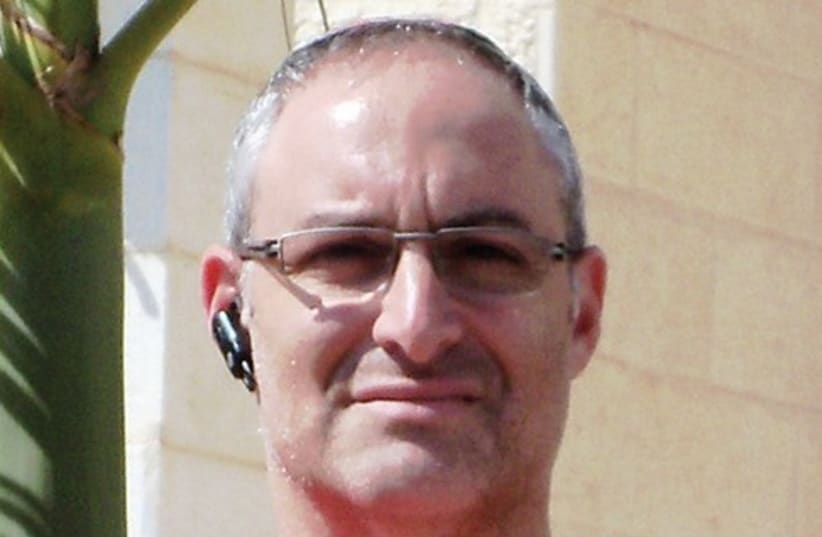
Moshe Fuld has stayed true to his convictions and, as he promised himself, made aliya with his family.
By ABIGAIL KLEIN LEICHMANMoshe Fuld 521(photo credit: Courtesy)
When other little American boys were playing with GI Joe action figures, Moshe Fuld was playing with a Moshe Dayan doll.Raised in the Hillcrest neighborhood of Queens, New York, he is the oldest of five sons of the fervently Zionist Rabbi Yonah and Mary Fuld. Remarkably, the entire family made aliya in the past 20 years, with Moshe bringing up the rear on August 10, 2006.That he arrived last does not indicate any lack of passion for Israel. A consummate planner and hard worker, he was busily getting all his ducks in a row and waiting for the opportune time to make the move.NEVER A DOUBT Fuld volunteered for the IDF right out of high school, to get his service completed before he aged out of the system. During college, he broke up with a longtime girlfriend because it became apparent that she did not want to live in Israel.“There was never a question in my mind that I’d end up here,” says Fuld, who formally met his wife, Chaya, in Queens College but knew her casually from the Hillcrest neighborhood where she’d grown up just five blocks away from him. They married in 1990.“We made a pact to make aliya 10 years after I finished law school, paid back my loans and made some money. Unfortunately, we were off by about three years,” he says. “It was 13 instead of 10.”But he made good use of those extra years. Having worked his way through New York Law School at night, Fuld opened his own firm soon after graduation, eventually hiring five lawyers and 20 support staff. “All of them, by design, were Jewish except my receptionist and file clerk. Most of the support staff were Russian Jewish women.”In sharp contrast to many attorneys who work grueling hours, Fuld made a choice to forfeit tens of thousands of dollars in potential profits so that he could leave work early enough every day to spend time with his daughter and two sons.“I swore I’d never let my business get in the way of being there for my children. I always had one more lawyer on staff than I really needed because at 4:45, no matter what, I went home – or even earlier if I could,” he says. “I’ve kept that promise till today.”Even with his shorter hours, the law firm was successful, and yet he left it at the height of his career.In 2005, he and Chaya decided to make aliya the following year from their comfortable home in Teaneck, New Jersey. Their daughter would be starting high school and they did not want to wait any longer.“Before we made aliya I stopped having personal contact with clients so they wouldn’t feel abandoned all of a sudden,” he says. Last year, after running the practice long-distance, he sold the majority portion to his managing attorney.IN LOVE WITH HASHMONAIM After making their decision, the Fulds scouted out potential places to live and became instantly enchanted with Hashmonaim as soon as they got through the centrally located town’s security gate.“We have friends all over the place, and my brothers and parents live in nice areas too – Kochav Hashahar, Efrat and Jerusalem – but Hashmonaim reminds us of Teaneck, where nobody looks at the other person’s skirt length or color of their kippa. We must have known two dozen families here even before we moved in. Everybody around us is an A-plus type of person.”The older two Fuld kids had been in a Hebrew immersion program since first grade at SAR Academy in Riverdale, New York, so they came with good Hebrew skills and acclimated quickly. The oldest (now a soldier in the air force) started high school, the middle child entered fifth grade and the youngest went into first grade. “We have been very pleased with the public schools,” says Fuld. “It’s like Gan Eden [the Garden of Eden] for children here. They’re having the best childhood.”Chaya continued at her job as an accountant for a US-based Jewish non-profit, working primarily from her office in the house the Fulds built in Hashmonaim.Moshe explains that they wanted a home large enough to host his parents and all his brothers and their wives and children for holidays. “We are 31 people altogether, so I took it upon myself to make a house where I could have the whole family under one roof.”SECOND CAREER After selling the law firm, Fuld took a Lander Institute course on Internet marketing and a class at a MATI small business development center. He decided to make a business out of what he had already been doing since making aliya – namely, finding out everything he could about service providers in Israel so that he could give advice to, and run interference for, other new immigrants.“While I was doing laundry, cleaning and cooking, I took this on as an intellectual quest,” explains Fuld, who is head of the absorption committee in Hashmonaim. “I heard horror stories about people getting burned by bank and cable companies, so now I’m a wealth of information. I know all the shtick of all the providers and how to get the best prices.”He launched AngloProtekzia (www.angloprotekzia.com) at last summer’s immigrant absorption expo in the Jerusalem Convention Center, where he explained his business model: “We get paid out of savings we find for you. We audit all your household bills, negotiate with your service providers – land line, cell phone, electric, cable, Internet, bank, insurance – and we take 50 percent of the first year’s savings. The other 50% goes back into your pocket. Then you’re my client for life and there’s no more cost.”As an alternative arrangement, for an hourly fee Fuld will help new immigrants negotiate all their service contracts up front. “I will get them rates they couldn’t get themselves because I’m negotiating on behalf of many clients,” he says. And he is opening Sapak V’dai, a similar service for Israelis. “They’re no better off than Americans with their bills,” Fuld says.PERSONAL HEROES Fuld was very involved in the Student Struggle for Soviet Jewry as a teen in New York. “The first time I laid eyes on [former Refuseniks] Natan Sharansky and Ida Nudel, chills went through my whole body because these were the people on the placards I once held,” he says.“My second hero was Yoni Netanyahu. I remember exactly where I was when the raid on Entebbe happened [in 1976]. I was on the waterfront in Camp Hillel, and that really made an impression on me.”An additional inspiration was Aaron Feuerstein, the CEO of Malden Mills in Massachusetts, who in 1995 continued paying his 3,000 employees their full salaries and benefits for six months while his burned-down factory was rebuilt. It cost Feuerstein an estimated $25 million, but he announced that his Jewish values left him little choice.“That shaped my business persona,” says Fuld. “That is the model I’ve tried to emulate in business. I always erred on the side of my employees. I wanted the non-Jewish ones to realize what a mensch is.”
if(catID != 151){
var cont = `Take Israel home with the new Jerusalem Post Store