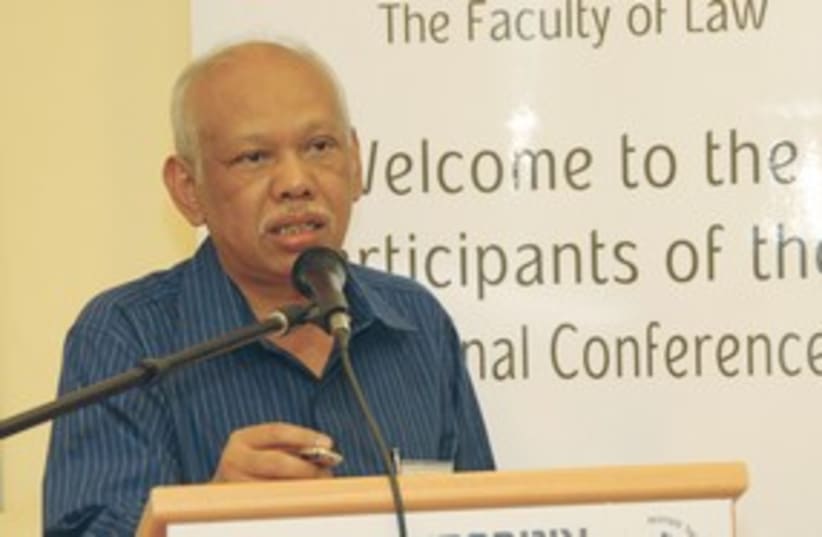
Indonesian historian Azyumardi Azra, one of the world’s leading scholars
of moderate Islam says Islam and Judaism can learn from each other.
By JONAH MANDELAzyumardi Azra _311(photo credit: Meshoolam Levy)
The non-moderate vein of Islam prevalent in the Middle East is due to the Arabs' “besieged” mentality, a result of centuries of Western occupations and sectarian clashing, according to an Indonesian historian and one of the world's leading scholars of moderate Islam."Muslims in the Middle East are on the defensive – they possess an undersiege mentality,” explained Prof. Azyumardi Azra on Monday. “They are afraid of interacting, and giving greater room,” whether to different Muslim sects or members of other religions.Later in the day, Arza delivered a lecture on the interplay among the Indonesian state, democracy and the Shari’a, at Bar-Ilan University’s international conference on Religious Law and State Affairs. The conference, supported by the Tager Family Jewish Law Program in the university’s Faculty of Law, advances research in Jewish law from a variety of viewpoints – among them religious, historical and philosophical.A professor of history at the State Islamic University in Jakarta, Azra is the founder and editor-in-chief of Studia Islamika, Indonesian Journal for Islamic Studies, and on the board of editors of the Journal of Qur’anic Studies at SOAS, University of London. In 2010 he was granted an Honorary CBE (Commander of the Order of the British Empire) from Queen Elizabeth II, for his dedication to promoting interfaith understanding.THIS WAS his first visit to Israel, and besides his surprise over how green the country was, he noted how Jerusalem’s Old City was full of Muslims, Christians and Jews – a meeting place of Abrahamic faiths. But despite the religions’ common ground, the Middle East is not a place of religious tolerance.“The sectarianism in the Middle East among Muslims leaves little room for compromise,” Azra said of the divisions among Sunnis, Shi’ites, Salafites, Wahabites and other Islamic groups in the region. “Of course the situation is getting worse with authoritarianism” prevalent in some of those countries.Could the current political upheaval in the Middle East create the setting for a more moderate form of Islam to emerge?“There are problems in the current transitions,” he said. “First, because of the long-entrenched military power, like in Egypt, which resulted in almost no civil society. In Libya’s case, there is no viable political structure, only tribalism.”According to Azra, “the challenge for Arab countries to develop democratic systems is huge. We must encourage civil societies. The problem is that when you have socialbased mass organization – the Muslim Brotherhood – they are very political, and not operational in cultural aspects of improvement such as in social affairs or education, and enhancing understanding among Muslims.”To Arza, the lack of moderation in Middle East Islam stems from the historical settings of the region.“Muslims have been on the defensive since the time of Napoleon Bonaparte in the late 18th century. Many Muslims in the Middle East had been under the control of Western powers. That’s why conspiracy theories are so prevalent.”So, while in the Middle East “there are reformists, and moderate forces,” those might “not [be] powerful enough to bring the Muslims that have been under conspiracy theories and under-siege mentality for so long” to a different phase, he said.“One of the necessary prerequisites for Muslims to develop now, would be self-confidence among themselves, to bridge the differences amongst Muslims, and between them and non-Muslims.”Of course, the Middle Eastern model of Islam is not the religion’s only modus operandi.“In Indonesia we have sectarian differences, but we give room for compromise. We are fortunate, and have, in the last two decades, experienced religious convergence, exchanges among different sectarians, an exchange of practices,” Azra said. “This created [greater] room for compromise and accommodation.”The South Asian republic, home to the world’s largest Muslim population, also has a very different attitude toward women than that of this region.“In the Middle East, Muslims are a male-dominated society. Males play an important role at the expense of women, who have been segregated for centuries,” Azra said. But in Indonesia, women can recite the Koran in mosques, as their voice is not considered “arwa” – sexually arousing to men. Middle Eastern Muslim men, as well as many Orthodox Jews, refrain from hearing a woman’s voice in song, let alone liturgy. In addition, Indonesian Muslim women pray together in the same mosque space as men do, on different sides but without a dividing barrier.As for the Western “impression of Islam as a radical religion, since the colonial period, Westerners look at Islam only in the Middle East, and identify it with that region and the Arabs, disregarding the fact that Islam has a strong influence in South and Southeast Asia,” he noted.“ISLAM AND Judaism can learn from each other,” Azra added. “Christianity, Islam and Judaism came from the same roots. We have a lot in common, and should strengthen the commonalities among us. We should not only look to differences; even among children in one family, there are differences, but one needn’t emphasize them.”Prof. Zvi Zohar of Bar-Ilan University’s Faculty of Law, who was a member of the conference organizing committee, agrees that Shari’a, the religious law of Islam, is very similar to Halacha.“There are many similarities which we can build upon and which can be the basis for intellectual and academic conversation with Islamic scholars and the people of Indonesia, a country with which Israel has no diplomatic relations,” he said.To Zohar, who is also one of the editors of the biannual journal of law, religion and state published within the framework of the program, it is fundamental to involve Islam in discourse such as that hosted by the conference.“In any discussion of the relationship of law, religion and state, there are many reasons to inquire into Islam,” he said. “Islam and Judaism are much closer in their structure and relation between religion and state” than Christianity, for example.“To our sorrow, the Israeli-Palestinian conflict has been escalated by certain quarters to be seen as interreligious conflict,” Zohar said. “The founders of Israel had nothing against Islam, it is merely a matter of [historic coincidence] that the people living here were Muslims. We have every reason to be interested in entering into dialogue with Islam, and must not let conflict obscure the common grounds.”He added, “If we talk together we could learn about each other and see the similarities and common issues that are facing people in both communities, and find that there is a spectrum in both. Indonesia is an important country with an important culture of its own, and we are hopeful that this will form the basis of future cooperation in a positive spirit.”
if(catID != 151){
var cont = `Take Israel home with the new Jerusalem Post Store