The Health Ministry has done nothing to persuade Israelis to get the annual flu shot. But it can be done, with creative thinking.
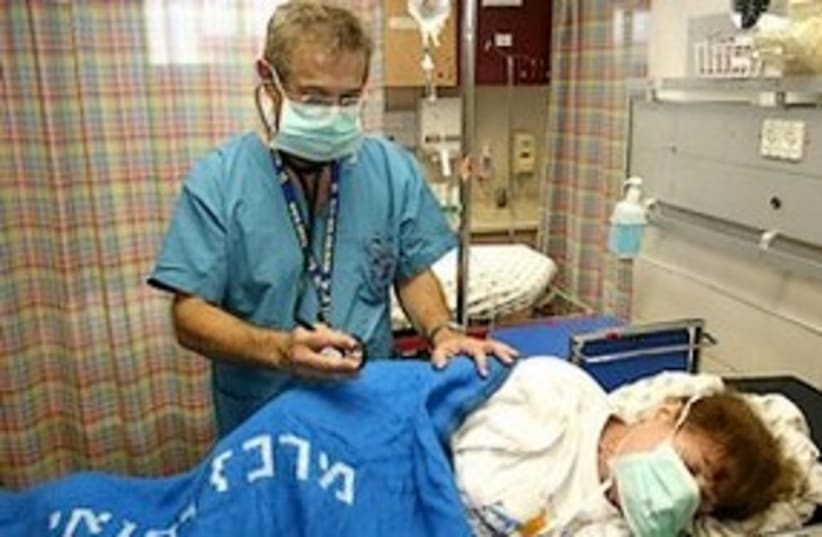
By JUDY SIEGEL-ITZKOVICHSwine flu patient (photo credit: Ariel Jerzolomiski)
Just as almond trees blossom in February and the beaches begin to fill up in June, the chaotic scene in the country’s hospitals every winter returns with predictable regularity.The emergency rooms and pediatric and internal medicine departments are packed; helpless patients cry out for nurses who say they are close to collapsing; and Health Ministry officials open their wallets for emergency measures.But the health authorities never seem to do anything serious to prevent people of all ages from developing influenza complications such as pneumonia and other infections that – in those with weak immune systems and chronic diseases – can kill them.Flu vaccinations were not always free. At first, only those regarded as being at high risk of complications – the elderly, people of all ages living or working in institutions and individuals suffering from heart disease, diabetes and other chronic illnesses – were eligible for free shots. Then it became free for everybody, and, a few years ago, the ministry recommended that everybody above the age of six months should get a flu shot at their health fund clinic.But administrators of the four public health funds have never bought enough vaccine to cover the whole population; they do not want their money to go down the drain.They know only a small minority will actually be vaccinated.The little vials usually cannot be used the following year because the flu virus strains change; a new formula of vaccine strains is produced based on those identified in the Far East, where they first strike.ACCORDING TO the latest ministry figures, only 16 percent of the population – 1,126,000 out of eight million – were vaccinated this winter, and only 57.6% of high-risk populations including those over age 65 have gone for the shot.Even a few years ago when the public panicked over the lack of vaccine against the H1N1 strain of flu, the vast majority of the public have not gone for vaccination. Now, some of the health funds’ supplies have already run out.So by late January (or even earlier, depending on the weather), weak patients enter crowded hospitals – lying in hospital corridors where they have no privacy and can’t sleep, and even in cafeterias serving meals. They also tend to pick up nosocomial diseases – infections they did not bring with them but that were spread in the hospitals themselves – that combined with flu complications can make them even sicker.People must go early – preferably right after the High Holy Days in October – to get their shots, as it takes weeks for the vaccine to produce protective antibodies. Flu vaccinations do not completely prevent all people from getting infected, but if they do develop the flu, it is inevitably a milder case than it would be without the shot. Yet most people are reluctant to roll up their sleeves. They have heard of people who got the shot and immediately “got sick.” They don’t like needles. Or they just don’t want to “waste time.” Even if the nasal spray vaccine were more effective, most probably would still decline to be vaccinated.All this sickness costs lives – and a lot of money. Occupancy in the general hospitals’ key departments range from 120% to 180%.Patients have been advised to prefer their health fund clinic doctors rather than to go to hospital emergency rooms if they are not “too sick,” but some patients who were sicker than they appeared to be and whose hospitalization was delayed have died as a result.All the ministry said last week was that due to the overcrowding in hospitals, an arrangement had been made in coordination with the Finance Ministry and the Israel Nurses’ Union that additional funds would be allocated for extra shifts in emergency rooms during the crisis. This was decided according to the previous model of increases given to nurses in internal medicine departments during the previous flu crisis.BUT THERE is a simpler and cheaper way to cope with these annual medical crises: prevention. After Yom Kippur, the health funds mail reminders to high-risk members to come in for their shot, but at least half of them are ignored, and there is no active effort by either the ministry or the insurers to implement the ministry’s recommendation for all over the age of six months to get vaccinated.Although the ministry runs a short media campaign on condom use for World AIDS Day on December 1, it sponsors only a few public service ad campaigns on other health causes through the year, saying it lacks the funds. Orchestrating and coordinating a public information campaign on flu shots would certainly help. But many Israelis don’t trust what the government and the Health Ministry recommends.Unable to think out of the box – with a mind-set of “putting out fires” rather than preventing them from being set in the first place – ministry public health officials have not found a way to encourage the majority of the public to get vaccinated.Last week, I suggested an idea, but 24 hours after the query was dispatched, no response at all was received from either ministry spokeswoman Einav Shimron-Greenboim or director-general Prof. Ronni Gamzu and public health chief Prof. Itamar Grotto, all of whom dealt with it.THE IDEA: Every family whose members get flu shots could be offered a health-oriented gift, paid for by the ministry, that would encourage widespread vaccination and reduce the number needed to be hospitalized. It could be a digital blood-pressure measuring machine, digital scale, blood-glucose monitor, body-building weights set, a professional first-aid kit or similar gifts that would promote health. The ministry could issue a public tender inviting companies to offer their products at the lowest price for inclusion in a list of gifts, which would be presented to families by their health funds when all members complete their shots. The savings in hospitalization costs would undoubtedly cover the expense.Although ministry officials were not interested, the new head of Hadassah University Medical Center’s emergency department, Dr. Aziz Darawsha – who is chairman of the National Council for Emergency Medicine – was very excited about the idea. “Yes, it’s excellent,” he told me. “I am for any creative idea that will increase the number of those vaccinated against the flu. It will certainly be cost effective. Israelis like gifts. I can’t say how much higher vaccination rates will reduce the number of patients with flu complications and deaths in the hospital, but I have no doubt it will be significant. There will be less disease, lessserious disease and fewer deaths.”The emergency medicine specialist added that the lack of public information campaigns on the urgency of flu vaccination and “the Israeli mentality – that nothing will happen to them so they don’t need to be vaccinated, that they should avoid needles, that the vaccine will make them sick and that the shot really hurts – all of them incorrect – are responsible for the very low compliance figures.”If the ministry continues to ignore the preventive approach and no progress is made to prevent the annual winter chaos, next January the scene will return: beds lining hospital corridors, nurses and doctors complaining about being overworked, a high toll of dying patients and banner headlines in the papers bemoaning the situation.It doesn’t have to be.
if(catID != 151){
var cont = `Take Israel home with the new Jerusalem Post Store