Although a new discovery will pick up 100 percent of Down fetuses with a simple blood test, many families want to keep and raise them. These ‘special people’ deserve equality, love and assistance.
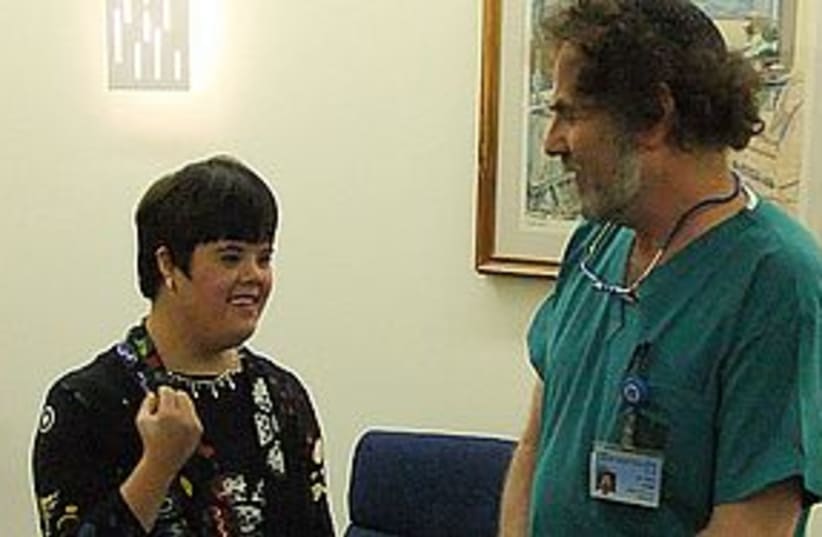
By JUDY SIEGEL-ITZKOVICHefrat dotan down syndrome 311(photo credit: Judy Siegel-Itzkovich)
People with Down syndrome have something extra. It is not only the extra 21st chromosome that causes all the physical, developmental and cognitive problems – but the extra soul, delightfulness and gentleness that they seem to have at any age. Those who have seen Down syndrome children at play or adults volunteering in the Israel Defense Forces, working with children or in a service profession knows they are especially giving and undemanding.“It should not be Down syndrome but Up syndrome,” said Efrat Dotan, a buoyant and beautiful 28-year-old born to modern Orthodox Jerusalem parents who refused to abort a fetus with the syndrome. Efrat not only works for her living at Jerusalem’s Shalva Center for Disabled Children, taking care of babies with the same disability, but doubles as an interviewer of statesmen, politicians, celebrities, physicians, scientists and others, and is due to be dispatched by Shalva to Washington to put her microphone in front of even more people.“Living Independently” – like Efrat, who introduced the speakers – was the name of an all-day conference to mark World Down Syndrome Day at Hadassah University Medical Center on Jerusalem’s Mount Scopus recently. It was held a few days belatedly, as the international day is intentionally held on the 21st (referring to the chromosome) of March (the third month, referring to the excess chromosome). The Hadassah Medical Organization hosted the fifth-annual event, while organizers and participants included Shalva, the Jerusalem Municipality, the Ministry of Welfare and Social Affairs, the Shalem Foundation, the Hebrew University and Yated – all of whom devote efforts to improving the life, treatment and integration of Down syndrome children and adults.Outgoing HMO director-general Prof. Shlomo Mor- Yosef, who greeted the hundreds of (mostly female) participants, revealed that he himself has a sister, now 58, who was born with Down syndrome. “I am very proud that Hadassah is part of this activity and work to help people with the syndrome,” he said.John Langdon Down was the British doctor who first described the syndrome in 1866. In 1959, the cause – having a total of 47 instead of 46 chromosomes – was discovered by Jerome Lejeune, who identified the 21st chromosome trisomy. While in the mid-20th century, those born with the defect survived maybe into their 30s or 40s, better understanding, imaging and treatment have raised mean survival to 60.As people with Down syndrome often have a multitude of health problems and a variety of checkups to be performed, Hadassah on Mount Scopus has a multidisciplinary, one-stop clinic for them, eliminating the need to run from one facility to another. It offers not only strictly medical diagnoses, but also psychological, genetic, dietary, communications and scanning help.PROF. EITAN KEREM, the new head of pediatrics at Hadassah University Medical Center in Jerusalem’s Ein Kerem, was promoted from the pediatric department on Mount Scopus, where this expert in pediatric respiratory medicine directed the cystic fibrosis center. “We have on Mount Scopus a chronic disability unit for childrern, and the Down syndrome center, where many of the patients are now adults.” That is due to the fact that Down syndrome is better diagnosed prenatally, and in the near future such diagnosis will be 100 percent accurate at an early stage of gestation, allowing earlier abortions. But even with threedimensional imaging and invasive amniocentesis and chorionic villus sampling, about 150 Down babies are born in Israel each year, as some families – both observant and secular, Jewish and Arab – oppose the destruction of these pure souls.Dr. Ariel Tenenbaum, head of Hadassah’s Down center and main host of the conference, said that an easy test of a pregnant woman’s blood discovered by researchers in Cyprus less than two months ago to identify the genetic syndrome in fetuses at 11 or 12 weeks with 100% accuracy could significantly reduce the number of mentally disabled children born in Israel.The new blood test discovery, published in Nature Medicine by lead author Dr. Philippos Patsalis of the Cyprus Institute of Neurology and Genetics, showed 100% sensitivity and 100% specificity in all Down syndrome pregnancies. The blood test was examined in 14 women with proven Down syndrome fetuses and 26 with normal fetuses. It is premature for pregnant women to ask for the test now, because it has to be tried in more women, approved by the authorities and produced on a commercial basis; then it is likely to become a standard test in high demand around the world. One foreign company said it could launch the new test in about a year. The team of researchers from Cyprus, Britain and Greece said they correctly identified 14 Down syndrome cases and 26 normal fetuses in a double-blind test. The blood exam could easily be performed in ordinary labs that test pregnant women’s blood.Until then, women who want to know for sure if they have a Down fetus will have to undergo invasive tests (amniocentesis or chorionic villus sampling, which can raise the risk of miscarriage and other complications). They can get less-accurate results by having conventional blood test screening, which most Israeli women (but many fewer haredim) undergo today.TENENBAUM, whose center has been operating for some seven years, discussed the numerous physical problems that appear in people with the syndrome. These, he said, include sleep apnea, recurrent lung infections, heart defects, gastrointestinal blockages, reduced hearing, hip dislocations, hypothyroid conditions, diabetes, cataracts and dental disorders. Children with the syndrome have a widely recognized appearance, with a head that may be abnormally small and perhaps with a flat area on the back; the inner corner of the eyes may be rounded or slanted upward like an Oriental instead of pointed like a Westerner’s.The Hadassah pediatrician also described the characteristic flattened nose, decreased muscle tone at birth, excess skin at the nape of the neck, small ears and mouth, single crease in the palm of the hand, and typical behavioral problems such as short attention spans, slow learning, impulsive behavior and, as teens, frustration over their limitations.They also often have below-average cognitive ability, but a few have severeto- profound mental disability. One out of three have attention deficits, he added.PROF. SIMCHA YAGEL, director of the ultrasound center of Hadassah-Mount Scopus’s obstetrics/gynecology department – who actually delivered Efrat in 1983 – said the scanning of Down fetuses is incredibly detailed today.About 40% of congenital defects appear in the developing heart.When defects are diagnosed early in the womb with advanced 3-D imaging, surgeons may be able to repair the defect even before birth, said Yagel as he showed images of a hypoplastic left heart and transposition of the great arteries. One can also look at blood flow in other blood vessels, including the veins.“There may also be a blockage in the esophagus that can be treated,” he continued.He recalled vividly Efrat’s mother’s delivery. “It was my privilege to bring you into the world,” he said, hugging the young woman. “It was great that I was born – even with Down syndrome. I am different, but I am worth it!” she unabashedly replied.Dr. Michal Luria of Hadassah’s sexual health clinic focused on the touchy subject – especially among the observant – of sexual relations between Down syndrome adults who don’t get married (although a handful do). “This matter is on the border where culture, ethics, religion, ethics, ideals, psychology and biology meet,” she said.“It is not just about having sex, but the basic right of every person to be happy and make connections with friends and lovers, experiment with their body, have sexual feelings and learn social skills. They need sex education, lessons on hygiene and how to take care of oneself, to understand anatomy and how the body develops, empowerment and setting limits.” She noted that there have been numerous cases of sexual abuse of Down people and others who are mentally disabled. “When we counsel them, we make a mark on the floor, explaining that the individual decides who is allowed to come into their space, that there is touch that is good and touch that is not good. They must understand whether a behavior is appropriate, whether you can hit your brother, wave to a neighbor, kiss your dentist, what private parts are, and how to protect yourself in public bathrooms or bedrooms.”There should be more places for Down individuals to meet and create social lives, she said. The feeling of embarrassment disappears with time. “But they need information and supervision; they must be helped with birth control, as a pregnancy to a Down syndrome couple inevitably means more disability. If we see such a couple kiss, we should educate them, as they have normal urges. Those with Down can be homosexual as well. We usually don’t think of this. We have to honor this, as nobody chooses it; they are born with it.”In recent years, numerous films have portrayed Down syndrome in realistic ways, said Emanuel Schein of the organization Shekel, but others still spread stigma. “The media and movies influence opinion and can create or break stereotypes. I am now doing a doctorate on cinema and disability. Some are patronizing, portraying the disabled as sick and victims of violence. There are also Down people who say they are ‘ill.’ Some may be shown as a burden on society and their families, as being their own worst enemy and dangerous to society because they supposedly can’t control themselves.”But Schein insisted that disabled people work in the media and films. “We developed a TV community showing the disabled how to edit movies.” A new local film that will soon be at the Tel Aviv Film Festival has actors who have Down. He also presented an American documentary about a non- Orthodox family having a moving bar mitzva for the Down child in their family.Thanks to this film, such celebrations are not foreign to us.”Shalva, founded in 1990 by Rabbi Kalman and Malki Samuels, can take a lot of credit for the advancement of Down children. Their son Yossi was born a normal child 34 years ago, but a tragic bad vaccination led to him becoming both deaf and blind. Their experience with the challenge of raising a special-needs child, coupled with a strong desire to help families in similar situations, was the inspiration behind the creation of Shalva.Its facilities provide services to more than 500 with special needs, including infants, children, adolescents and young adults through a variety of specially designed programs and round-the-clock therapies, seven days a week; Shalva, staffed by professionals as well as volunteers, accompanies the child and family from birth to adulthood, and its Learning and Development Institute, led by Tel Aviv Prof. Malka Margalit, works to advance understanding of the special-needs population. The institute hopes to extend this knowledge to field professionals as well as to the lay population.It is no surprise that Efrat Dotan and her family praise both Prof. Reuven Feuerstein’s International Center for the Enhancement of Learning and Shalva (where she spent years as a child) for encouraging her and – in the end – hiring her to advance those like her.
if(catID != 151){
var cont = `Take Israel home with the new Jerusalem Post Store