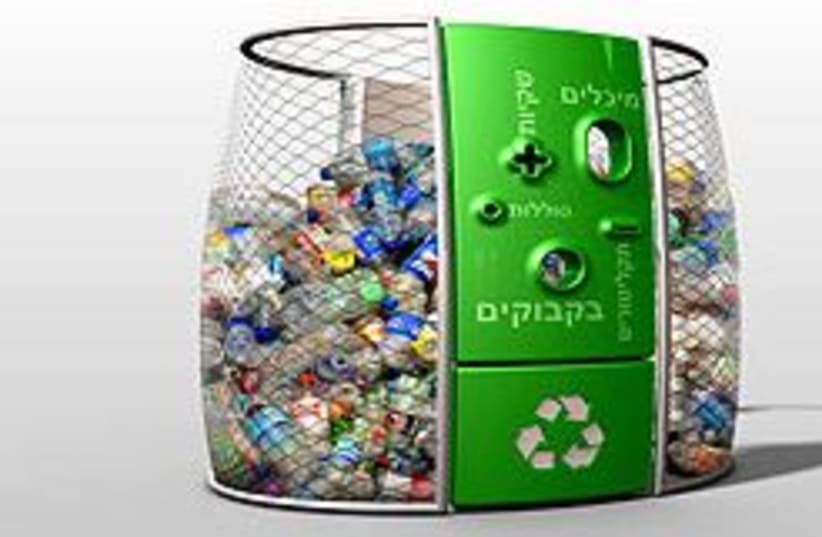
Separation at the source means a separate trash can for disposed food.
By EHUD ZION WALDOKSrecycling bin 2 311(photo credit: courtesy)
What do you see when you look at your garbage? Or do you avoid looking at your trash can as much as possible, quickly dumping your waste in and moving on? Well, look again, because each trash can holds a wealth of raw materials.Trash includes organic material – peels, eggshells, pits, carrot and cucumber ends, and so on. All of that can be composted into fertilizer.The other part of garbage is mostly plastic bottles, packaging, paper of all sorts, glass and metal cans. Now think about the basic components of all of those things – plastic, paper, glass, metal. A laundry list of basic resources modern man consumes every day.So the plastic bottles go into the recycling receptacles, as does the paper. Glass and metal can be recycled at municipal recycling centers.The Environmental Protection Ministry is pushing the Packaging Bill, which would provide a solution for all types of packaging, from coffee cups to cereal boxes.What about the organic material that makes up about 40 percent of trash? There’s a new solution in the works for that as well. It’s called separation at the source. What that means is that municipalities would provide residents with another trash can exclusively for organic material. The regular trash would take the “dry” stuff – to be recycled as much as possible via existing frameworks and the Packaging Law.The organic trash can would need a new separate system to enable residents to convert it into fertilizer.Last week, the Environmental Protection Ministry announced that it had offered and was continuing to offer NIS 200 million worth of assistance over the next few years to the local authorities to move toward separation at the source within three years.One hundred and twentyfour local authorities have already submitted requests for funding to draw up plans to separate at the source, while another 65 have filed requests for funding to create recycling master plans. The ministry said it would also offer a bonus of NIS 132 per household that separated at the source during the years of the project.Next month, the ministry will announce an assistance track for creating end-solutions for trash – composters, anaerobic digestion systems and the like. Without the end-solutions, separation at the source is pretty useless.The ministry has budgeted another NIS 300m. for these end-solutions. Around 50 requests for assistance have already been filed and are awaiting ministry approval.The idea is to move away from dumping garbage in landfills, which has become increasingly problematic. The ministry has calculated some of the costs for dumping in landfills.Six million tons of waste are generated in Israel every year – 4.2 million from households and the rest from industry. Seventy-five percent of garbage is interred in landfills, including 87% of household trash.The direct cost comes out to NIS 185 per ton of garbage dumped. That includes paying the transfer station, for transport, and for entry into the landfill. The external costs add an additional NIS 115 per ton. External costs consist of greenhouse gas emissions, air pollution, the reduced value of the land and more.All together, dumping in landfills costs municipalities some NIS 1.26 billion per year.The ministry has been actively discouraging dumping and encouraging recycling by raising the landfill levy every year. For each ton of garbage dumped, a levy is assessed. The money collected goes into the Clean-up Fund that provides funding for the recycling programs.Furthermore, the value of the raw materials represented by all the plastic, glass, paper and metal that is interred rather than recycled comes out to NIS 875m. per year, the ministry has estimated. The financial benefit of turning trash from a waste to a resource is manifold: from the raw materials, to producing electricity from biogas, to reducing greenhouse gases to creating new jobs.According to Michaela Polansky, environmental projects coordinator at Urbanics, all of the municipalities are ready to move toward separation at the source in theory.“What has happened over the last two years is that the local authorities have realized that something has to change. Primarily because of the landfill levy,” Polansky told The Jerusalem Post on Monday. Urbanics consults to local authorities on planning and economics about a variety of environmental issues, including helping them prepare master plans for waste disposal.However, the local authorities require the ministry’s money and expertise to implement the plans.According to Polansky, some local authorities are already incorporating pilot projects in separation at the source into their master plans. Tel Aviv, for instance, is preparing a massive project.But many others are just completing master plans for recycling receptacles for bottles and paper.Polansky said it was very important that those pilot projects succeed, “because the local authorities are watching and waiting to see if they work.”Without end-solutions, there was no way separation at the source could succeed, she said.
if(catID != 151){
var cont = `Take Israel home with the new Jerusalem Post Store