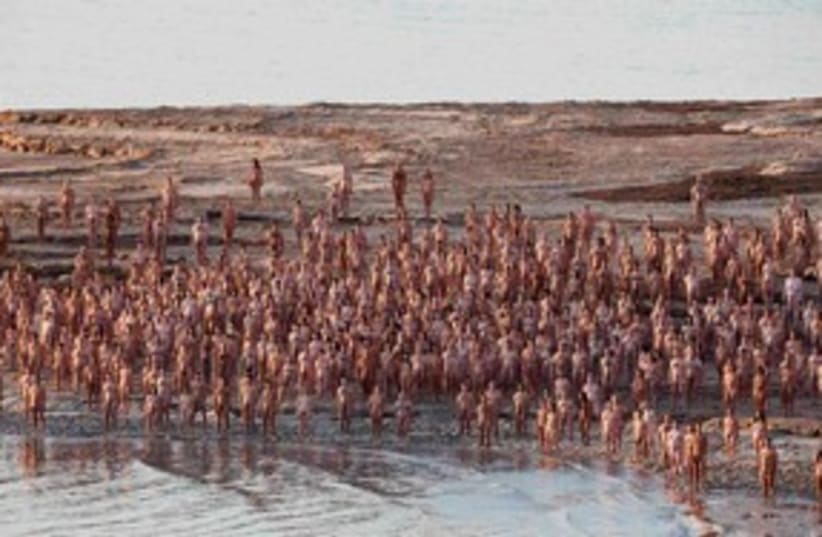
Spencer Tunick installation highlights shrinking Dead Sea, celebrates freedom of artistic expression.
By ANNE GRANT, SPECIAL TO THE JERUSALEM POSTNaked volunteers pose for Spencer Tunick 311 (R)(photo credit: REUTERS/Nir Elias)
It’s been a wild ride of a summer with the social protest movement, and over the past two months I’ve found myself a part of many crowds chanting many things. But I never expected to find myself part of a crowd of 1,000 nude people chanting “The nation demands that you drop your underwear!” Taking part in world-renowned American artist Spencer Tunick’s “Naked Sea” art installation early on Saturday morning of more than 1,000 nude people ages 20 to 77 in the Dead Sea was both exhilarating and strangely natural.Tunick, who has organized more than 75 similar art installations at landmarks around the world, including one in Zocalo Square in Mexico City with 18,000 participants, worked for four years to make the Israeli installation a reality.RELATED:Naked Sea: Israelis ready to get naked for artTunick’s decision to shoot at the Dead Sea coincides with the New7Wonders of Nature campaign and pleas to stop the rapid shrinking of the salty sea located at the lowest point on earth.Despite some fairly muted opposition at the last minute from the religious camp – including a condemnation from Chief Rabbi Yona Metzger and another from MK Zevulon Orlev (Habayit Hayehudi) that this was “Sodom and Gomorroh,” and a last-minute withdrawal of funding from the Megilot Regional Council – the event went on as planned with no major incidents.“This is not just to make art, this is to celebrate that this is happening in Israel,” Tunick, 44, told the crowd before we undressed, adding that he had made more than 20 trips to Israel and has family in Netanya and Kibbutz Revivim in the Negev. This installation could not happen [anywhere] else in the Middle East, he said.After a disorganized hours-late start from cities around the country, buses converged on the Dead Sea, at a location that was a closely guarded secret, at the northern end around 5 a.m.Following a short introduction – “make sure not to smile when you’re in position” – the participants rose as one and removed their clothes.“I thought it would be harder to get undressed in front of so many people, but it was liberating,” said Zev, from Tel Aviv.“It returned us to a respectful connection between human beings and nature. I mean, we were naked for most of history,” said fellow Tel Avivian Michal, who, like many others, felt a deep connection to the Zen-like nature of the event.“If you hear the silence and see 1,000 naked people around you, it’s the most beautiful moment,” Tunick said during his briefing.Unfortunately the spiritual silence was not to be: Almost immediately after everyone entered the water, five mechanized gliders arrived, swooping so low it was possible to watch the pilots focus the zoom lens on their camera, in a breach of privacy that made Tunick furious and made many participants uncomfortable.The gliders, which stayed for around half an hour, cast a pall over the installation and made it impossible to hear Tunick’s directions as he raced against the sun to capture the photograph.“They [the aircrafts] were not welcome and not wanted, and we are not sure if these people were just curious or if they were trying to damage the installation,” said Ari Gottesmann, one of the two main organizers in Israel.The team was investigating legal options against the gliders.“Except for the aircrafts, it was really successful and enjoyable – a fun atmosphere, and really important for the freedom of expression,” said Monica Brodsky, 56, from Kibbutz Hahotrim south of Haifa. “It was not at all sexual, but I knew it wouldn’t be sexual,” she said.Instead of the mass orgy feared by religious leaders, it was a celebration of the diversity of the human body contrasted against the stark beauty of Israel’s geography, an expression of love and freedom on the most basic level, a joyful salute by the old, young, fat and skinny, and every color of the Israeli and Jewish rainbow.Aside from the planes, the event went off without incident – fairly impressive considering the harsh physical environment that could have easily caused serious injury to the participants. After an hour in the Dead Sea holding different positions (certainly the longest I have ever been in the salty water, and an experience I hope never to repeat), and an hour standing in the sun, I started to feel a bit like beef jerky, wellsalted and laid out to harden in the sun.After finishing the installations, including an all-male shoot and 150 women covered in 500 kilos of mud donated by the brand-new -417 cosmetics company, Tunick told The Jerusalem Post that he was ecstatic.The installations came out “exactly as I wanted them to,” he said.He slammed the decision of the Megilot Council to withdraw its NIS 150,000 contribution, less than a week before the project as “complete, and utter corruption and lies.”As the sun climbed higher, the magic melted away as participants hurried to shower off the caked-on salt. In the harsh daylight, people quickly put on their clothes, except for a few oddballs who tried to prolong the moment that was clearly over.As the permit for nudity on a public beach expired at 8 a.m., hysterical organizers admonished the last holdouts, including a man playing the flute while nude – to get dressed and head for the busses.“Why are you still naked?! This is ridiculous!” main Israeli organizer Ari Fruchter yelled at a middle-aged man smoking a cigarette.The exhausted and dehydrated masses trudged back to the buses to begin the rest of their weekend fully clothed. But it certainly felt like we had shared something special that would be hard to explain to those who hadn’t taken part.Tunick said that his installations aren’t just about the final photograph, but about the “waltz of art” created by each participant.“Today I’m just a catalyst for more than 1,000 Israeli artists,” he told the Post after the shoot. “This is important, even for religious people. The safety of democracy is dependent on a society that accepts freedom of expression in art.”
if(catID != 151){
var cont = `Take Israel home with the new Jerusalem Post Store