Watch live streaming video from sabanforum2011 at livestream.com
Although Panetta criticized what he described as Israel’s “isolation,” he recognized that Israel has been the victim of an “international campaign” to discredit the country.“Unfortunately, over the past year, we’ve seen Israel’s isolation from its traditional security partners in the region grow, and the pursuit of a comprehensive Middle East peace has effectively been put on hold,” he said.RELATED:Israel seeks new friends to counter Islamism Panetta: Strike on Iran could hurt world economy When asked by a participant about the stalled peace talks with the Palestinians, the 73- year-old former CIA director growled that “the problem now is that we can’t get to the damn table.”While not responding directly to Panetta’s comments about getting “to the damn table,” Prime Minister Binyamin Netanyahu’s spokesman Mark Regev said Saturday night that Israel has “been repeatedly calling for a resumption of the peace talks.”Regev pointed out that Netanyahu stood at the UN on September 23 and said he would meet with Palestinian Authority President Mahmoud Abbas anywhere and anytime, including right there in New York. Regev said that Israel also immediately accepted the Quartet’s framework for restarting talks, which was also issued on September 23, but that the Palestinians rejected it.“The prime minister has repeatedly said he was willing to meet Abbas in Ramallah, or invite him to Jerusalem, but the answer has always been negative,” he said.“We are ready and remain ready for the immediate resumption of talks without preconditions.The problem has been that the Palestinians have not taken that position. We hope that changes.”In addition to his tough talk, Panetta said that the Obama administration had some “carrots” for Jerusalem as well.Israel, he said, would retain its regional military edge, with Washington providing missile defense systems and cutting-edge F-35 fighter jets.In addition, he reiterated the administration’s commitment to prevent Iran from manufacturing nuclear weapons, and that the Obama administration had not ruled out military action. He described such a response as “a last resort,” saying that the first choice was to continue the current policies of diplomacy and sanctions.“Frankly, some of those [Iranian] targets are very difficult to get at,” said Panetta, echoing a comment made by then- Republican presidential candidate Herman Cain last month.Cain was mocked following a GOP debate when it seemed like he said that Iran’s mountainous territory would present an obstacle for US bombers.Panetta also warned that such an attack was likely to merely delay – and not end – Iran’s nuclear development, and could also yield “unintended consequences” regarding regional stability, including restoring public support for President Mahmoud Ahmadinejad, shaking already unstable Western economies and provoking Iranian attacks against US forces.Regarding Panetta’s comments about Iran, Defense Minister Ehud Barak said Saturday on Channel 2’s Meet the Press program that, while it would be “excellent” to stop Iran’s nuclear program through diplomacy, “all the options are on the table.”Barak played down speculation that Israel and US-led allies were waging a clandestine war on Iran, saying sanctions and the threat of military strikes were still the way to curb its nuclear program.The defense minister, after being asked whether two explosions in Iran last month showed that “the war has already begun” through sabotage, said that he believed that this was not the case.“I don’t think so,” he told Channel 2. “I think that the answer to your question is negative.”Barak’s remarks signaled doubt in the long-term efficacy of any such tactics.“I have nothing to say about the actions themselves. I just say that if you compare the situation eight years ago, or four years ago, to today’s situation, the Iranians are much closer to nuclear capability,” he said.Despite the recent explosion in Iran, Barak said that, “as time goes by, Iran is getting closer.”“Therefore the sanctions have to be intensified, quick, determined...and therefore everyone is saying that no option should be taken off the table,” Barak added, using a phrase favored by Israel and the United States to show that they consider military strikes on Iran’s nuclear sites a last-ditch option.“Israel is a sovereign state,” he said. “It is a strong and important country in the region. The Iranian challenge is a challenge for the whole world and also not simple for Israel. In the final analysis, Israel is responsible for its security, future and existence. Israel cannot free itself from taking decisions as a sovereign state.”One of last month’s explosions in Iran killed at least a dozen members of the Revolutionary Guards, including a general. Iran called it an accident that occurred while weapons were being moved.The Iranians have suffered from computer viruses in industrial systems. Several nuclear scientists have been killed or disappeared over the years in what Tehran says were Israeli or US covert operations.The idea that such operations may have escalated to include spectacular blasts with double-digit death tolls has stirred concern in Israel, where some commentators warned of a possible spillover into reprisals by Iran or its sympathizers abroad.Jerusalem Post staff contributed to this report.
Panetta: Strike on Iran must be the last resort
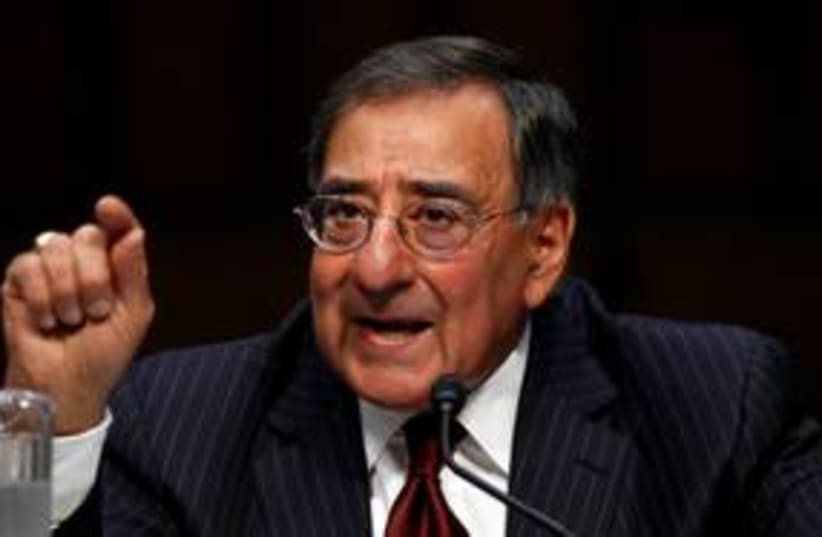
US defense secretary says Israelis, Palestinians need to "get to the damn table"; Livni demands tough, int'l Iran sanctions.